29.05.2026
393
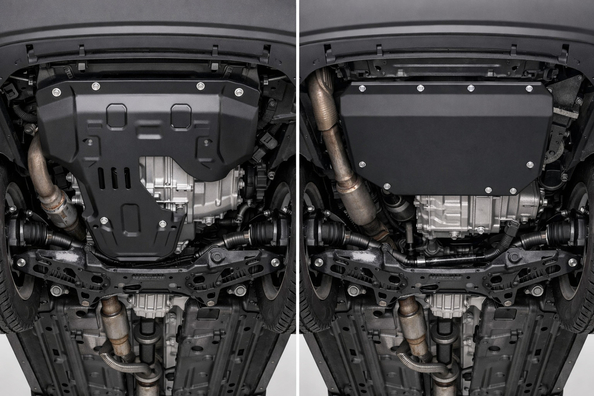
Transmission protection can действительно be more necessary than engine sump protection—but not “in general,” rather in your car’s specific geometry: when the gearbox, transfer case, or their lines hang lower, while the sump is already covered by an OE or reinforced shield. On potholes, ruts, winter ice ridges, rocks, and construction sites, the hit often lands right in the middle of the underbody, not at the front lowest point near the engine.
So the right question is: what is actually more vulnerable underneath your vehicle, and where do you drive. For city use and highways, engine sump protection is more often installed first. For bad roads, snow, light off-road driving, and vehicles where the drivetrain hangs lower, a separate or modular transmission (gearbox) guard can deliver more real-world benefit.
The essence of the choice is not the part’s name, but the risk zone. One unlucky contact with a pothole, rock, or hard ice can damage either the engine oil pan or the gearbox housing. In both cases the outcome is the same: a fluid leak, a breakdown, and expensive repairs. So you shouldn’t look at what “people install more often,” but at what sits lower on your specific vehicle and what is covered worse.
Transmission protection is more important than sump protection in three typical cases: the sump is already protected and duplicating it makes no sense; the vehicle has a low-mounted gearbox or transfer case; your route regularly includes ruts, dirt roads, graded gravel, high curbs, winter potholes, or construction sites. If the car mostly drives on asphalt and the lowest, most vulnerable point at the front is the engine pan, the priority remains with sump protection.
| Option | Strengths | Weaknesses | Who it’s for |
|---|---|---|---|
| Engine sump protection only | Covers the most typical front impact zone; usually cheaper and simpler to choose | Doesn’t solve the problem if the gearbox or transfer case hangs lower | City, highway, crossovers without frequent trips onto bad roads |
| Gearbox protection only | Targets the exact problem area if the gearbox is more vulnerable; doesn’t duplicate an already protected sump | May require a base engine guard; doesn’t cover the front part of the underbody | Vehicles with OE sump protection but an exposed gearbox; winter roads, ruts, light off-road |
| Full kit: engine + gearbox | Widest coverage; a logical choice for regular impact-prone conditions; often modular | More expensive, heavier, longer installation, more compatibility requirements | Those who truly drive on bad roads, job sites, or off asphalt |
In short: a separate gearbox guard is a targeted fix for a specific problem, while a full kit is a strategy for regular risk.
DD Tuning expert comment: the most common mistake is installing sump protection out of habit without checking what hangs lowest on that specific vehicle’s underbody. The second typical story is buying a separate gearbox shield that actually installs only together with a base engine guard. Before ordering, it’s worth checking the mounting diagram, model year, drivetrain, and whether the car has a lift or a non-standard exhaust.
Engine sump protection only. This is the base scenario for a car that drives on asphalt and only occasionally hits potholes or snow. It’s justified when the engine oil pan is the first low point that takes an impact. But if the gearbox sits lower or there’s an open transmission section behind the sump, this choice leaves the main risk uncovered.
Gearbox protection only. The smartest option when the sump is already protected and the problem shifts to the middle of the underbody. This is where it delivers maximum benefit in ruts, on graded roads, in slushy snow, and on construction sites. The key is not to buy blindly: some models mount to their own points, while others work only as an extension of the engine guard.
Full kit: engine + gearbox. This is not “just in case,” it’s for a regular use case. It’s logical if the vehicle often encounters rocks, trips outside the city, sharp terrain breaks, or work use. The extra cost is justified not by metal thickness alone, but by coverage width, proper modularity, and service access—if the design is done right.
Steel or aluminum. For harsh impact conditions, steel is chosen more often. For those who don’t want extra weight and worry about corrosion, aluminum is often more sensible. But it’s not only the material that matters: the plate shape, ribs, support points, service openings, and whether the guard will trap dirt under the car are all important.
For a typical city car without systematic trips onto bad roads, the priority is often the sump. For a crossover or pickup that in winter hits potholes, ice, and deep ruts every day, a separate gearbox guard already looks more practical—especially if the front part of the underbody is factory-protected.
For light off-road driving, trips to fishing spots, the country house, the mountains, or construction sites, it’s better to think not in separate plates, but in terms of covering the impact path underneath. If the risk repeats, a full kit is often cheaper in the long run than closing vulnerable points step by step and still missing something.
| Scenario | What to choose | Why |
|---|---|---|
| City and highway, rare potholes | Engine sump protection | Most often it’s enough to protect the front low point without extra weight and expense |
| Winter roads, deep potholes, ruts | Gearbox protection, if the sump is already protected | The impact often goes to the center of the underbody, where the gearbox or its lines are vulnerable |
| Bad roads every day, construction sites, dirt roads | Full kit: engine + gearbox | Provides broader coverage and less chance of missing a weak area |
| Light off-road a few times a month | Full kit or modular system | A single shield may not cover the transfer case, transition zones, and the rear part of the risk area |
| Vehicle with a low gearbox but factory protection up front | Separate gearbox protection | No point paying twice for a sump that’s already covered |
A more expensive solution makes sense not when you want to “install the maximum,” but when it gives real additional coverage and saves you trouble later. The extra cost is justified if the vehicle regularly drives on bad roads, if the risk is split between the engine and transmission, if you need modularity without drilling, proper service access, and a lower chance of conflicts with mounts.
Separately, it’s worth choosing a pricier option when weight matters: aluminum solutions are usually lighter, and full modular systems suit those who want to protect several components at once. If the car lives mostly on asphalt, overpaying for a large kit often doesn’t pay back in practice.
To compare the buying logic, it’s worth looking separately at gearbox protection, comparing it with engine sump protection, and before making the final choice reviewing the material how to choose engine sump protection. This helps you understand whether you need a targeted gearbox guard or whether a full set already makes sense.
From a customer’s experience: a typical situation is a crossover with an OE front splash guard that in winter regularly clipped ice and ridges exactly in the area under the gearbox. After installing a separate gearbox guard, the person didn’t get a “magic” increase in off-road ability, but the constant fear for the middle of the underbody on a familiar route disappeared. In another case, a pickup owner after a few trips on dirt immediately switched to a full kit, because a single plate didn’t cover the entire risk area.
Gearbox protection is more necessary than sump protection when the transmission is truly the lower and more vulnerable point, and the sump is already protected or doesn’t take the main hit in your use case. If the car mostly drives in the city and on highways and the first risk is the engine oil pan, it’s more logical to start with sump protection.
The key is not to buy by name and not to overpay for unnecessary coverage. This material is based on real selection experience, practice, and real-world use cases: look at the underbody geometry, your route, installation, and serviceability—and then the choice between gearbox protection, sump protection, or a full kit becomes completely obvious.
| ✔ | Gearbox protection is truly useful in specific scenarios where the transmission or transfer case hangs lower than the oil pan and the center of the underbody takes the first hit. In such conditions, it covers a real risk area instead of duplicating a part that is already protected. |
| ✔ | If the oil pan is already covered by the factory or reinforced shield, a separate gearbox guard can deliver more practical benefit without unnecessary duplication. This is especially appropriate on winter roads, in ruts, on gravel roads, and at construction sites. |
| ✔ | A separate gearbox guard is usually simpler and cheaper than a full engine + gearbox kit. For the driver, this means a targeted solution for a specific problem without extra weight and expenses for the whole system. |
| ✔ | A properly chosen gearbox guard not only takes the impact itself, but can also be part of a modular system with normal access for servicing. This makes it possible to protect weak points step by step if the vehicle is used in mixed conditions. |
| ✘ | Separate gearbox protection does not solve the problem if the front lower point is still the engine oil pan. In that case, it leaves unprotected the part that on your vehicle may be the first to take the impact. |
| ✘ | Some gearbox protection models can only be installed together with the basic engine protection or require a specific mounting scheme. If compatibility is not checked in advance, you may end up buying a shield that cannot be installed separately. |
| ✘ | A separate gearbox shield does not cover the entire lower part of the vehicle, including the front underbody area and sometimes the transition sections to the transfer case. On rougher routes, this may be insufficient. |
| ✘ | A poorly chosen or installed guard can reduce ground clearance, add noise or vibrations, and make access for service work more difficult. In other words, the benefit depends not only on the shield itself, but also on the quality of the installation and the design. |
Shipping to EU
Wholesale and retail
Own warehouse
Опис продукту
Подарунки не надаються при оформленні покупки у кредит під 0,01% або при покупці частинами.