31.07.2026
153
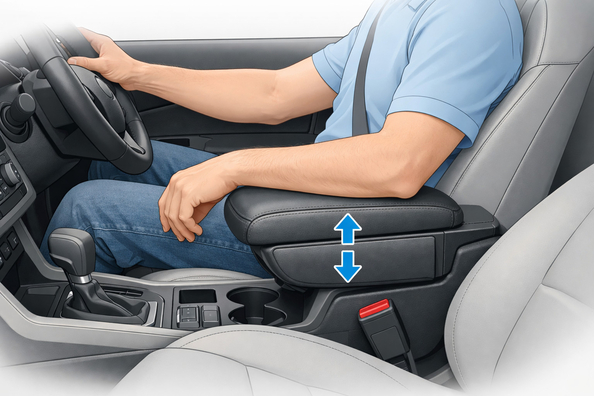

Right-hand fatigue on the road most often isn’t caused by an “uncomfortable elbow”, but by a poor driving position: the arm either hangs without support, or rests in the wrong place and at the wrong angle. If the armrest is too low, too high, or too far away, the shoulder tenses up, the elbow drifts outward, and the wrist starts bending upward toward the steering wheel.
An armrest really does help—but only when it supports the lower part of the forearm rather than pressing into one point under the elbow. If fatigue is accompanied by numbness, tingling, hand weakness, or the pain doesn’t go away after rest, that’s no longer just an accessory issue: it’s worth thinking not only about the cabin, but also about a medical evaluation.
During a long drive, the right arm often works in a static position: part of the load goes to the steering wheel, part—to the center console or armrest. Even if the posture feels fine, prolonged tension in the shoulder, neck, and forearm muscles gradually builds fatigue.
The issue is made worse by seating geometry. When the backrest is reclined too far, the seat is set low, or the steering wheel is too far away, the driver reaches forward and unconsciously raises the shoulders. Add road vibration, and after an hour or two the arm “locks up” even without sharp pain.
Start not with the armrest, but with your driving position. Set the seat so your legs aren’t fully straight, there’s a small reserve behind the knee, and the backrest is roughly within 90–110°. The steering wheel should not be right up against you, but not too far either: a guideline is about 25–30 cm to the chest, hands on the wheel without reaching forward, elbows moderately bent.
Then do a simple check. If, when resting on the armrest, your shoulder rises—it’s too high or too far away. If you immediately “fall” to the right—it’s too low. If the elbow rests but the hand bends upward toward the wheel—the support is in the wrong place, or the wheel is set too high or too far.
Another marker is when the fatigue appears. If it’s only on long, smooth highway runs, the cause is more often static posture and lack of forearm support. If discomfort is present already in the city, in traffic jams, and on short trips, it’s worth checking your position much more carefully and not ruling out a nerve or vascular issue.
DD Tuning expert comment: The most common mistake is looking for the softest armrest without checking the distance to the steering wheel and the elbow angle. The second typical story is when a person rests exactly on the elbow rather than the lower part of the forearm, so even a good support starts to press. Before choosing, sit the way you actually drive on the highway and check whether your shoulders stay relaxed.
| Symptom | Likely cause | What to do |
|---|---|---|
| Tension in the neck and right shoulder after 30–60 minutes | Armrest is too high or too far, the shoulder is constantly raised | Lower the support or move it closer, check the distance to the steering wheel |
| Lower back pulls and the torso leans to the right | Armrest too low | Raise the support or adjust seat height and backrest angle |
| Wrist hurts when the elbow rests on the support | The hand bends upward toward the wheel, the support doesn’t hold the forearm | Adjust your position, look for a longer or higher forearm support |
| Tingling in the little finger or ring finger | Pressure from a hard edge at the elbow area or nerve irritation | Remove point pressure, replace the hard support; if it doesn’t go away—see a doctor |
| The arm gets tired only on the highway | Static posture, no proper support in monotonous driving | Add forearm support and take short breaks every 2 hours |
| Numbness, hand weakness, pain doesn’t go away after rest | Not only an ergonomics issue | Don’t waste time on accessories alone—get a medical evaluation |
An armrest feels most beneficial on a calm highway run, when the arm can spend part of the time resting on the support without losing control of the car. In the city, the effect is usually weaker because you have to lift your arm more often.
Upgrades make sense when your seating position is already close to correct, but your arm simply lacks stable support over long distances. In that case, it’s worth looking at armrests: if the car doesn’t have an OEM solution, a logical start is a universal armrest; if you need the same format in a different finish, you can also compare the gray option.
An accessory makes sense when you’re missing literally just a few centimeters of support height or length, when the factory part is hard or loose, or when there’s no armrest at all. Don’t spend money if the seat is too far back, the backrest is reclined, the support interferes with the handbrake or gear lever, or the discomfort has already turned into persistent pain and numbness.
| Solution | When it works | When not to spend money |
|---|---|---|
| Adjusting the seat and steering wheel | When your arm reaches forward and your shoulders are tense | Almost never unnecessary; this is the first step before any purchase |
| Softer and wider support | When the issue is a hard edge and point pressure | If the support height and distance are wrong |
| Universal armrest | When the car has no comfortable support or the factory one is too short | If it interferes with shifting, the handbrake, or forces you to reach |
| Extending or raising the support | When you’re just a little short on height or length | If the overall driving position is wrong and the misalignment is significant |
| Breaks every 2 hours | When fatigue builds specifically from a prolonged static position | Doesn’t replace fixing the issue if pain appears even on a short trip |
| Self-experiments without a doctor’s check | Only for ordinary fatigue without neurological symptoms | If there is numbness, weakness, a cold hand, or pain that won’t go away |
From a customer’s experience: a driver was looking for a way to reduce right-hand fatigue on the highway and initially just wanted a softer pad. After checking, it turned out the seat was slid too far back, and the arm was supported only by the edge of the elbow. After adjusting the position and installing a universal support, the forearm stopped hanging, and on 3–4 hour trips the discomfort noticeably decreased.
An armrest helps not by itself, but as part of a correct driving position. If it supports the lower part of the forearm, doesn’t raise the shoulder, and doesn’t bend the wrist, right-hand fatigue really decreases; if the geometry is poor, the accessory can even make the situation worse.
So the logic is simple: first your position, then a symptom check, and only then choosing a support. This material is based on real selection experience, practice, and real usage scenarios—not on the idea that one accessory automatically solves any discomfort on the road.
Shipping to EU
Wholesale and retail
Own warehouse
Опис продукту
Подарунки не надаються при оформленні покупки у кредит під 0,01% або при покупці частинами.