29.07.2026
223
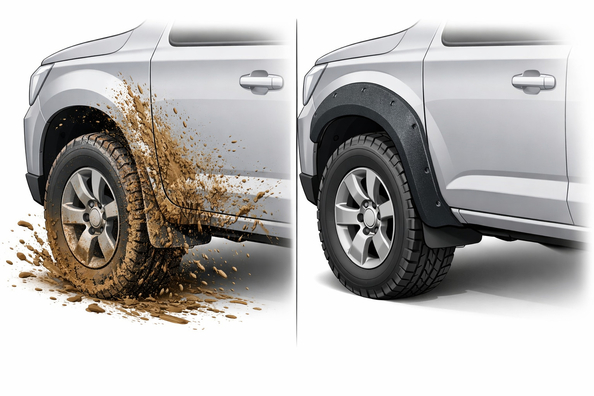
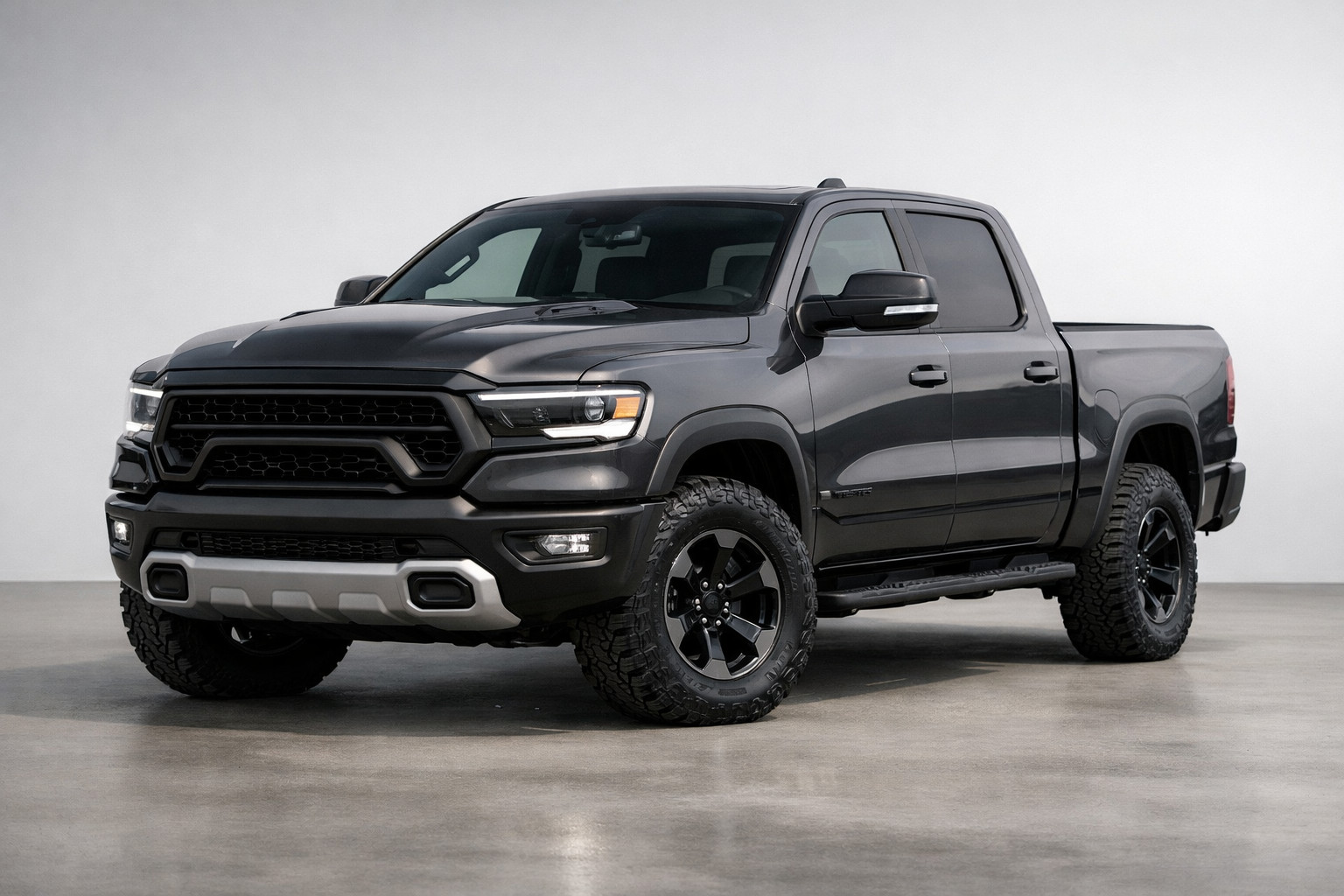
If after rain the dirt from the front wheels ends up as a stripe on the lower part of the doors and the edge of the arch, the issue is almost never the weather itself, but where the spray trajectory from the tire goes. Most often this happens after changing wheels, offset, installing spacers, or lifting the suspension—when the factory arch coverage is no longer enough.
Bushwackers don’t always help. They work when you need to physically cover the part of the wheel that sticks out. But if the car dirties the doors even on stock wheels in ordinary slush, properly selected mud flaps are usually more effective: wide, close to the tire, and positioned low to the road.
It’s the front wheels that throw the most dirt onto the doors. When the tire picks up water, snow, or fine grime, the stream flies backward and slightly outward. If the outer edge of the tread sits outside the arch line, or the arch doesn’t cover the wheel enough, the spray goes not only into the wheel well but also onto the doors and rocker panel.
On a wet road this becomes especially noticeable already at city speeds, and in slush and on gravel the effect is even stronger. That’s why the same vehicle may barely dirty the body in dry weather, but suddenly start coating the doors after rain or after changing the wheel setup.
DD Tuning expert comment: the most common mistake is buying fender flares without checking how far the tread actually protrudes and whether there will still be room for a mud flap. The second typical mistake is installing a soft, short mud flap high under the bumper: it’s there visually, but in practice it barely intercepts the stream. Before buying, always look at the vehicle at full lock and assess not only the top of the arch, but also the lower rear edge of the front wheel area.
| Symptom | Likely cause | What to do |
|---|---|---|
| Dirt in an even stripe on the lower part of the front doors | The front wheel protrudes beyond the body due to offset, spacers, or a wider tire | Check tread protrusion; if it’s there, consider fender flares or returning to a less aggressive wheel position |
| Doors get dirty mainly in rain and slush, but the wheels are stock | Weak or missing lower splash protection | Install wider and lower mud flaps positioned closer to the tire |
| After a suspension lift there’s more dirt | With increased travel the arch covers the wheel worse | Check the wheel through suspension travel; combine flares with mud flaps |
| After installing flares, the doors are still dirty | The flare covered the top of the arch but didn’t catch the lower stream; mud flaps aren’t installed or are incompatible | Improve the lower splash protection, choose a different type of mud flap |
| Heavy dirt and pebbles on the arch edge and rocker panel | A protruding tire plus driving on gravel, wet ground, or winter slush | You need additional arch coverage and a proper mud flap, not just a cosmetic trim piece |
What works is anything that changes the geometry of wheel coverage or intercepts the flow before it reaches the doors. If the problem is caused by a protruding tread, fender flares really do make sense: depending on the type, they can add roughly 25–63 mm of coverage. This is useful when the tire is slightly outside the body line and you don’t want to switch to a different wheel.
If the car dirties the doors mainly on wet highways and in slush, mud flaps should usually be the first move. An effective mud flap doesn’t just hang behind the wheel—it sits close to it, low enough to the road, has sufficient width, and doesn’t curl from airflow.
The best result comes from a combination: a flare closes the arch from above, and a mud flap cuts the stream from below. This is how you reduce door dirt, stone hits on the rocker, and salt buildup in winter at the same time.
If the tread truly extends past the fender edge, it makes sense to look at bushwackers. They’re logical when you need extra arch coverage—not just to protect the lower door area from normal water mist.
If the wheels are stock but dirt flies in rain and snow, start with mud flaps. This is a cheaper and often more effective step, especially when the problem shows up at speed rather than after a major change in wheel stance.
When the factory set doesn’t fit after flares or doesn’t cover the needed width, universal mud flaps can save the day. But it’s important not to buy blindly: you need to check width, height, full steering lock, and suspension clearance. If the wheel is pushed out too far, sometimes it’s more honest to return to a different offset or remove spacers than to try to cover everything with accessories.
| Solution | When it works | When it’s not worth spending money |
|---|---|---|
| Bushwackers | When the tire slightly protrudes beyond the body and you lack upper and side arch coverage | When the dirt is mainly due to missing lower splash protection |
| Mud flaps with the right width and height | When the doors get dirty in rain, slush, and at speed even without a major wheel poke | When the tread clearly sticks out past the fender and the stream goes out to the side past the body |
| Bushwackers plus mud flaps | When you have both wheel protrusion and heavy lower spray of water and stones | When the problem is actually caused by an unsuitable offset that pushes the wheel too far out |
| Changing offset or removing spacers | When the problem appeared immediately after changing wheels or installing spacers | When the wheels are stock and dirt flies due to weak mud flaps |
| Post-install adjustment: checking steering lock, clearances, and compatibility | When accessories are already purchased but you need real effect from them, not just looks | When the solution type was chosen incorrectly and the accessory doesn’t match the root cause |
From a customer’s experience: after installing wider wheels and spacers, dirt started flying onto the front doors after almost every rain. At first only fender flares were installed, and there were fewer stone hits on the edge, but the doors still stayed dirty. After selecting wider mud flaps for the new wheel geometry, the problem noticeably decreased, and there was no need to go back to the stock offset.
Bushwackers make sense when the wheel lacks arch coverage: changed offset, spacers, a wider tire, a lifted suspension. If dirt on the doors appears mainly in rain and slush on an almost stock setup, more often it’s not them but properly selected mud flaps—or a combination of both solutions—that works. This conclusion is based not on theory, but on real selection experience, practical work, and real usage scenarios where what matters is not the accessory name, but precisely matching the cause of the problem.
| ✔ | Bushwackers are useful when the tire actually sticks out beyond the fender edge due to a changed offset, spacers, or wider tires. In that case, they add the needed arch coverage and reduce mud splashing onto the doors and sill. |
| ✔ | Properly chosen mud flaps are often more effective than fender flares if the vehicle gets dirty in rain, slush, or on a wet road without significant wheel protrusion. It is important that they are wide, sit close to the tire, and are low to the road. |
| ✔ | A combination of Bushwackers and mud flaps gives the best result when there is both a protruding wheel and strong lower spray of water and stones. This at the same time reduces dirt on the doors, stone strikes on the sill, and salt buildup in winter. |
| ✔ | After changing wheels, tires, or installing spacers, it is relatively quick to understand whether the problem is specifically in the wheel geometry. To do this, it is enough to check the tire protrusion, full steering lock, and mud flap compatibility. |
| ✘ | Bushwackers do not solve the problem if the main source of dirt is weak or missing lower splash protection. In that case, even after installing the flares, the doors may remain dirty. |
| ✘ | Short soft mud flaps mounted high above the road barely catch the spray. They may look like they are there, but they have little practical effect. |
| ✘ | Not all factory mud flaps are compatible with fender flares, and after installing the flares they may simply not fit back in place. Because of this, you can spend money and still not get the needed coverage. |
| ✘ | If the wheel sticks out too far because of an unsuitable offset or spacers, one decorative flare may not be enough. In such a situation, you sometimes have to go back to a different offset or remove the spacers. |
Shipping to EU
Wholesale and retail
Own warehouse
Опис продукту
Подарунки не надаються при оформленні покупки у кредит під 0,01% або при покупці частинами.