25.06.2026
359
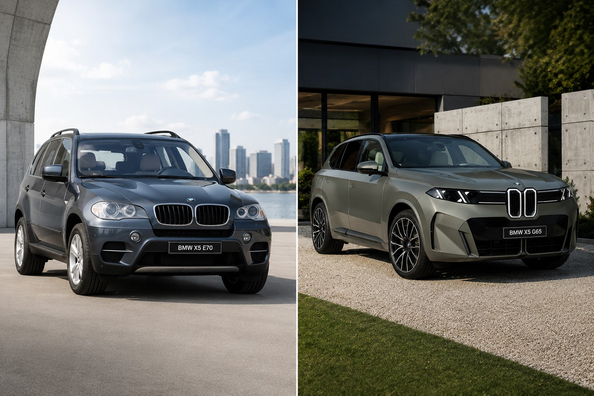

In short: the BMW X5 G65 is worth considering for its new platform, driver assists, digital cabin, and electrified versions. The BMW X5 E70 makes sense when simpler ownership logic, strong towing, better durability on rough roads, and that same old X5 that still feels like a mechanical car rather than a big gadget matter most.
But this isn’t a choice between simply new and simply old. The G65 is still known mostly from official data, some of which is preliminary, so real-world longevity and noise levels at high mileage aren’t yet clear. The E70, on the other hand, has been studied for years, but along with its character you also get age-related risks: suspension, air suspension, transfer case, electronics, and the consequences of someone else cutting corners on service.
Essentially, the G65 wins where the owner uses every day what they’re paying for: modern assists, better infotainment logic, a quieter and more technologically complex cabin, a hybrid or an electric version. Even the base trims are very quick, and the vehicle itself is larger, wider, and more modernly tuned for highways and city driving.
The E70 is strong in a different way. It’s an old-school X5: simpler in design, formally stronger for regular towing, with good geometry for snow and broken roads. But you should buy it based on condition, not the spec sheet. In a good example, it’s still a very lively BMW; in a tired one, it’s an expensive resuscitation.
| Option | Strengths | Weaknesses | Who it suits |
|---|---|---|---|
| BMW X5 G65 | New platform, strong set of assists, digital cabin, adaptive suspension standard, petrol, diesel, PHEV and EV, high everyday comfort | No real-world longevity statistics, some data still preliminary, lower trailer towing in base versions, large wheels worse for rough roads, high entry price | Those who want new tech, daily comfort, electrification, and don’t plan to skimp on equipment and service |
| BMW X5 E70 | More straightforward mechanics, strong towing, good geometry for winter and rough roads, lively steering feel, wide service and parts market | Age-related risks in suspension, air suspension, transfer case, electronics, diesel system and body details; noise and comfort depend heavily on condition | Those looking for a characterful X5, often tow a trailer, drive off good asphalt, and are ready to spend time on careful selection |
The G65 is a leap in technology. It has a new interface, a large central display, an optional passenger display, modern assists, standard adaptive suspension, and a very broad powertrain lineup: from petrol and diesel to plug-in hybrid and the fully electric iX5. Even regular versions are quick, and the wheelbase has grown longer, which helps stability and space. In standard petrol, diesel, and electric versions, trunk capacity goes up to 1850 L; in the PHEV it’s smaller.
The weak point of the G65 isn’t in the numbers, but in forecasting future costs. Standard 21-inch wheels, even larger 22–23-inch wheels on higher trims, complex electronics, hybrid or electric components, and a body packed with assists mean a more expensive ownership logic. This also matters for accessory installation: inaccurate parts compatibility on a new generation usually costs more than on an older X5. If you need a car for a few years with maximum comfort and no desire to put up with age, the G65 looks stronger. But if you want an 8–10 year durability forecast, there are still few answers.
The E70 is valued not for nostalgia, but for specific things. It’s more compact, yet still very spacious, with 620–1750 L of trunk space, officially tows 3500 kg in regular versions, offers 222 mm ground clearance and 500 mm wading depth. In a good example, it’s a calm long-distance crossover and at the same time the X5 that hasn’t lost its chassis feel. For snow, country trips, towing, and imperfect asphalt, it’s more practical than its age might suggest.
The problem with the E70 is that you can’t judge it by the listing price. Service history, cold start behavior, the condition of the front suspension, rear air suspension, transfer case, DPF, injectors, electronic parking brake, panoramic roof, and infotainment are critical. In diesel versions 30d, 40d, and M50d there’s usually more sense than in V8 or M versions if you need not a weekend toy but a working large crossover. On the other hand, for installation and retrofitting the E70 is often more convenient: the design is well known, independent workshops understand it, and the range of solutions has long been established.
For the city, daily driving, frequent highway trips, and family use, the G65 looks more convincing. It offers better digital logic, modern assists, powerful base engines, and the ability to choose PHEV or EV if your usage justifies it.
For towing a heavy trailer, winter operation, driving on bad roads, and buying with an eye toward straightforward independent service, the E70 is more rational. But only if it’s not the cheapest car on the market, but a verified example.
If what matters most is the emotion of an old BMW, the E70 is closer to the classic idea of an X5. If you want modern quietness, interface, and fewer compromises in daily use, the advantage goes to the G65.
| Scenario | What to choose | Why |
|---|---|---|
| Daily city driving and family trips | BMW X5 G65 | Better assists, a more modern cabin, more comfort, and easier day-to-day interaction with the car |
| Long highway trips with an emphasis on quietness and convenience | BMW X5 G65 | New platform, adaptive suspension standard, stronger comfort and infotainment capabilities |
| Regular towing of a heavy trailer | BMW X5 E70 | Officially 3500 kg towing in many versions, while the G65 has lower base figures |
| Bad roads, snow, rural routes | BMW X5 E70 | Better official geometry, more practical wheels, and less worry about complex external electronics |
| I want a plug-in hybrid or an electric version | BMW X5 G65 | The E70 doesn’t offer that format, while the new generation has both PHEV and a fully electric option |
| I want less electronic complexity and more straightforward servicing | BMW X5 E70 | The platform has long been known, though you can’t save on pre-purchase diagnostics |
Paying extra for the G65 is logical when you actually use its advantages: assists every day, a modern cabin, frequent highway trips, city driving, charging at home or along your route, and the desire to drive a current platform for many years. If you plan retrofits after purchase, it’s better to immediately look at model-specific solutions for BMW X5 G65: with the new body, a compatibility mistake usually costs more than the price difference between the right and a random option.
For the E70, the more expensive solution isn’t the most powerful version, but a well-kept vehicle with history, diagnostics, and a healthy suspension. If the car is already chosen, it’s more practical to look for specific items for BMW X5 E70; if you’re still comparing generations and adjacent models, it’s more convenient to start with the general BMW catalog. On the used market, paying extra for condition is almost always smarter than saving on entry price.
The G65 wins on technology, everyday comfort, digital logic, and powertrain choice, but its real long-term durability still needs time to be proven. The E70 wins with character, towing, service transparency, and better readiness for harsher use—but only if you buy condition, not a cheap price tag. The simple takeaway: for a new rhythm of life, city driving, and tech—G65; for a trailer, bad roads, and that old BMW feel—E70.
| ✔ | BMW X5 G65 has a new platform, modern assistants, and a more digital interior, so it is easier and more convenient to use in everyday driving. For city use, family trips, and highways, this provides a noticeably more modern ownership experience. |
| ✔ | G65 has a wider range of powertrains: there are gasoline, diesel, plug-in hybrid, and fully electric versions. This makes it possible to choose a car for a specific driving style rather than adapting to one engine format. |
| ✔ | BMW X5 E70 is better suited for towing and driving on poor roads: in many versions it officially pulls 3500 kg, has 222 mm of ground clearance, and good geometry for winter and rough surfaces. This makes it a practical option for a trailer, the country house, and suburban routes. |
| ✔ | E70 is simpler in design and more straightforward for servicing and retrofitting. Less dependence on complex electronics and a long-established parts market make ownership easier. |
| ✔ | In good condition, E70 still delivers that same mechanical feel of the old X5, valued for its steering response and chassis character. If you need not a gadget but a car with expressive behavior, this is one of its strengths. |
| ✘ | BMW X5 G65 does not yet have real long-term statistics on durability, noise, and running costs at high mileage. Because of this, it is difficult to honestly assess what will happen to it after a few years and outside the warranty. |
| ✘ | G65 will almost certainly be more expensive to buy and more difficult to repair after the warranty, especially because of the electronics, hybrid or electric components, and large wheels. Retrofit mistakes can also cost more than on the old body. |
| ✘ | BMW X5 E70 has plenty of age-related risks: weak points in the suspension, rear air suspension, transfer case, diesel peripherals, electronics, and small body details. Buying a cheap example can easily turn into an expensive repair. |
| ✘ | Comfort and noise in the E70 depend greatly on the specific condition of the car, not just the model. On a tired car, the difference from a well-kept example can be so large that almost everything needs to be checked, not just mileage. |
Shipping to EU
Wholesale and retail
Own warehouse
Опис продукту
Подарунки не надаються при оформленні покупки у кредит під 0,01% або при покупці частинами.