 Author: Radomskyi Maksym Vasyliovych
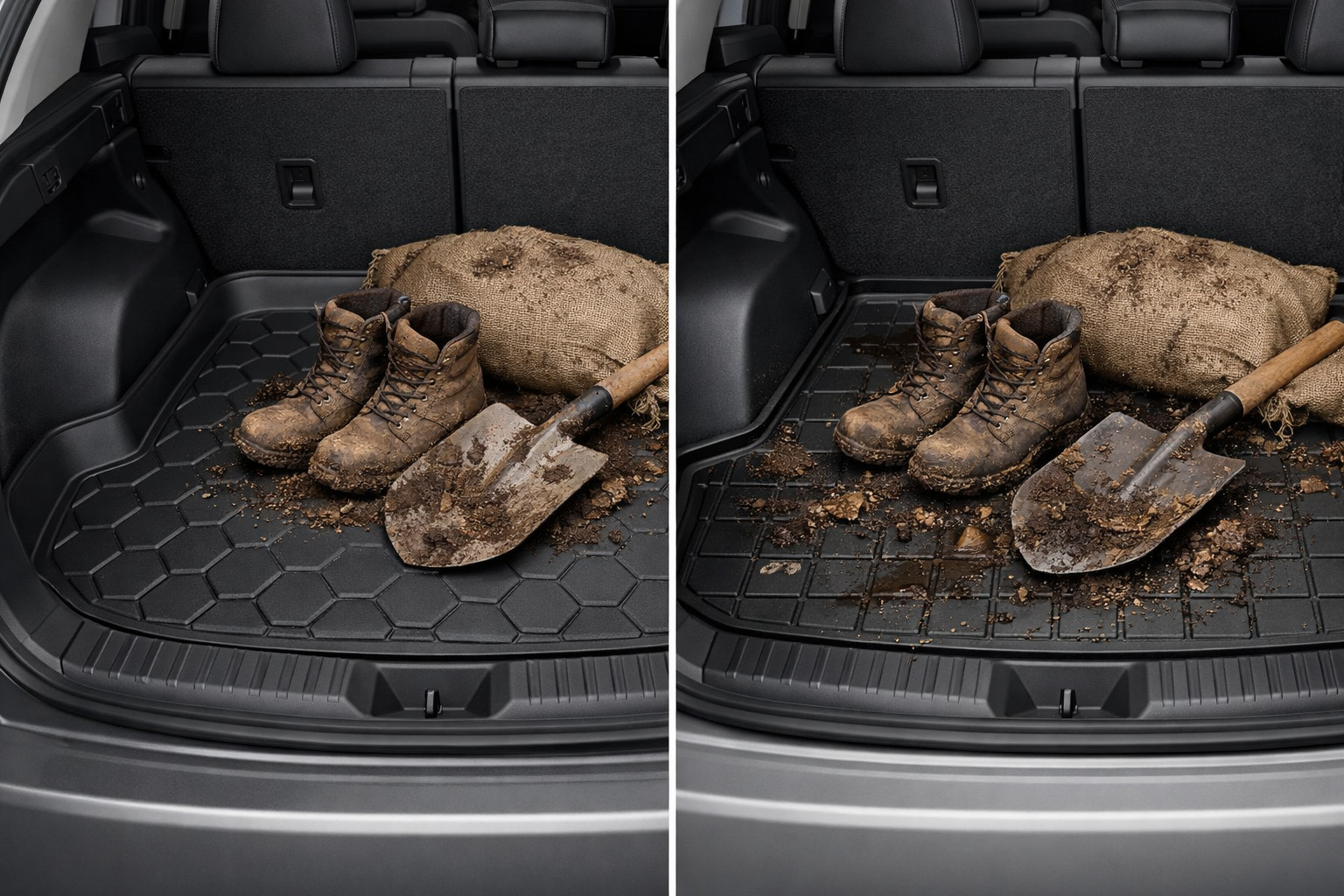
If your trunk regularly sees wet boots, a stroller after rain, bags of soil, jerry cans, or fishing gear, in most cases it’s more practical to choose a 3D mat. It follows the shape of the trunk more precisely, covers the edges better, and keeps dirt and water contained. A regular rubber mat wins where the main priority is a lower price, a quick solution, and the ability to trim it to fit different cars.
The main mistake in this topic is comparing only the word “rubber.” In reality, you’re choosing between a model-specific tray with exact geometry and a universal sheet that needs to be adjusted. For dirty hauling, that’s not a cosmetic difference but a practical one: how much debris gets under the mat, whether the cargo slides around, and how convenient it is to wash everything.
What the choice really comes down to
A 3D trunk mat is a model-specific solution for a particular body. It’s made to match the floor shape, wheel arches, and edges, so it covers more area and usually has raised sides and channels for liquids. For dirty hauling, that means fewer gaps where sand can get in and a lower chance of staining the factory carpeting.
A regular rubber trunk mat is mostly a universal mat. Its advantage is that it’s cheaper and doesn’t require precise model matching. But you pay for that with a less exact fit, weaker side protection, and the risk of trimming it wrong.
So the choice is simple: if you want to truly protect the trunk from dirt, water, and shifting cargo, look toward 3D. If you just need to separate bags from the factory carpet without overpaying, a standard rubber option is enough.
What criteria you should compare by
- Installation. A model-specific 3D mat goes in as a ready-made part. A universal one has to be laid out, test-fitted, marked, and trimmed. If you make a mistake, you can’t undo it.
- Practicality. Look not only at coverage area, but also the raised sides, channels, coverage near the arches and the loading threshold. For dirty hauling, what matters is whether the mat can hold water and whether debris spills out along the edges.
- Noise. Some 3D solutions use a multi-layer construction that dampens impacts from small cargo better. A simple rubber mat usually doesn’t have this advantage, but it depends on the specific design.
- Service life. Durability isn’t defined by thickness alone. What matters is whether the mat slides on the floor, whether thin sections crack after trimming, and how it handles regular removal with water and dirt.
- Price. Compare not only the upfront price tag, but also the time lost on fitting, cleaning the trunk edges, and the risk of buying a second mat after a bad cut on the first.
Quick comparison of options (table)
| Option | Strengths | Weaknesses | Who it’s for |
|---|---|---|---|
| 3D trunk mat | Precise fit, better edge protection, raised sides and channels for dirt, often better cargo grip | More expensive, not every 3D is equally deep, a wet mat isn’t always easy to remove without spilling | Those who often carry dirty, wet, or loose items and want minimal cleanup |
| Regular rubber mat | Lower price, universal fitment, can be trimmed to size, sufficient basic protection for light tasks | Follows the trunk shape worse, less side protection, cargo may slide, risk of mistakes when trimming | Those who mostly carry shopping, bags, light gear and don’t want to overpay |
DD Tuning expert comment: Most often buyers look only at the side-wall height and miss the important areas—wheel arches, the tailgate latch area, underfloor access panels, and the edge near the loading threshold. That’s exactly where a universal mat leaves gaps, and some rigid 3D solutions can make it harder to quickly access the compartment or spare wheel. If you regularly carry wet items, check not only the “tray,” but also how easy it is to pull it out without spilling over the edge.
Detailed breakdown of each option
3D mat
The key strength of 3D is the fit. When a mat follows the trunk shape, debris is less likely to build up around the perimeter, and dirt doesn’t creep under the edges. For a crossover like the Audi Q5, this is especially noticeable near the arches and in the loading area, where universal solutions often leave sections uncovered.
The second advantage is liquid control. These mats usually have raised sides, texture, and channels, sometimes even a lower reservoir. This works better with snow, sand, wet gear, and garden equipment. But there’s a nuance: just because a mat is called 3D doesn’t guarantee very tall sides. Some models have moderate side walls, so carrying a lot of liquid without any spill risk is still not a good idea.
Another plus is behavior on the move. Some 3D solutions are made to slide less and to damp impacts from small cargo better. This is useful when crates, tools, or a dog crate often ride in the trunk.
There are downsides, too. A model-specific solution costs more, is tied to a specific vehicle, and isn’t always equally convenient for access to underfloor storage. If the mat is filled with water or mud, it must be removed carefully: an exact shape helps with protection, but it doesn’t make transporting liquids inherently safe.
Regular rubber mat
Its main argument is a simple entry into the purchase. Buy it, trim it, lay it down. For city tasks this is often enough: grocery bags, a suitcase, a gym bag, spare shoes.
This solution is good where precise geometry isn’t needed. If you change cars, you can move the mat to another vehicle or use it as a temporary option. That’s why universal mats are often bought “for now” or for a work vehicle with no requirement for a perfect fit.
The weak point is the compromise in shape. A universal mat often has a lower inner lip and doesn’t reach the edges, and after trimming, corners and tight spots become vulnerable. Also, some mats need time to fully flatten after unpacking, and the surface may turn out to be slippery for plastic crates or containers.
An important point: more weight doesn’t mean a better result. There are cases where a model-specific 3D mat is lighter than a universal one but protects better thanks to geometry, not mass.
Which option is better for different scenarios
For regular dirt, wet items, and loose materials, a 3D mat is better. What matters here isn’t prestige, but the fact that it covers more area and leaves fewer chances to dirty the factory trim.
For city use, when the trunk mostly carries grocery bags, a backpack, a first-aid kit, and small gear, a regular rubber mat is enough. It’s cheaper and doesn’t require finding a solution for your exact modification.
If you often transport crates, tools, or a dog, it’s worth looking not only at water protection, but also how the surface holds cargo. Here a quality 3D usually wins because it slides less and follows the floor better.
If you just need temporary protection before selling the car or for one winter, a universal rubber mat may be the more rational choice.
Use-case scenarios and what to choose (table)
| Scenario | What to choose | Why |
|---|---|---|
| Stroller, scooter, wet shoes after rain | 3D mat | Holds water and dirt along the edges better, less debris gets under the mat |
| Supermarket shopping, suitcase, gym bag | Regular rubber mat | Basic protection is enough; paying extra for a model-specific shape isn’t always justified |
| Garden tools, bags of soil, fishing gear | 3D mat | Raised sides, channels, and precise fit work better with dirty and loose items |
| Work vehicle where the lowest price matters | Regular rubber mat | Cheaper upfront, easier to replace without precise matching |
| Frequent trips with crates, boxes, tools | 3D mat | Usually better floor grip and less cargo sliding in turns |
Common mistakes when choosing
- Buying by photo, not by geometry. A nice-looking pattern is worthless if gaps remain along the edges.
- Ignoring installation. A universal mat seems easy, but one trimming mistake—and it won’t lay properly.
- Confusing 3D with “anything more expensive.” 3D construction differs by brand: stiffness, side-wall height, layering, and anti-slip can vary a lot.
- Not thinking about access to the underfloor compartment. If you often need the spare wheel, jack, or organizer, check whether the mat makes access harder.
- Expecting a flat rubber mat to be watertight like a tray. For seriously dirty hauling, this is often exactly why people get disappointed.
When it makes sense to pay more
Paying extra for 3D is justified when the trunk is truly used for work—not just carrying grocery bags. If you have an Audi Q5 8R and need protection tailored to the body shape, it makes sense to look at the model-specific 3D mat for Q5 8R. If you want to compare the approach itself and see similar solutions, it’s useful to browse the 3D trunk mats section.
A more expensive option also makes sense when you often wash the trunk after trips or plan to keep the factory covering free of embedded dirt for longer. If the task is simpler and budget is the top priority, it’s worth comparing it with basic rubber trunk mats: for some scenarios, that really is enough.
From a customer’s experience: A crossover owner first bought a universal rubber mat because he mostly carried shopping and wanted to save money. After a few trips to the country house with wet crates and bags of soil, he switched to a model-specific 3D because he got tired of cleaning the trunk edges and shaking debris out from under the mat. In the end, the more expensive solution was appealing not for “premium” reasons, but because it reduced cleanup after every trip.
Conclusion
For dirty hauling, in most cases it’s better to choose a 3D mat: it fits more precisely, holds water and debris better, and leaves fewer unprotected zones. A regular rubber mat is worth choosing when the key criteria are a lower price, universality, and basic protection without a need for an exact fit.
The key to the right purchase is simple: evaluate not the material name, but your use case. If your trunk often sees dirt, wet items, and shifting cargo, paying extra for a model-specific 3D is usually justified. If it’s occasional city use, a universal rubber solution is often sufficient. This material is based on real selection experience, hands-on practice, and real usage scenarios—not on abstract promises.
How it works
- Assess what you actually carry If the trunk often contains wet boots, a stroller after rain, bags of soil, cans, or fishing gear, you need protection against water and dirt along the edges. For such scenarios, it is more practical to look at a 3D mat.
- Determine whether a precise fit is needed A 3D mat follows the shape of the trunk and covers the arches and edges, so less dirt gets underneath it. A universal rubber mat is suitable if basic protection is enough and perfect geometry is not critical.
- Compare installation and trimming The model-specific 3D version is installed like a ready-made part. A universal mat needs to be tried in, marked, and trimmed, and after a mistake, you will no longer be able to correct the fit.
- Check the practical details Pay attention to the side walls, liquid channels, protection near the sill, arches, and access to the underfloor compartment. These small details determine whether dirt will get under the mat and whether it will be convenient to use.
- Choose the option for your use case For regular dirt, loose materials, and frequent cargo transport, a 3D mat is better. If the trunk mostly carries groceries, a suitcase, or a sports bag, an ordinary rubber mat is usually enough.
- Do not overpay without need If you need temporary or budget protection, a universal rubber mat may be more reasonable. If, however, it is important to clean up less after trips and better preserve the factory covering, the extra cost for 3D is usually justified.
Pros and cons
A 3D trunk mat is more expensive and is tied to a specific car model. If the car changes or you need a temporary option, it’s less convenient.
Not every 3D trunk mat has truly high sidewalls or an equally deep tray. If you carry a lot of liquid, the protection may turn out to be not as reliable as expected.
A universal rubber mat follows the trunk’s shape less accurately and often leaves gaps along the edges. As a result, dirt can more easily get under the mat and onto the factory floor covering.
After trimming, a universal mat loses strength at the corners and narrow sections, and the mistake can’t be fixed. It can also sit too slippery for plastic boxes or containers.
A 3D trunk mat follows the trunk shape more precisely, so it better covers the edges, wheel arches, and areas near the sill. This reduces the chance of dirt and water getting under the cover.
It usually has sidewalls and liquid channels, so it holds wet sand, snow, and water inside better. For regular transport of dirty items, it is more practical than a flat mat.
A 3D version usually stays better on the floor and lets cargo slide less while driving. This is useful for boxes, tools, containers, or a dog crate.
A regular rubber mat is cheaper and simpler to use at the start. It can be trimmed to fit different cars, so it works as a temporary or universal solution.
For city use and basic protection, a standard rubber mat is often enough. It works well with groceries, bags, luggage, or sports gear without overpaying for a precise model-specific shape.