 Author: Radomskyi Maksym Vasyliovych
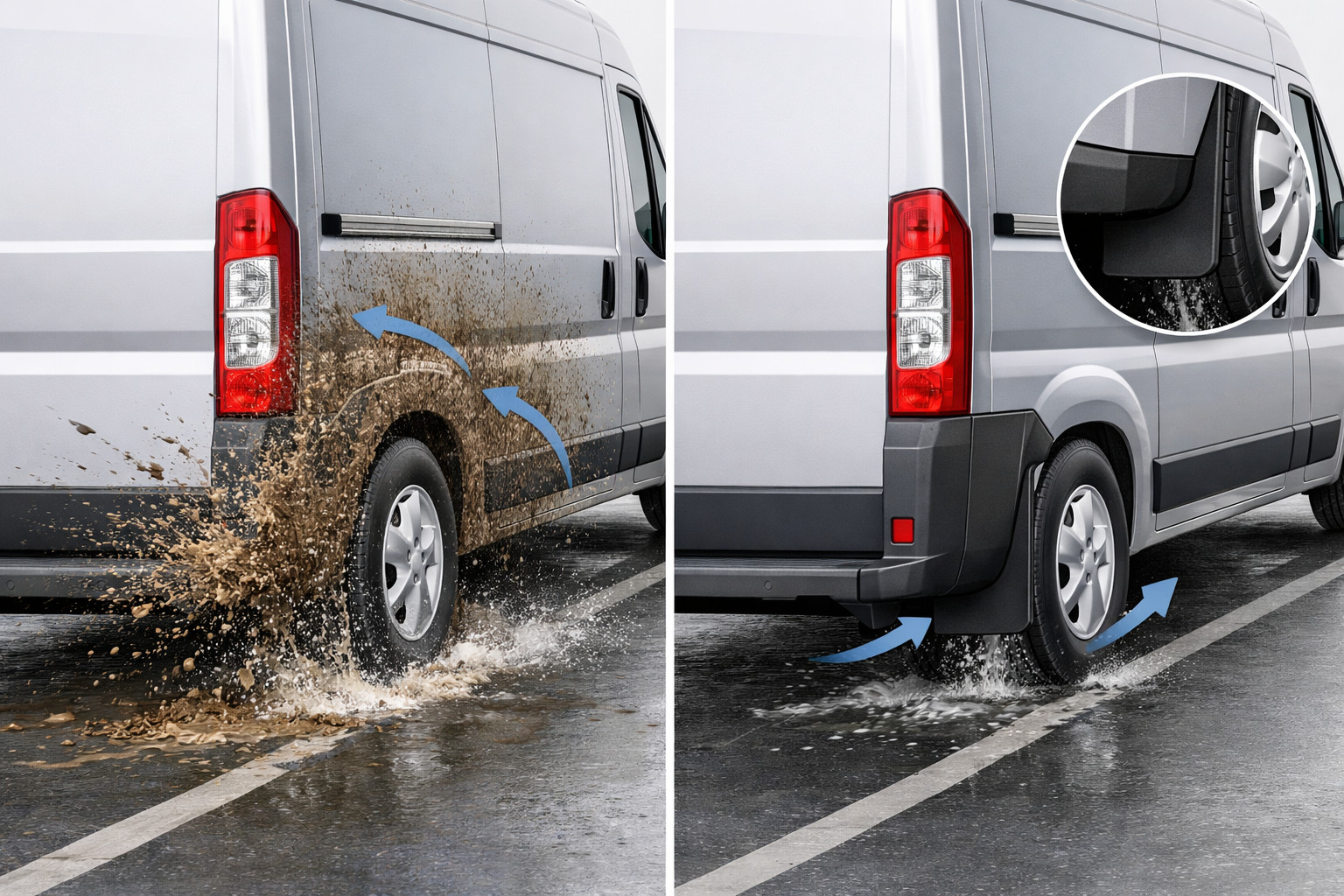
On the Citroen Jumper, dirt on the sides after rain doesn’t appear because the body “attracts” water, but because its own wheels lift a mix of water, dust, and fine road grime and smear it along the side panel. Due to airflow near the A-pillar and mirrors, the mirrors and the front part of the side window also get dirty very quickly.
Mud flaps really do help here, but it’s important to judge their effect correctly. They won’t keep the Jumper completely clean after rain, but they can noticeably reduce the dirty stripe along the lower part of the doors and on the side panels—if they’re fitted at the front, have adequate width, and are installed without being crooked.
Why this problem happens
The Jumper has a large, long side panel, so any spray from the wheels is easy to see even after a short drive on a wet road. The main source of dirt is the front wheels: they throw water and road particles outward, and the airflow presses this mix against the body.
On long and high versions, the contamination is simply more noticeable because of the larger side area. Separately, the A-pillar with the mirror also plays a role: the airflow swirls moisture in a way that deposits quickly on the mirror housing and the edge of the side window, even if the lower side panel is only moderately dirty.
Main causes
- Spray from the front wheels. This is what most often creates the dirty stripe on the front doors and along the rocker panel.
- Airflow around the A-pillar and mirror. Because of it, the mirrors and the front edge of the side windows get dirty separately.
- No front mud flaps. If only rear ones are installed, the main source of dirt along the side remains uncontrolled.
- Short or narrow mud flaps. Universal parts often don’t cover the real spray zone.
- Weak or incorrect mounting. If a mud flap sits crooked, too high, or bends backward at speed, the benefit drops sharply.
How to tell what the cause is in your case
- After driving in the rain, look at where the dirty stripe begins. If it starts at the front wheel arch and runs along the lower doors, the main cause is the front wheel.
- If the mirrors and the front edge of the glass get dirty fastest, while the lower side panel isn’t critical yet, the airflow around the A-pillar and mirror plays a major role.
- Check what’s installed now. Only rear mud flaps or very short universal ones almost always give weak results specifically on the sides.
- Look at the mounting from the side. If the part sits too close to the arch, is crooked, or noticeably bends backward, it intercepts less spray than it should.
DD Tuning expert comment: The most common mistake is installing only rear mud flaps and expecting the front doors and mirrors to stay cleaner. On the Jumper, the front wheels are the main contributor to side-panel grime, so a short universal part or weak mounting often won’t give a noticeable effect. When choosing, look not only at price, but also at width, shape, and how it sits relative to the arch.
Symptoms, causes, and what to do (table)
| Symptom | Likely cause | What to do |
|---|---|---|
| The lower front doors and rocker panel get dirty first | Spray from the front wheels | Start with front vehicle-specific mud flaps and check their fit |
| Mirrors and the edge of the side window get coated very quickly | Airflow around the A-pillar and mirror | Reduce the spray source up front; don’t expect random mirror covers to solve the problem |
| Dirt reaches the middle of the side panel even with mud flaps | Parts are too short or mounted too high | Switch to wider vehicle-specific or OEM ones instead of keeping a decorative option |
| The dirtiest area is behind the arch and near the rear part of the side panel | Spray from the rear wheel adds to it | Consider rear mud flaps as an addition, not a replacement for the front |
| After installation, almost nothing changed | Unsuccessful installation or weak mounting | Check position, rigidity, and whether the part bends back while driving |
What really helps
- Front mud flaps. They most often deliver the most noticeable effect on the lower door and rocker area.
- Wider vehicle-specific or OEM parts. Accurate shape and proper coverage work better than short universal options.
- Correct mounting. Even a good kit loses its value if it’s crooked or pulls away from the arch.
- A combination of front and rear mud flaps. The fronts reduce the main grime along the side, the rears refine the area behind the arch and lower down.
What barely works or helps only briefly
- Rear mud flaps only. They don’t remove the main cause of dirt on the front section of the side panel.
- Very short universal mud flaps. Looks are there; spray interception is minimal.
- DIY add-ons near the mirrors. They may not help or can even create extra turbulence.
- Just washing the body more often. That removes the result but doesn’t change the spray source.
- Expecting perfectly clean mirrors and side panels. Even a good mud flap set usually only reduces the problem, not eliminates it completely.
When accessories or replacing parts makes sense
If your Jumper has no front mud flaps, that’s where you should start. For a targeted solution, a mud flap set for Citroen Jumper is suitable, and if you need to compare several options by shape and build, it makes sense to browse the whole category of mud flaps for Jumper.
If the inner arch protection is already damaged or missing, it’s worth checking the inner fender liners in parallel. They don’t replace mud flaps and don’t “cure” mirror contamination, but they’re necessary when the arch protection is already deformed and the wheel is operating in worse conditions than intended.
A separate case is worn-out, hardened, or poorly mounted factory parts. Then replacement is justified even without additional experiments: often the problem isn’t the idea of a mud flap itself, but that it no longer sits or works as it should.
Solution: when it works and when it’s not worth spending money (table)
| Solution | When it works | When it’s not worth spending money |
|---|---|---|
| Front vehicle-specific mud flaps | When dirt runs from the front arch along the lower doors | When you expect perfectly clean mirrors and the entire side after rain |
| Rear mud flaps | When you need to reduce dirt behind the arch and on the rear lower body area | When you’re trying to use them as a replacement for the front |
| Replacing short universal ones with wider vehicle-specific ones | When the current parts intercept almost nothing | When your current mud flaps already have the right shape and the problem remains only around the mirrors |
| Re-installation or new mounting | When the mud flap is crooked, too high, or bends back | When the part itself is simply too small and poorly shaped |
| Restoring the inner fender liners | When the inner arch protection is broken or missing | When you want to solve the main contamination of the side glass and mirrors with this |
From a customer’s experience: a Jumper owner doing daily deliveries complained that after every rain the lower doors turn grey after the first trip, and the mirrors have to be wiped at every stop. Instead of random universal parts, he chose vehicle-specific front mud flaps, and the old crooked mounts were replaced. As a result, the dirty stripe on the doors became lower and lighter, although the mirrors still require periodic wiping.
Conclusion
On the Citroen Jumper, fast side-panel contamination after rain most often starts with the front wheels, and then airflow around the A-pillar and mirrors amplifies the problem. That’s why mud flaps make sense if you’re not expecting a miracle but a real reduction of grime along the lower doors and side panels: the best results come from front ones that are wide enough and correctly installed.
If only rear ones are fitted, the parts are too short, or the mounting is weak, the effect will be small and it’s easy to waste money. This material is based on real selection experience, hands-on practice, and real use cases: first you need to understand where the dirt starts, and only then choose between replacing mud flaps, correcting the installation, or restoring the arch components.
How it works
- Determine where the dirt starts After driving in the rain, inspect the side of the vehicle: if the streak starts from the front wheel arch and runs along the bottom of the door, the main source is the front wheels. If the mirrors and the edge of the side window also get dirty quickly, airflow around the front pillar is additionally at work.
- Check what is already installed Look to see whether front mud flaps are installed and assess their size and fit. Rear-only, short, or universal items usually do not cover the main splash zone on the Jumper.
- Assess the quality of the mounting The mud flap should sit straight, not be too high, and not bend back at speed. If the element is misaligned or held too loosely, it catches far fewer splashes than it should.
- Start with front model-specific mud flaps Front mud flaps are the ones that most often provide a noticeable reduction in the dirty streak along the bottom of the door and the sill. It is better to choose wider model-specific or original options rather than short universal add-ons.
- If needed, add rear mud flaps or restore wheel-arch protection Rear mud flaps can supplement protection behind the arch and in the lower part of the body, but they do not replace the front ones. If the inner protection in the arch is damaged or missing, it is worth checking the wheel-arch liners.
- Do not expect complete elimination of dirt Even well-chosen mud flaps will not keep the sides and mirrors completely clean after rain. Their real job is to reduce dirt, not eliminate it completely.