27.07.2026
121
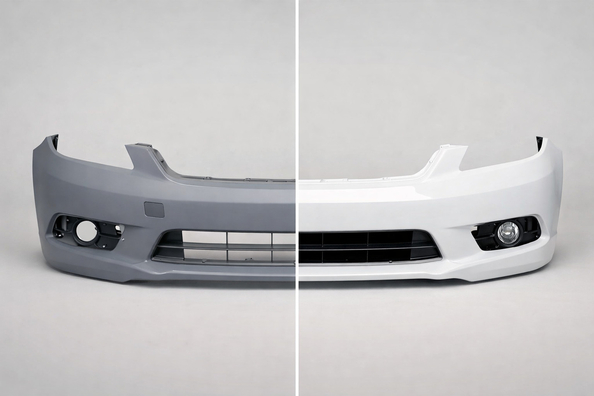
In short, in most cases when replacing a front bumper it’s more cost-effective to buy a primed part and paint it to match the specific car. That way you control the shade better, reduce the risk of missing the color, and don’t overpay for paint that may later have to be redone.
A ready-painted bumper makes sense when speed and minimal work are critical. But it doesn’t eliminate questions of fitment, gaps, mounting compatibility, or shade differences between bumper plastic and the metal body. These small details are usually what determines whether the replacement turns out well.
You’re not just choosing between two conditions of a part—you’re choosing between two cost scenarios. A primed bumper has a lower initial risk: you can test-fit it, check the geometry, then properly match the color and only after that paint it. A ready-painted bumper has one main advantage—faster installation.
The issue is that the “painted” label doesn’t always mean the same quality. For some brands these parts are factory-painted; for others they’re painted by the supplier. In practice, those are two very different stories in terms of color accuracy, film thickness, and repeatability.
| Option | Strengths | Weaknesses | Who it’s for |
|---|---|---|---|
| Primed bumper | Better color control, can be painted to the car’s actual condition, easier to check fit before final finish | Requires painting, drying, and proper plastic preparation | Those who want to balance price, appearance, and lower risk |
| Ready-painted | Faster installation, fewer separate steps, the car returns to service sooner | Risk of shade mismatch, doesn’t guarantee good gaps, sometimes hard to return after test-fitting | Those who are time-critical and buy from a supplier with a real warranty |
DD Tuning expert comment: the most common mistake is buying a painted bumper by paint code only and ignoring that plastic and metal perceive color differently. The second common mistake is skipping a dry test-fit before final installation. If there are sensors or radar zones, you can’t mindlessly add extra layers of material or repair areas where the manufacturer doesn’t allow it.
This is the most practical option for a standard replacement. The part already has an intermediate layer, so it needs less prep than raw plastic. In standard processes the difference is noticeable: a raw part requires significantly more procedures than a primed one. That means a primed bumper doesn’t automatically make the job cheaper, but it removes some unnecessary operations.
The main advantage is control over the result. The painter sees the car’s real condition, accounts for sun fade, metallic or pearl characteristics, and the color can be matched in the same orientation the bumper will sit on the car. This is how you reduce the chance of ending up with a separate “foreign” piece on the front.
This option attracts with speed: you skip painting and drying, which usually take dedicated time. If the car must return to work quickly, that’s a real advantage.
But the risks are different. Even if the paint code is correct, the shade on plastic can look visually different from the neighboring metal panels. Add the bumper’s curvature, different texture, material thickness—and you get a situation where “almost the same color” looks fine in photos but not in real life. And if, after test-fitting, you find uneven gaps, whistling at speed, or problematic mounts, the speed advantage disappears.
It’s also worth paying special attention to cars with sensors and radars in the fascia area. For such cars, factory coating tolerances and repair restrictions near sensor mounting points matter. Saving money on a random part here can end up costing more.
If the car isn’t new, the body has faded a bit, and the color is complex, a primed bumper is almost always the smarter choice. It gives you a chance to match the front end to the car’s current appearance, not to an abstract catalog code.
If you need the fastest possible repair after a minor hit, the car is in daily use, and the supplier assumes the risk of repainting or returns, then a ready-painted bumper can be justified. But you should buy it only when you understand: you’re paying not for a better result, but for saving time.
| Scenario | Best choice | Why |
|---|---|---|
| The body isn’t new, the paint has already faded | Primed bumper | Easier to match the shade to the car’s real condition |
| Complex metallic or pearl | Primed bumper | Lower risk that the plastic will visually stand out from the overall tone |
| The car is needed daily, downtime is expensive | Ready-painted | Saves time if fitment and color are acceptable on the first test-fit |
| Sensors, radars, high accuracy requirements | Primed bumper or factory-painted | You need control of coating thickness and procedures specific to your model |
| You just need the cheapest solution “so it fits” | Primed bumper | Less chance of paying twice due to an unsuccessful color match on a painted part |
A more expensive option makes sense in three cases. First, when every day of downtime costs you more than the potential extra spend on a ready-made part. Second, when the car is fairly new and a shade difference on the front end would be very noticeable, so you choose a higher-quality part and don’t cut corners on test-fitting and painting. Third, when replacing the bumper turns into a small styling update.
In that scenario, it’s logical to immediately check front bumpers if you need a full replacement; front bumper lip spoilers if the fascia itself is intact but you want to change the lower edge; or body kits if you plan to refresh the front end comprehensively rather than patch one part.
From a customer’s experience: after a light impact, the owner of a silver crossover initially wanted a ready-painted bumper because the car was needed every day. After test-fitting, it turned out the shade on the plastic was noticeably cooler, and one edge required gap adjustment. In the end, they chose the primed option, painted it to match the body’s real condition, and got even joints with no color difference in daylight.
For most front bumper replacements, the primed option is more cost-effective: it gives better color control, a calmer test-fit process, and fewer chances of having to redo the job. A ready-painted bumper is worth buying when deadlines are truly critical and the supplier can confirm coating quality and fair return terms.
The key idea is simple: look not only at color, but also at fitment, gaps, plastic type, sensor zones, and the total estimate. This material is based on real matching experience, practice, and real-world use cases—not on the theory of “what’s cheaper on the price list.”
| ✔ | A primed bumper gives better control over the shade: it can be painted to match the actual condition of the body, taking into account fading and the difference between plastic and metal. |
| ✔ | Before final installation, a primed part is easier to test-fit and check for fit, gaps, and compatibility with the mounts, which reduces the risk of rework. |
| ✔ | This option is usually more cost-effective in the overall estimate, since it is not tied to an already applied coat of paint that may not fit and may require repeat work. |
| ✔ | For complex colors, metallic or pearl finishes, a primed part is more practical because it allows the color to be matched to the specific car. |
| ✔ | If the car is not new and the body has already faded a bit, a primed bumper better matches the car’s current appearance rather than the catalog paint code. |
| ✘ | Separate steps for painting, drying, and proper plastic preparation are required, so the repair takes more time. |
| ✘ | A ready-painted bumper is installed faster, but its color may not visually match the body even with the correct paint code. |
| ✘ | A pre-painted part does not guarantee a perfect fit: uneven gaps, whistling at speed, or problematic mounts will have to be addressed separately. |
| ✘ | For cars with sensors or radars, there is a risk of getting the coating thickness or permissible repair zones wrong if you choose a part without taking these limits into account. |
Shipping to EU
Wholesale and retail
Own warehouse
Опис продукту
Подарунки не надаються при оформленні покупки у кредит під 0,01% або при покупці частинами.