17.07.2026
192
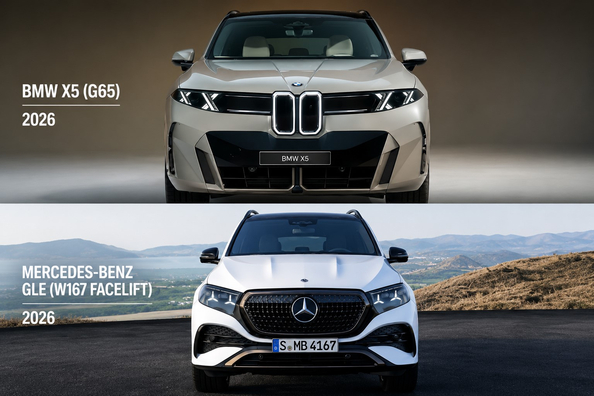
If you need a crossover right now, the Mercedes GLE W167 Facelift looks like the more rational choice: the model is available, the platform is mature, and its character is calm and very well suited to everyday driving. But if you can wait until late 2026 or early 2027, the new BMW X5 G65 looks stronger overall: it’s more engaging for the driver, technologically fresher, and has a bigger margin for the future.
The main trap here isn’t the screens or the brochure horsepower. What really decides are delivery timelines, your trip patterns, whether you have home charging for a plug-in hybrid, cargo practicality, towing, highway noise, the long-term durability of new tech, and even everyday things like installing a child seat.
In essence, this is a choice between a newer, but not instantly available platform and a mature, already well-understood vehicle. BMW X5 G65 only starts production in August 2026, with sales beginning in late November; plug-in hybrids and the electric version will arrive even later. So for buying today, the GLE looks more logical purely on timing.
If you remove the waiting factor, the BMW in this pair is generally the stronger driver’s crossover. In the gasoline version it’s almost price-parity with the GLE 450, but offers more power and a larger trunk. In the plug-in hybrid pair, the X5 50e is quicker, lighter, and more practical in cargo volume and towing, while the GLE 450e counters with a lower entry point and the option of fast charging. In diesel logic, Mercedes looks stronger in dynamics, but BMW is more interesting for consumption and towing capability.
| Option | Strengths | Weaknesses | Who it suits |
|---|---|---|---|
| BMW X5 G65 | Fresher platform, stronger handling, more tech, better practicality in gasoline and plug-in hybrid logic, higher margin for the future | You have to wait for sales to start, more uncertainty about durability in early versions, on the 50e only 11 kW AC charging | For those who like highway driving, want a new generation for the long run, and can wait |
| Mercedes GLE W167 Facelift | Available now, comfortable in daily driving, mature tech, more convenient day to day, on the 450e there is DC fast charging | Less composed at high speed, heavier as a plug-in hybrid, smaller trunk, less of a “newness” feel | For those who need a crossover without waiting, with an emphasis on comfort and calm ownership |
BMW’s main argument is simple: it’s a newer generation with a better technological horizon. Even the base X5 40 xDrive is hardly more expensive than the GLE 450, yet delivers 400 hp, 0–100 km/h in 5.3 s, and a 650 L trunk. On the highway this matters: the X5 feels more tied down, and its chassis holds pace better without the sense of a heavy superstructure over the wheels. For bad roads it also has more hardware in reserve: adaptive suspension is part of the base logic, with optional two-axle air suspension and rear-axle steering.
In plug-in hybrid form, the X5 50e looks stronger on almost all practical parameters: it’s quicker, has a larger trunk, lower weight, and tows up to 3300 kg. But there’s an important condition: the 50e only makes sense with regular charging at home or at work. Without that, the extra cost for the more complex tech pays off worse. The second nuance is early-batch durability. Related versions have already seen mentions of specific electronics and cooling issues, so for a cautious buyer the X5 G65 isn’t “buy it and forget it,” but rather a willingness to give the new model a bit of time.
The GLE’s strength isn’t that it’s objectively better at everything, but that it’s very well put together as an everyday tool. The control layout is easier to process, seat comfort is excellent, the suspension character is calm, and overall there’s less stress for the owner. If kids often ride in the car, small things like child-seat installation, easy cabin access, and general everyday convenience make the GLE look convincing.
The GLE 450e also has a strong argument: up to 102 km of electric range and DC fast charging up to 60 kW. For an urban use case, that’s genuinely convenient. But the compromises are noticeable: the trunk is only 485 L, the weight is high, and on fast highways it feels less composed than the BMW. The diesel GLE 450 d is interesting for those who drive far a lot and don’t want charging routines: there’s plenty of torque, the character is very even, though in terms of driver-focused precision it still isn’t an X5.
For a purchase without waiting, Mercedes wins. There’s no complicated math here: an available car is better than one that hasn’t reached the dealer yet—especially if you’re buying as family transport and don’t want to be an early adopter of a new generation.
For a driver who regularly runs highways, likes a tighter steering feel, and wants not only comfort but also a sense of control, BMW looks more interesting. This applies to both the gasoline version and the 50e plug-in hybrid.
For city use, a plug-in hybrid only makes sense if you can charge regularly. If you have nowhere to charge, it’s better not to fool yourself with pretty consumption figures and to go with a regular gasoline or diesel. This is where people most often buy the wrong car.
| Scenario | What’s better to choose | Why |
|---|---|---|
| You need the car now, without waiting | Mercedes GLE W167 Facelift | You can buy it right now, the platform is mature, and the risk of early teething issues is lower |
| You’re ready to wait until late 2026 | BMW X5 G65 | You’ll get a newer generation, a better tech base, and more composed highway behavior |
| City use, home charging, need a family plug-in hybrid | BMW X5 50e | Quicker, more practical for trunk and towing, fewer weight-related compromises |
| You want a plug-in hybrid but often rely on public chargers | Mercedes GLE 450e | DC fast charging makes that scenario more realistic |
| Calm daily driving, seat comfort, family mode | Mercedes GLE W167 Facelift | More relaxed character, straightforward everyday ergonomics, easier to live with day to day |
| Frequent highways, fast pace, desire to “drive” the car | BMW X5 G65 | Chassis is more tied down, the sense of control is clearer, and in the gasoline pair the price-to-performance ratio is stronger |
A more expensive choice in favor of the BMW X5 G65 is justified when you’re buying the car for the long term and you know for sure you need not just convenience, but a new platform with a better chassis, more modern electronics, and headroom for future versions. In that case, it makes sense to track the BMW X5 G65 specifically, rather than looking for a compromise based only on entry price.
A more expensive GLE makes sense if your priority isn’t the numbers but a comfortable spec and predictable ownership without waiting. Then it’s useful to look right away at solutions for the GLE W167. And if you already have a pre-facelift body and the question is more about the look than the car itself, sometimes it’s smarter to invest in facelift retrofit kits rather than replacing the car entirely.
If you need to buy without a pause, the Mercedes GLE W167 Facelift looks the most rational today. If you can wait and want a more modern, driver-focused, and technologically stronger crossover, the advantage shifts to the BMW X5 G65. The key takeaway: in this matchup, what decides isn’t the badges, but timelines, charging infrastructure, practicality, and whether you are—or aren’t—ready to buy into the first wave of a new generation.
| ✔ | BMW X5 G65 has a fresher platform and better long-term potential. For those buying a car for years to come, this means a more modern technical base and more room for future versions. |
| ✔ | On the highway, the X5 G65 feels more composed and keeps its pace better. This is practically useful for those who often drive fast or over long distances. |
| ✔ | In the gasoline version, the X5 40 xDrive offers more power and a larger trunk at a price close to the GLE 450. In other words, for a similar budget, you get a more versatile package for everyday use. |
| ✔ | The X5 50e looks stronger as a plug-in hybrid: it is quicker, has a larger trunk, lower weight, and better towing capability. This is useful if you have home charging and need a hybrid for family trips. |
| ✔ | Mercedes GLE W167 Facelift is available now and does not require waiting. For a purchase without delay, this is the most practical option. |
| ✔ | GLE is better suited to everyday use: it has a more convenient control layout, comfortable seats, and easier child seat installation. For family use, this is a tangible advantage. |
| ✔ | The GLE 450e has fast DC charging up to 60 kW and up to 102 km of electric range. In the city, this makes the plug-in hybrid scenario much more convenient, especially if you often use public chargers. |
| ✘ | BMW X5 G65 cannot be bought right away: production starts only in August 2026, and sales will begin at the end of November. For those who need a car now, this is a significant drawback. |
| ✘ | The first batches of the new X5 carry more uncertainty regarding durability and reliability. The article separately mentions possible nuances with electronics and cooling in related versions. |
| ✘ | In the BMW X5 50e, the point disappears without regular charging at home or at work. If there is no such infrastructure, the more complex and expensive technology performs worse than a regular gasoline or diesel car. |
| ✘ | Mercedes GLE W167 Facelift feels less composed at high speed than the X5. For a driver who often travels on the highway, this means less sense of control. |
| ✘ | The GLE 450e has only 485 l of trunk space, and the weight is high. This limits practicality compared with the X5, especially if you often carry things or family luggage. |
| ✘ | There are more complaints about wind noise around the mirrors and suspension noise on the GLE, especially in the context of the air suspension. For those sensitive to acoustic comfort, this is a noticeable drawback. |
Shipping to EU
Wholesale and retail
Own warehouse
Опис продукту
Подарунки не надаються при оформленні покупки у кредит під 0,01% або при покупці частинами.