
































































 Author: Radomskyi Maksym Vasyliovych
If this is your first emergency kit, it almost always makes sense to start with a basic city set. It’s cheaper, takes up less space, and covers what you most often really need: roadside visibility, communication, light, and first aid. An extended set makes sense not “just in case”, but when you have night trips, highway driving, winter conditions, a weak battery, no spare wheel, or long trips far from service.
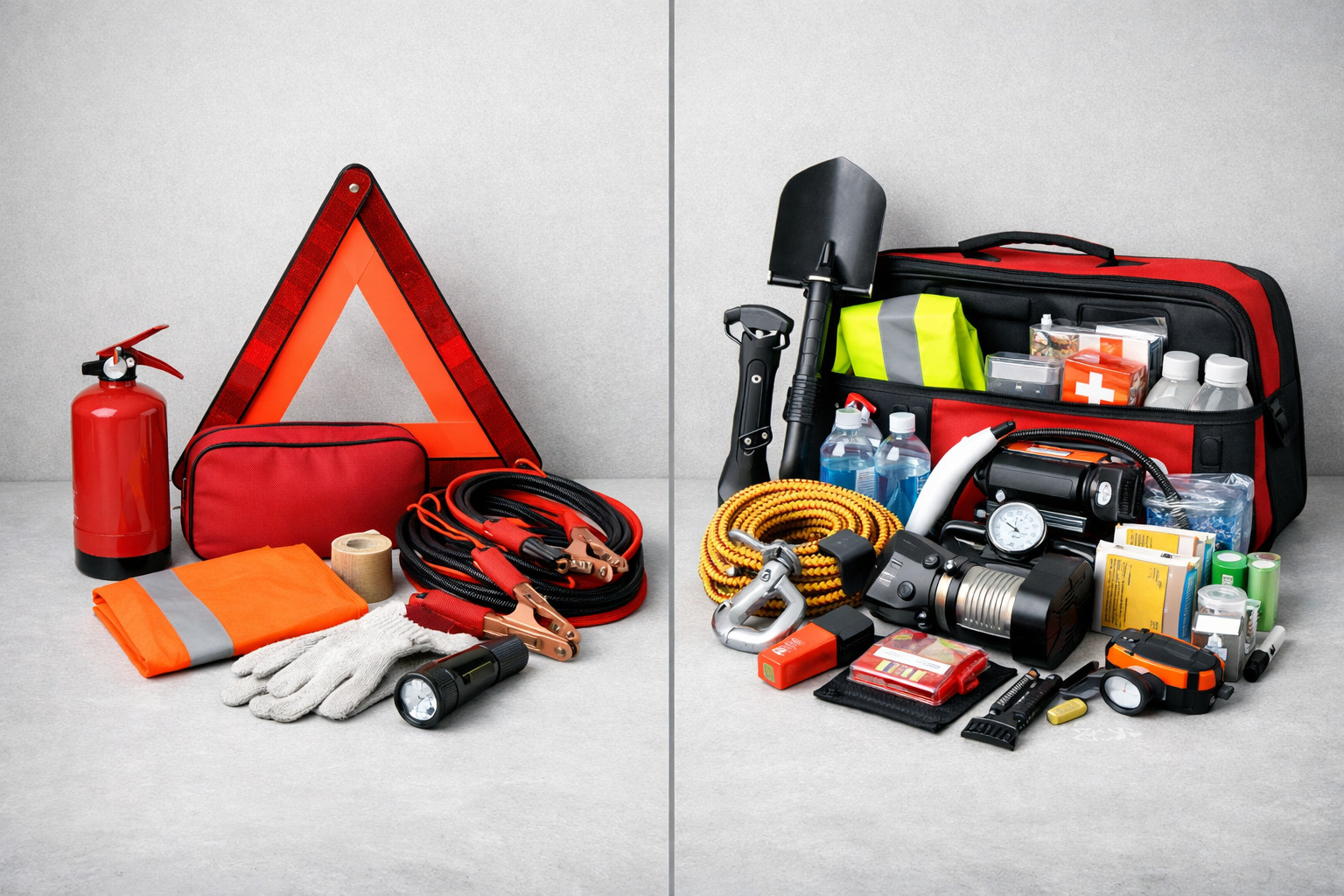
The main difference between these options isn’t the number of items, but the level of self-sufficiency. The basic kit helps you wait safely for help or solve a simple issue. The extended kit gives you a chance to start the car yourself, deal with a wheel problem, and stay warm if you have to wait longer.
What the choice is really about
A basic kit isn’t “cut down” — it’s a starter set without dead weight. In practical terms it’s 6–7 items: a reflective vest, warning triangle, flashlight, phone power, a first-aid kit, and either jumper cables or a jump starter. It works well for the city and short trips where help is nearby.
An extended kit is the next level. On top of the basics, it adds items for autonomy: a tire solution, extra winter gear, more warm items, and sometimes separate tools. Not everyone needs it, because it takes up space, costs more, and requires regular checks.
The mistake is simple: people compare kits by the item list, but you should compare them by scenario. If you hardly ever leave the city, a full “emergency suitcase” can carry extra kilos for years. But if you drive highways in winter, a basic kit will quickly show its limits.
What criteria to compare by
- Placement and accessibility. For an emergency kit, this isn’t about fixed installation, but how quickly you can grab an item. The vest and triangle should be accessible before you even step out of the car — not buried under suitcases in the trunk.
- Noise. This matters primarily for an air compressor. Cheap models can be very loud, and at night or on the highway that’s not a minor detail.
- Service life. A jump starter needs recharging, flashlight batteries need checking, and the first-aid kit, sealant, and fire extinguisher have an expiration date. The more advanced the kit, the more items you have to monitor.
- Practicality. Jumper cables are cheap, but useless without another car. Sealant helps only with a small puncture in the tread and won’t save you from a sidewall cut. That’s why not everything compact is equally useful.
- Price. It’s smarter to buy in stages: first visibility and communication, then starting, then tire and seasonal items. That way you don’t overpay for a kit where half the contents don’t work for your scenario.
Quick comparison of the options (table)
| Option | Strengths | Weaknesses | Who it’s for |
|---|---|---|---|
| Basic city kit | Compact, cheaper, quickly covers the main roadside risks, doesn’t overload the trunk | Doesn’t solve long waits in the cold, a flat tire issue, and doesn’t always help with a weak battery | Those who drive in the city, close to service, without frequent night and winter highway trips |
| Extended kit | More self-sufficiency, better for highways, winter, night trips, and situations without quick assistance | More expensive, heavier, takes up space, some items age or require charging | Those who often drive far, have a weak battery, a car without a spare wheel, or regularly face winter conditions |
DD Tuning expert comment: The most common mistake is buying a big ready-made kit and tossing it into the far corner of the trunk. In a real situation, the vest, flashlight, and triangle must be within reach, and the jump starter or cables should be checked in advance. Another common misstep is treating tire sealant as a full replacement for a spare, even though it doesn’t work for every puncture.
Detailed breakdown of each option
Basic city kit
Its strength is that it solves the most typical problems without extra bulk. The vest and triangle provide visibility, the flashlight lets you work in the dark, a charger or power source keeps you connected, and the first-aid kit covers basic medical needs. For starting at this level, people usually choose either cables or a jump starter.
Cables are the cheaper option. For a passenger car, a practical length guideline is 3–6 meters. Their advantage is simplicity and no need for charging, but without another vehicle they won’t help. A jump starter is autonomous, but you have to recharge it regularly — otherwise at the right moment it’s just a box in the trunk.
The weak point of the basic kit is that it almost doesn’t cover a prolonged scenario. If you have a flat tire, if you’re stuck on a winter highway, or if help is far away, this kit is often not enough.
Extended kit
The logic here is different: not just to wait it out, but to give yourself more chances to fix the problem on your own. On top of the basics, you add a tire kit, winter items, sometimes separate tools, and extra warmth. For the cold season this usually means a blanket, warm gloves, a hat, an ice scraper, a brush, a small shovel, and something for traction under the wheel.
When it comes to the tire block, you need to assess capabilities realistically. Sealant is a temporary solution for a small tread puncture. It won’t work for more serious damage. A compressor is useful, especially if there’s no spare, but it’s louder, takes space, and quality varies widely from model to model. If the car’s design allows you to carry a spare, then a spare with a jack and lug wrench is often more practical than relying only on sealant.
The downside of the extended kit is that it requires discipline. You need to check the jump starter charge, batteries, the condition of the first-aid kit, sealant, and other consumables. In other words, you’re buying not only more items, but also more responsibility for their readiness.
Which option is better for different scenarios
For daily city driving, a basic kit is almost always the smarter choice. Compactness, quick access, and minimal price matter here, and the chance of being stranded for hours without help is lower.
If the car is older, the battery isn’t new anymore, or the car is often parked outside in winter, it’s better to strengthen the basic kit right away with an autonomous start. In exactly these cases the difference between cables and a jump starter becomes real, not theoretical.
For highways, night drives, and out-of-town routes, the extended kit wins on practicality. Here it’s not only about visibility, but also the ability to inflate a tire, wait for help in the cold, and have more than one vest if there are several people in the car.
If your car doesn’t have a full-size spare, the tire block should be the first add-on after the basics. If you often travel with family, think not in terms of “one kit per car” but in terms of the number of people: one vest and one blanket is no longer enough.
Usage scenario and what to choose (table)
| Scenario | What to choose | Why |
|---|---|---|
| Daily city driving | Basic city kit | Provides visibility, light, communication, and first aid without extra cost and weight |
| Car with an old or weak battery | Basic kit plus a jump starter | Autonomous starting is more useful than cables when there may be no other car nearby |
| Frequent highway driving | Extended kit | More self-sufficiency is needed: tire, warmth, extra time until help arrives |
| Winter trips outside the city | Extended kit with a winter block | Without a blanket, gloves, brush, scraper, and shovel, a basic kit runs out fast |
| Car without a spare | Basic kit plus a tire solution | Tire trouble becomes one of the main risks, so a compressor or another workable plan is needed earlier |
| Trips with multiple passengers | Extended kit | You need more vests, more warm items, and better readiness for waiting |
Common mistakes when choosing
- Buying a kit based on the number of items. A long list doesn’t mean the items will be useful for you.
- Ignoring accessibility. If the vest and triangle are under luggage, they don’t perform their main function in the first minutes.
- Confusing a temporary fix with a full solution. Sealant doesn’t repair every kind of tire damage.
- Not accounting for service life. A dead jump starter, an expired first-aid kit, or old sealant only create an illusion of readiness.
- Underestimating compressor noise and size. On paper it’s minor, but in real use this is exactly why the item often annoys you or ends up unused.
- Taking one vest for the whole car. For trips with passengers that’s not enough, especially at night or in winter.
When a more expensive solution makes sense
A more expensive kit is justified when it adds not “ten more items” but a real function. That could be a jump starter with protection against incorrect connection, thicker cables for a heavier car, a higher-quality compressor for a car without a spare, or a more reliable vest and triangle for night highway driving. If you want to break down the logic step by step, see the emergency kit breakdown.
It also makes sense to pay more for a better compressor if you will actually use it rather than just store it in the trunk. In that case, not only performance matters, but also reasonable noise, cable length, and connection convenience. For this, it helps to cross-check your choice with how to choose a car compressor.
Another case where paying more is fine: when you’re addressing a specific weak point of your car. If there’s no spare or the factory tool kit is questionable, it’s better to spend right away on a proper tire solution rather than a universal “big kit”. Here, a separate approach to tools helps too, along with understanding which jack is better for a passenger car.
From a customer’s experience: The owner of a city hatchback initially wanted to buy a large winter kit, but after reviewing the scenario, he took a basic kit, a jump starter, and a good flashlight. A few months later, when regular highway trips started, he separately added a compressor, a blanket, and gloves. As a result, the car didn’t gain extra dead weight, and every purchased item is actually used.
Conclusion
It’s worth starting with a basic kit if you need your first working set without overpaying: visibility, communication, light, a first-aid kit, and a clear solution for starting. An extended kit is justified when you regularly drive on highways, in winter, at night, or don’t want to depend on quick assistance with a tire or battery issue.
The smartest buying scheme is simple: first cover visibility and communication, then starting, then tires and seasonal items. That way there’s less chance of buying dead weight and a higher chance of building a kit that truly works. This material is based on real selection experience, hands-on practice, and real usage scenarios — not a dry count of items in a box.
How it works
- Assess your driving scenario First, determine where you drive most often: the city, highways, night trips, winter, or long routes. For city driving, a basic kit is usually enough, while for highways and winter trips, it is worth considering an expanded one.
- Start with a basic city kit As your first kit, choose a vest, warning triangle, flashlight, phone charger, first aid kit, and a way to jump-start the car — cables or a booster. This covers the main risks: visibility, communication, light, and first aid.
- Make sure items are easy to reach The vest and triangle should be within reach before you even leave the car, not buried deep in the trunk. Also, make sure in advance that the booster is charged and the flashlight works.
- Add a jump-start or wheel solution if needed If the battery is weak or the car is often parked outside, it is better to reinforce the basics with a booster. If there is no spare tire or you often drive long distances, add a compressor, sealant, or another working wheel solution separately.
- Expand the kit for cold weather and long trips For highways, winter, and waiting for help, add a blanket, warm gloves, a hat, an ice scraper, a brush, and a small shovel. The longer you can wait on your own, the more sense an expanded kit makes.
- Regularly check condition and usability An expanded kit includes more items that age or discharge: a booster, batteries, a first aid kit, sealant, and a fire extinguisher. Check them periodically so the kit is not just complete, but ready to use.
Pros and cons
The basic city kit is cheaper and more compact, so it’s easier to keep in the car at all times without extra bulk. It covers the most common tasks: roadside visibility, lighting, communication, and first aid.
For city driving and short trips, the basic kit is more practical, because help is usually nearby and there is no need for long autonomy. What matters there is a quick, ready solution, not a large number of items.
The extended kit gives you more autonomy: it helps you deal with a wheel on your own, get through the cold, and not depend immediately on outside help. This is especially useful for highways, winter, night trips, and long-distance travel.
In the extended kit, you can cover the weak points of a specific car, such as the lack of a spare wheel or a weak battery. Then the kit addresses not theoretical risks, but the real risks of your particular scenario.
The material recommends buying everything in stages: first visibility and communication, then starting, then the wheel and seasonal items. This approach reduces the risk of overpaying for things that won’t be needed in your driving routine.
The basic kit helps little in drawn-out situations, when you have to wait a long time or in the cold. It does not solve the problem of a flat tire and may be insufficient with a weak battery.
If you are driving on the highway, at night, or in winter, the basic kit quickly becomes too little. In such conditions, there is not enough autonomy, warmth, or a proper solution for the wheel.
The extended kit is more expensive, heavier, and takes up more space in the trunk. On top of that, some of its items need to be checked regularly, charged, or replaced before their expiration date.
Not all elements of the extended kit are equally useful in practice: sealant only helps with a small puncture in the tread, and jumper cables are useless without another car. Because of this, a large kit is easy to buy “just in case,” but not for a real scenario.