
21.07.2026
239
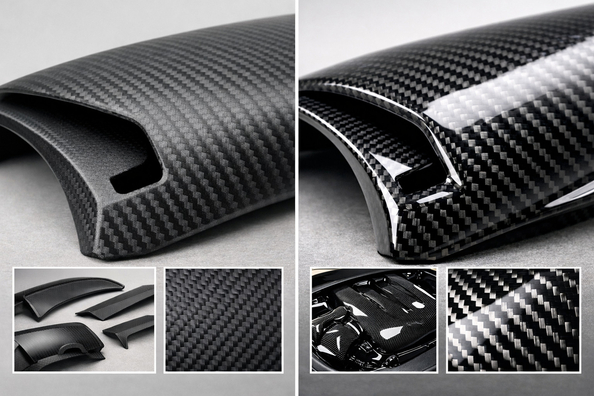
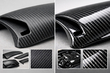
In short, the choice is simple: for loaded, large, highly visible parts and cars where precise geometry and consistent quality matter, dry carbon often makes more sense. If we’re talking about a decorative element, a limited budget, or a part without serious loads, wet carbon often delivers a decent result for less money.
The main trap is that the name itself guarantees nothing. Real quality is influenced far more by porosity, resin content, lamination consistency, clear coat, edges, and mounting. That’s why one good wet layup part can turn out to be more practical than a poorly made “dry carbon.”
Dry carbon in most cases means prepreg: the fabric already has a controlled amount of resin, and curing happens under precisely set temperature and pressure. This delivers better repeatability and fewer random defects from manual work. Wet carbon, or wet layup, is made more simply: dry fiber is impregnated with resin during layup. This process is cheaper and more accessible, but it depends more on the manufacturer’s workmanship.
For the buyer, this isn’t “premium vs budget,” but “consistency vs compromise.” Dry carbon is more often bought where low variability, stiffness, and a predictable result matter. Wet is chosen where a good look and decent fit are enough, and there’s no point overpaying for a technology whose potential you simply won’t use.
| Option | Strengths | Weaknesses | Who it’s for |
|---|---|---|---|
| Dry carbon | Better repeatability, fewer voids, more accurate control of fiber-to-resin ratio, higher potential stiffness and surface quality | Higher price, stricter manufacturing requirements, not every expensive part is automatically made well | For those buying large, loaded, visible, or high-speed elements and wanting a predictable result |
| Wet carbon | Lower price, simpler production, better availability, a solid option for decorative and uncomplicated parts | Greater quality variation, more resin, higher risk of voids, unevenness, and differences between batches | For those who prioritize appearance, budget, and no need for maximum performance properties |
DD Tuning expert comment: the most common mistake is buying carbon by the weave photo and the word dry in the name. In practice, more issues come from weak clear coat, thin edges, and poor mounting, which make the part start doing its own thing after the first winter or a few highway trips. If the element is exterior, always уточнюйте, how the edges are made, what it’s coated with, and how exactly it mounts on the car.
Dry carbon. Its strong point is process control. In one comparison, autoclaved prepreg samples had a higher fiber content than wet layup, which usually means less “excess” resin and a more predictable structure. For large spoilers, splitters, mirror housings, hoods, or other visible parts, this matters: less chance of getting waves, extra weight, or unstable geometry. But dry carbon doesn’t forgive sloppy work—if the mold, mounting, or finish is weak, a high price won’t solve the problem.
Wet carbon. Here, everything depends more on the craftsman and the specific production. In comparative data, such parts more often have lower fiber content and more voids, which hurts consistency and potential strength. But for decorative trims, non-critical aero elements, or projects where staying on budget matters more, wet layup is often sufficient. If the manufacturer does careful lamination, seals the surface well with clear coat, and doesn’t cut corners on edges, such a part can last a long time without drama.
Separately about noise, squeaks, and service life. There’s no simple rule like “dry is quieter” or “wet will fall apart.” If a part fits under tension, is held on weak double-sided tape, or has crooked support points, noise will appear regardless of the technology. Same with longevity: outdoors, it’s sun, chemicals, washes, salt, and the quality of the clear layer that decide.
For track use, high-speed driving, large aerodynamic elements, and expensive cars where the part is always in view, dry carbon is usually the more logical choice. There, the extra cost isn’t only for weight—it’s for more stable geometry, less variability, and a better chance of getting a clean surface without hidden defects.
For a daily car, city driving, winter, and bad roads, what matters isn’t loud words but durable clear coat, proper edges, and correct installation. If the part is decorative or not under heavy load, a good wet layup can be the smarter choice. For interior inserts, small trims, and cosmetic pieces, dry carbon often brings less practical gain than it seems at purchase.
| Scenario | What’s better to choose | Why |
|---|---|---|
| Track, high speeds, loaded aero element | Dry carbon | Stable geometry, lower variability, and better control of the structure matter |
| Daily car, decorative trims | Wet carbon | No point paying for potential you’ll barely feel in real use |
| Expensive visible part on a weekend car | Dry carbon | Justifies itself better where appearance and long-term coating stability matter |
| Project with a limited budget | Wet carbon | Lower entry cost if the manufacturer doesn’t cut corners on finish and mounting |
| Winter, dirt, washes, less-than-ideal roads | Depends on build quality, not the name | Clear coat, edges, thickness, and installation method matter more than the terms dry or wet |
Paying extra for dry carbon makes sense when the part is large, noticeable, works at speed, or must hold its shape for a long time without surprises. This applies to exterior elements where geometry errors are visible immediately and coating defects show up quickly in use.
If you’re looking at truly expensive and visible solutions, it’s logical to start with categories where material and finish реально affect the result: natural carbon, spoilers, and rear diffusers. In exactly these parts, the difference between a neat prepreg part and an average wet layup is felt not in the description, but in fitment, stiffness, and how the product survives the season.
From a customer’s experience: for a daily car, they were looking for an exterior carbon element and at first wanted to buy the most expensive option only because of the dry label. In the end, they chose a well-made wet layup from a proven manufacturer, because the part was decorative and the deciding factors were even fitment, decent clear coat, and proper mounting. The result was satisfying, because paying extra for track-level properties in that scenario would have given nothing.
Dry carbon is usually stronger where predictability, stable geometry, and fewer технологічних compromises are needed. Wet carbon wins where a разумний budget is needed and there’s no requirement to squeeze the maximum out of the material. But in both cases, you should buy not the name, but the конкретну build quality: lamination, clear coat, edges, mounting, and shape accuracy.
This material is based on real selection experience, practice, and real use scenarios. So the краткий takeaway is: for track use, large exterior parts, and demanding projects, look toward dry carbon; for decorative and budget tasks, a good wet layup is more often enough—if it’s made without cutting corners on finish and installation.
| ✔ | Better suited for large and heavily loaded parts where precise geometry and stable shape matter. In such cases, dry carbon carries less risk of waves, distortion, and excess weight. |
| ✔ | Has higher quality consistency between parts and batches. This is useful when a predictable result is needed without major deviations from one product to another. |
| ✔ | Provides better control of the fiber-to-resin ratio, and therefore less excess resin and fewer chances of internal defects. This is especially noticeable on visible exterior elements. |
| ✔ | Justified for track use, speedways, and expensive cars where stiffness and a neat finish matter. In such tasks, the extra cost is more often tied not only to the material, but also to result consistency. |
| ✔ | At the basic level, it is simpler and cheaper to produce, so it is more affordable for decorative or uncomplicated parts. If maximum properties are not needed, this makes it possible not to overpay for unnecessary potential. |
| ✘ | Costs more, and this extra cost does not always provide a noticeable practical effect. For decorative trims or interior inserts, the difference in benefit may be smaller than the difference in price. |
| ✘ | Depends heavily on manufacturing quality, so a high price by itself does not guarantee a good result. If the shape, mounting, or finish is weak, the problems do not go away. |
| ✘ | Strict production requirements make it less universal and more demanding on the process. A poorly made part may have the same fitment issues as a cheaper option. |
Shipping to EU
Wholesale and retail
Own warehouse
Опис продукту
Подарунки не надаються при оформленні покупки у кредит під 0,01% або при покупці частинами.