04.09.2026
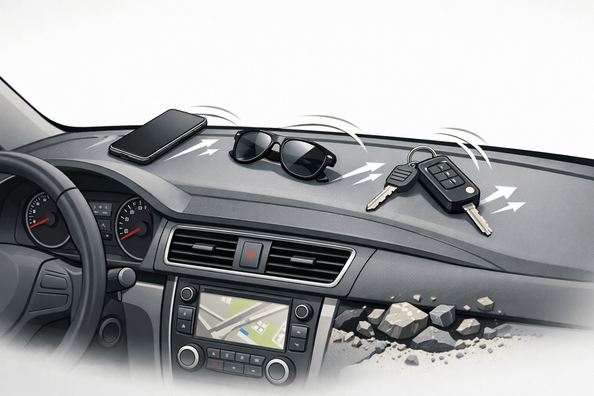

If small items slide off the dashboard over bumps, the problem is almost never the items themselves—it’s that the surface can’t hold them under load. On a smooth road you won’t notice it, but at expansion joints, speed bumps, and in corners, inertia easily overcomes weak friction.
A working solution depends on three things: the texture of your dash, whether there’s a slick film on it after interior care products, and whether the issue gets worse in hot weather. That’s exactly what you should check before buying any mat or other accessory.
A dashboard is rarely perfectly horizontal. Even a slight slope combined with a smooth surface creates a situation where a phone, sunglasses, or keys sit fine when parked, but start moving at the first serious bump. The smaller the contact area and the harder the object, the faster it breaks into a slide.
Interior detailing makes it worse. If the dash has been treated with a glossy product, or it has simply picked up dust and an oily film from hands, the coefficient of friction drops even further. In summer you also get overheating: silicone softens, adhesive bases weaken, and cheap mats can leave marks.
Start with a simple cleaning check. Wipe a small area with a damp microfiber, then use an interior cleaner with a matte finish. If the same item holds better afterward, the main cause was the film, not the dash geometry.
Next, compare behavior in the morning and after the car has been sitting in the sun. If the problem резко worsens specifically in a heated cabin, the cause is temperature: the dash, the mat, or the adhesive base is losing stability.
Another test is to move the item to a different spot on the dash. If it stays in one place but slides in another, the deciding factors are the slope and texture of that specific area. If it slides everywhere, you need either cleaning or a separate anti-slip layer.
DD Tuning expert comment: the most common mistake is trying to solve everything with yet another sticky mat without washing the old polish off the dash. The second typical problem is putting an adhesive base on a leather or heavily textured dash—where it holds at first and then peels off. If the problem is seasonal, test behavior specifically after heat, not in a cool garage.
| Symptom | Likely cause | What to do |
|---|---|---|
| Items slide only over bumps | Insufficient friction on a smooth or sloped dash | Clean the surface and add an anti-slip pad for the specific area |
| It got worse after interior care | Glossy or oily film left by the product | Wash off residue and switch to a matte cleaner without a slick finish |
| Fine in the morning, after sun everything slips | Cabin overheating, weakening of an adhesive or silicone layer | Reduce heat with a sunshade; don’t leave the mat in direct sun unnecessarily |
| The mat itself shifts along with the items | Poor mat material or incompatibility with the dash texture | Replace the mat with a different type, not just move it around |
| Shiny marks left after the mat | Cheap silicone or overheating | Remove the marks, avoid that material, and don’t stick a new one on top of it |
| Nothing holds properly on a textured dash | The relief prevents full, even contact | Look for a flat area or a separate base, if the dash material allows it |
The best first step is proper cleaning without gloss. A matte finish doesn’t make the dash sticky, but it removes what makes items start drifting: dust, grease, and slick residue from detailing products.
Second is a correctly chosen anti-slip pad. It should work not “in general,” but on the specific texture of your dash. On a smooth area, a good mat is enough; on an uneven surface, results are often worse because contact is unstable.
Third is controlling overheating. A sunshade won’t make the cabin cold, but it reduces direct heating and often eliminates the summer ухудшення, when the mat starts to soften or lose grip.
If it’s not about loose items but a suction cup or a holder pad, a separate check of the mount itself can help: sometimes it’s enough to rinse the suction cup with warm water and let it air-dry. But that doesn’t fix a slippery dashboard as such.
Household double-sided tapes and random sticky pads rarely provide long-lasting results in a car interior. Temperature swings, dust, and dash texture quickly cancel out the effect, and the marks they leave are often worse than the benefit.
Glossy polishes also don’t solve the problem, even if the dash looks “fresher.” They often leave a slick film that makes items slide more, and dust sticks more actively.
Cheap silicone mats are another weak option. In cool weather they may work tolerably, but in heat they often degrade, shift on their own, or leave an imprint on the dash. If, after a few days in the sun, the surface underneath has become shiny, it’s better to stop the experiment.
An accessory makes sense when you already understand the cause. If the dash is simply slippery and the area is more or less flat, it’s logical to start with an anti-slip dashboard mat. For a wider area or several small items, a larger anti-slip mat can be more practical so items don’t bump into each other on uneven surfaces.
If the problem almost always appears after the car sits in the sun, it makes sense to add a sunshade. It won’t eliminate heating completely, but it often stabilizes mat performance in summer and reduces the risk that the material will “flow.”
Replacing dash elements is rarely needed. It’s worth considering only when the dash covering is already damaged—too glossy, cracked, or when failed mats left marks that constantly reduce grip. If you have a leather dashboard, be especially careful with adhesive pads: for this material they often simply aren’t suitable.
| Solution | When it works | When it’s not worth spending money |
|---|---|---|
| Cleaning the dash with a matte finish | There’s dust, oily film, it became slippery after polish | If the dash is clean but the issue is caused by a steep slope or an overheated mat |
| A quality anti-slip mat | There’s a flat area and small items need to sit on the dash | If the surface is very heavily textured, leather, or constantly overheats |
| Adhesive base or mounting disc | You need to stabilize a pad on a textured area | For a leather dash, or when you want to reposition the base often |
| Sunshade | It gets worse in summer after sitting in the sun | If items slide the same in winter and in shade—the cause isn’t overheating |
| Stop storing items on the dash | The dash is very sloped, items are heavy or hard, and you need stability | Don’t ignore simple cleaning if the problem started recently and there are no obvious design limitations |
From a customer’s experience: people often look for an “even stickier” mat because the previous one didn’t work in the heat. After proper dash cleaning and switching to a more size-appropriate mat, the problem disappears even without complicated modifications. Most often, satisfaction comes not from the most expensive solution, but from compatibility with the specific dash texture and the usual parking conditions.
When items slide off the dashboard, you should start not with a random purchase but with diagnosis: surface cleanliness, texture, angle, and reaction to heat. In most cases, a combination of matte cleaning, a properly selected anti-slip pad, and basic overheating protection works.
If the dash is too sloped, heavily textured, or sensitive to adhesive materials, cheap experiments will only leave marks and waste time. This material is based on real usage scenarios, practical accessory selection, and common mistakes seen not in theory but in everyday car use.
Shipping to EU
Wholesale and retail
Own warehouse
Опис продукту
Подарунки не надаються при оформленні покупки у кредит під 0,01% або при покупці частинами.