05.08.2026
115
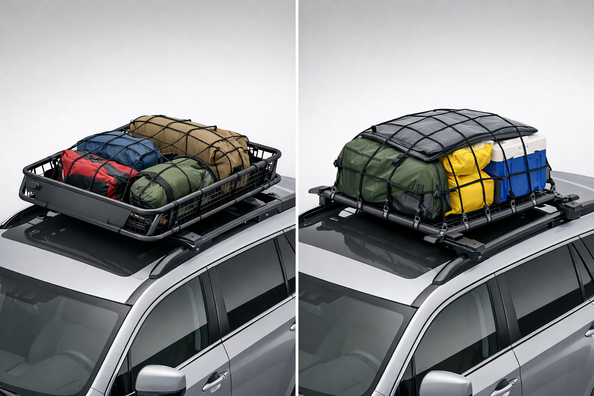
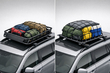
If you often carry a large load on the roof, and the items are tall, dirty, or awkwardly shaped, a roof basket is usually more practical. But if roof cargo is occasional and, in daily driving, lower noise, a lower profile, and a universal base for other accessories matter more, it makes more sense to look at crossbars with straps and a cargo net.
The main mistake here is comparing these options only by the load-rating number. In reality, what matters is installation, the system’s own weight, how easy it is to secure the load, behavior at highway speeds, and whether you need an open cargo platform or simply a base you don’t want to constantly hear above your head.
A roof basket is an open platform with side rails. Its strength is that large or awkward cargo is easier to place, brace against the rails, and cinch down with straps. For wet gear, jerry cans, bags, tools, or items you don’t want inside the cabin, it’s usually more convenient.
Crossbars with a net follow a different logic. The crossbars are the base, and the net only helps press down cargo that has already been placed and strapped. It’s not a container and not a replacement for straps. This option wins when the roof is empty most of the time and you don’t want to constantly carry a tall, noisy basket on the vehicle.
| Option | Strengths | Weaknesses | Who it’s for |
|---|---|---|---|
| Roof basket | Side rails, many tie-down points, more convenient for large and awkward cargo, easier to use with wet or dirty items | More noise, higher profile, heavier on its own, doesn’t protect from rain or snow | Those who regularly carry bulky, tall, or non-standard cargo |
| Crossbars with a net | Lower profile, less aerodynamic loss, lighter on its own, universal base for other accessories | The net doesn’t replace straps, less control over tall cargo, no weather protection, works worse with very awkward items | Those who rarely carry roof cargo but want a quieter, more flexible system |
DD Tuning expert comment: most often, people go wrong when they think the net alone will hold any cargo. In practice, you first need to cinch items down firmly with straps, and use the net as an extra backup. The second common mistake is not subtracting the weight of the basket or crossbars from the roof limit, so the payload margin disappears faster than expected.
A basket shines where the load doesn’t want to sit flat: large bags, tools, oddly shaped items, gear after rain or snow. The side rails provide clear geometry, and the open tubes offer solid strap points. In other words, you’re not just putting things on the roof—you’re getting a platform that actually helps you secure them.
But you pay for that with noise and extra air resistance. Also, the basket itself is heavier than a set of crossbars, so it uses up part of the roof limit before you even load anything. And one more thing: an open basket doesn’t solve rain, snow, dust, or prying eyes. If you need protection, that’s not its territory.
Crossbars are a base, not a ready-made cargo platform. They’re convenient because they don’t lock you into one scenario: today you can secure cargo, tomorrow install another accessory, and then drive with no load at all. If the crossbars are aerodynamic, in daily use this is usually calmer than a basket.
The weak point is that the net doesn’t create a rigid shape. It won’t turn tall, soft, or slippery cargo into a neat block. So for large loads, straps come first, and the net works over them. If an item is long, tall, or at risk of catching wind, a basket more often delivers a more predictable result.
For regular trips with large cargo, the basket has the advantage. Especially if the task repeats: carry a lot at once, load quickly, cinch down quickly, and not worry about where to find anchor points.
For city and highway driving without constant cargo, crossbars with a net make more sense. Less height, less chance of a constant hum at speed, and the base will come in handy later for other tasks.
If the cargo is large but happens rarely, the choice depends on whether you already have crossbars. When the base has been installed for a long time, a net and straps are often enough. But when the load is truly awkward, tall, or dirty, a basket brings more peace of mind during tie-down.
If the main requirement is protection from precipitation and prying eyes, the honest answer is: there’s no winner between these two options. You need a different solution.
| Scenario | What to choose | Why |
|---|---|---|
| You often carry large, tall, or dirty cargo | Roof basket | Provides side rails and convenient tie-down points, loads faster, and works better with non-standard items |
| Daily driving, roof cargo is rare | Crossbars with a net | Lower profile, less noise, and fewer compromises in normal use |
| You need a universal base for different accessories | Crossbars with a net | Crossbars remain the foundation for other tasks, and the net is used only when needed |
| You need to pack awkward cargo quickly without an ideal shape | Roof basket | An open platform makes it easier to arrange items and cinch them down with straps |
| You need protection from rain, snow, and prying eyes | Not these two options | Neither a basket nor a net provides a protected volume |
A more expensive system is justified when it will be on the roof often or almost permanently. In that mode, better aerodynamics, quieter operation, more stable mounts, and longer service life are felt every day. If you plan to carry large items regularly, it’s worth looking not only at the roof baskets themselves, but also doing a proper roof rack selection, because a weak base ruins the experience even with a good basket.
Another case where saving doesn’t work is when you actually need not an open cargo platform, but a protected volume. Then it’s more honest to move straight to roof boxes, rather than trying to force a basket or net to solve a task they weren’t designed for.
From a customer’s experience: a common situation is that a person initially just wants a net because it seems like the simplest and cheapest option. But when it turns out the cargo is tall, soft, and needs to be carried a few times a month, the choice shifts to a basket, because packing and cinching down takes less stress. The reverse happens too: for two trips a season, a customer keeps crossbars and straps so they don’t have to live with constant noise from a basket.
The short answer is: for frequent large loads, get a basket; for calmer daily driving with occasional trips, choose crossbars with straps and a net. A basket gives better tie-down geometry and more practicality with non-standard items, while crossbars win on weight, versatility, and comfort without a load.
What ultimately decides is not marketing promises, but your scenario, the roof limit of your specific vehicle, and your willingness to live with noise or extra steps during tie-down. This material is based on real fitting experience, practice, and real-use scenarios, so the main guideline is simple: don’t buy “just in case”—choose the format that truly matches what you carry most of the time.
| ✔ | A roof basket is more convenient for bulky, tall, or awkward cargo: the side rails help arrange the items and secure them better with straps. This is especially useful for wet gear, jerry cans, tools, or dirty items. |
| ✔ | For frequent hauling, a basket makes loading quicker and easier because you don’t need to find the ideal shape of the load. The article explicitly notes that for regular trips with large cargo, it is more practical. |
| ✔ | Crossbars with a net have a lower profile and less weight of their own, so they have less impact on the roof load limit and everyday comfort. This matters if roof cargo is rare. |
| ✔ | Crossbars are a versatile base for other accessories, and the net can be used only when needed. This option is convenient when the roof should stay clear most of the time. |
| ✔ | When there is no permanent load, crossbars with a net are usually quieter and less noticeable in everyday driving than a basket. This reduces noise and does not add extra height to the vehicle. |
| ✘ | A roof basket is noisier and creates more aerodynamic drag than low-profile crossbars. On the highway, this can be noticeable even with proper installation. |
| ✘ | A basket is heavier than a crossbar set, so it uses up part of the permissible load before you even put anything on it. For cars with a small roof load margin, this is a significant drawback. |
| ✘ | Neither a basket nor a net protects cargo from rain, snow, dust, or prying eyes. If you need a closed and protected space, the article recommends a different solution. |
| ✘ | A net is not an independent fastening and does not replace straps. For tall, loose, or slippery cargo, it works only as additional security, not as the main way to secure it. |
| ✘ | Crossbars with a net offer less control over very awkward or tall cargo. Such items are harder to secure reliably than in a basket with side rails. |
Shipping to EU
Wholesale and retail
Own warehouse
Опис продукту
Подарунки не надаються при оформленні покупки у кредит під 0,01% або при покупці частинами.