09.07.2026
237
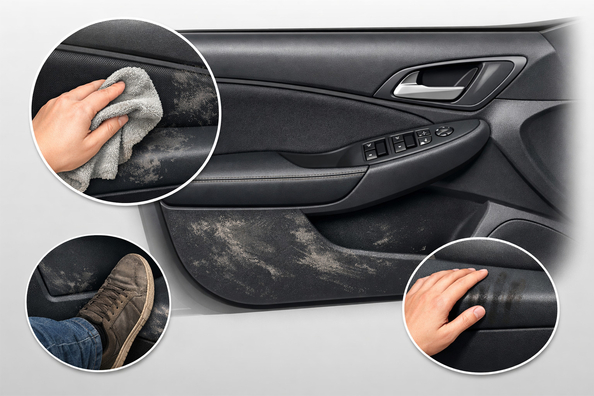
If the inner door panels quickly get covered with white marks, dark scuffs, or grime, it doesn’t always mean the plastic is bad. In most cases you’re seeing a combination of two things: transferred residue from hands, shoes, the seat belt, cosmetics, or road dirt, and real surface scuffing. On darker and glossier pieces it’s simply more noticeable.
The practical task is simple: first tell dirt apart from damage, and only then spend money. If the mark fades noticeably after gentle cleaning, the issue is maintenance and repeated contact. If a dull streak, scratch, or dent remains, chemicals alone won’t fix it.
The door panel constantly acts as a contact zone. You touch it with your palm when closing the door, with your knee or shoe when getting in, with the seat belt, a bag, kids’ items, and sometimes even an animal’s claws near the window. Some marks stay on the surface, some get embedded into the material’s texture.
The issue also depends on the finish itself. Textured plastic hides fine scratches better, but traps dirt in the recesses. Hard and dark parts show light streaks faster. In winter, the situation gets worse due to salt, wet sand, and dirt on shoes, which easily transfer to the lower part of the door.
DD Tuning expert comment: a common mistake is rubbing the door panel dry or with a stiff sponge when someone sees a white mark and assumes it’s just dirt. This often removes the top finish and makes the spot even more visible. Another mistake is pouring the product directly onto the panel near buttons and handles instead of applying it to the microfiber.
| Symptom | Likely cause | What to do |
|---|---|---|
| Whitish or slightly greasy film on a dark surface | Residue from hands, creams, sprays, dry skin | Gently wash with a microfiber cloth and a mild solution, without heavy rubbing |
| Gray streaks at the bottom of the door panel | Shoes, salt, sand when getting in | Clean it, check your entry path, protect the repeated-contact area |
| Thin repeating scratch on the side | Seat belt, buckle, or bag | Remove the source of friction; add a protective element if needed |
| Dots and dark dirt in the texture | The grain has collected dust and dirt | Work with a soft brush, not a dry cloth |
| The mark doesn’t disappear after washing | Scratch, damaged texture, or a dent | Don’t keep rubbing; consider spot repair or replacing the part |
| The same area is pressed in | Contact pressure from trim parts or a mounting/fitment issue | Look for the cause in panel fitment, not in chemicals |
Early, gentle cleaning works best. Start with dry cleaning, then use a microfiber cloth with a very mild solution. For stubborn residue, don’t press harder: it’s better to repeat the cleaning cycle or let the product dwell briefly, then gently go over it again.
On textured plastic, a soft brush often makes the difference. It pulls dirt out of the grain where a cloth only glides over the high points. If the door has suede inserts or a sensitive soft-touch coating, they need a separate neutral product and very careful care without over-wetting.
Another effective approach is to eliminate the source of repeated contact. If you can already see that the mark always appears in the same spot, constant scrubbing without prevention only wears the finish.
Accessories make sense when the problem repeats in the same spot. If the door panel is regularly hit by shoes or scratched by items during daily driving, it’s logical to install door protectors. If the main contact happens when getting in through a narrow opening, door sill plates help. When dirt and salt are constantly carried from shoes across the lower cabin area, it’s also worth starting with rubber floor mats.
If you install adhesive protection or film, don’t wash the interior right after installation. And if the panel already has deep scratches, broken texture, or dents from incorrect panel fitment, it’s more rational to consider repair or replacement rather than looking for yet another cleaner.
| Solution | When it works | When it’s not worth spending money |
|---|---|---|
| Microfiber and a mild cleaning solution | Fresh residue, hand marks, light dirt | Deep scratch, dent, destroyed texture |
| Soft brush for texture | Dirt packed into the plastic grain | Marks on a smooth surface are actual scratches |
| Silicone or glossy dressing | Only briefly masks dullness | When you need proper cleaning without changing the finish |
| Protective covers or film | There’s a constant contact point from shoes, claws, or the belt | You need to restore an already pressed-in or heavily scratched panel |
| Door sill plates | When getting in, shoes hit the lower cabin area | Marks appear higher up—from hands, items, or the belt |
| Replacing or repairing the door panel | There’s deformation, deep scoring, or a panel fitment issue | When the cause is only residue that can still be cleaned off |
From a customer’s experience: the owner of a family crossover asked to replace the door panels because he was sure the plastic was already ruined. After gentle cleaning with a microfiber cloth and a soft brush, most of the white marks disappeared, and the real issue remained only in the lower area that shoes kept hitting. In the end, there was no need for replacement: they protected the contact area and stopped the repeated wear.
Fast soiling of door panels most often doesn’t mean a single cause, but a combination of residue, dirt in the texture, and regular mechanical contact. That’s why the correct order is: first, a gentle check and cleaning; then find the friction point; and only after that—accessories or replacement. If the mark doesn’t disappear after mild care, don’t finish off the surface with aggressive chemicals.
Shipping to EU
Wholesale and retail
Own warehouse
Опис продукту
Подарунки не надаються при оформленні покупки у кредит під 0,01% або при покупці частинами.