 Author: Radomskyi Maksym Vasyliovych
If the car lives in the city, drives daily, and has cameras, parking sensors, and a typical parking routine, it’s more logical to look at a front guard. But if the vehicle regularly sees night highways, rural roads, forest tracks, rocks, animals, or needs to work with a winch, then the logic shifts to a heavy-duty bumper.
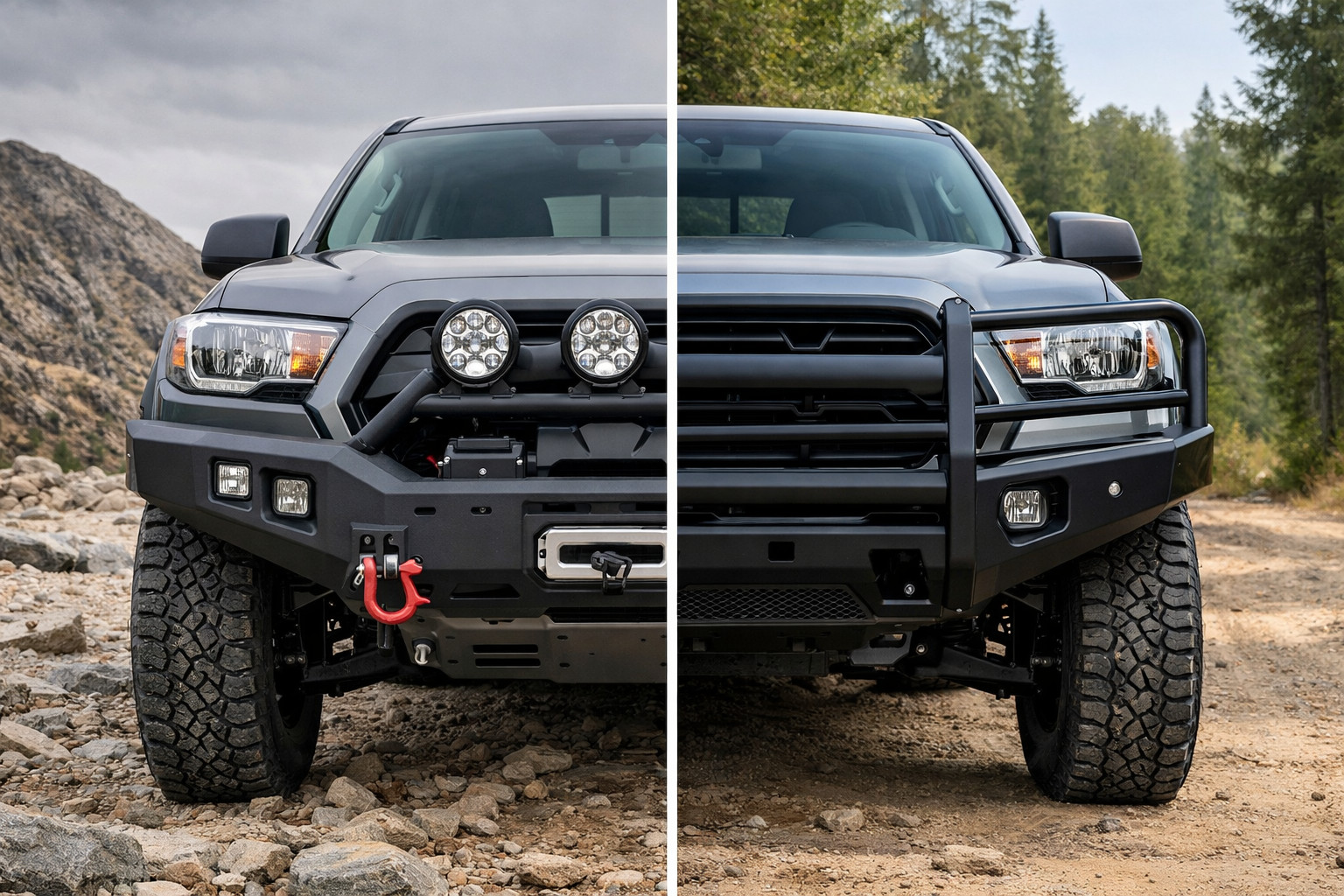
The main mistake here is that people mix up the names. A front guard, hoop bar, bull bar, and heavy-duty bumper may sound similar, but they differ not by the catalog wording, but by weight, design, mounting, compatibility with electronics, and whether the assembly can withstand a real impact rather than just a minor parking touch.
What the choice is really about
The idea is simple: you’re not just choosing metal up front, you’re choosing the level of intervention in the vehicle. A front guard is usually lighter, cheaper, and less painful in daily use. A heavy-duty bumper provides a higher strength reserve, but it also brings extra weight, more forward overhang, a higher price, and often the need to think about the suspension.
In practice, the difference is obvious even on a crossover: in one official example, a front guard adds 6 kg, while a heavy-duty bumper adds 34 kg. So this isn’t cosmetic. For a car that drives in the city every day, those kilos are felt less in theory than in maneuvering, front-axle loading, and future selection of additional equipment.
What criteria to compare by
Installation. A front guard is usually easier to install, although model-specific kits may still require removing part of the trim or accessing factory mounting points. A heavy-duty bumper is heavier and bulkier and more often requires more complex fitting, relocating sensors, or preparation for additional equipment.
Noise. There are almost no honest universal measurements here, so you should rely not on marketing promises but on the product’s shape. The more the element protrudes forward, the more tubes, lights, and bolt-on accessories it carries, the more attention you need to pay to aerodynamics. This is a criterion that’s best checked on a specific model, not “on average across the market.”
Service life. Material, thickness, weld quality, coating, and brackets matter here. Lightweight aluminum solutions are less afraid of corrosion, but they don’t replace a rigid heavy-duty structure. A heavy-duty bumper is chosen not for longevity in words, but for the ability to work under load and serve as a base for a winch and recovery points.
Practicality. For the city, weight, forward overhang, access to parking sensors and cameras, and ease of parking matter. For travel and work, protection from branches, rocks, and animals matters, as well as the ability to mount additional lighting and not fear contact where the factory plastic already ends.
Price. The difference is often not in percentages, but in multiples. In a typical crossover example, the heavy-duty bumper ended up costing more than three times as much. And that’s without factoring in installation, possible front suspension upgrades, a winch, and the related small parts.
Quick comparison of options (table)
| Option | Strengths | Weaknesses | Who it suits |
|---|---|---|---|
| Front guard | Lower weight, lower price, easier installation, less load on the front end, often more friendly to cameras and parking sensors | Limited real protection, less space for equipment, not the best base for a winch, more useful for minor contacts than for serious impacts | City driving, daily commutes, family crossovers, light trips outside the city |
| Heavy-duty bumper | Better front-end protection, rigid construction, more often suitable for a winch and work tasks, better for difficult roads | Higher weight, larger forward overhang, more expensive installation, possible front-end sag, more compatibility questions with radar and lighting | Rural areas, night highways, expeditions, pickups, commercial vehicles, regular off-road use |
DD Tuning expert comment: Most often, buyers look only at the photo and the name, not at the weight, bracket type, and sensor compatibility. A second common mistake is installing a heavy-duty bumper on a city crossover without calculating the load on the front suspension. If the vehicle has a camera, parking sensors, and adaptive systems, you need to check not only the product itself, but also where the sensors are relocated and whether additional lighting will block them.
Detailed breakdown of each option
Front guard
This is a rational choice when you don’t want to turn the car into a heavy work vehicle. It fits crossovers and daily drivers better because it adds little weight and doesn’t change the front-end behavior as noticeably. In model-specific versions, such protection can keep the surround-view camera and front parking sensors, which for a modern vehicle is often more critical than the mere fact of having metal up front.
Its limits are also clear: it’s not a structural replacement for the factory bumper. For minor contacts, protecting the front fascia, adding auxiliary lights, and everyday practicality, it makes sense. But if you’re genuinely worried about hitting an animal, a stump, or a rock ledge, don’t overestimate a front guard.
Heavy-duty bumper
This is a different level of modification. It’s heavier, wider, protrudes further forward, and creates a working front zone for harsh scenarios. Using the same crossover example, the difference isn’t only in weight but also in geometry: a heavy-duty bumper adds more length up front, but at the same time provides different rigidity and a better foundation for a winch, extra protection, and more serious loads.
The downsides aren’t theoretical either. The heavier the assembly, the more real the risk of front-end sag, changes in suspension behavior, and the need to think about springs or a load-rated setup. In addition, on modern vehicles a heavy-duty bumper must be evaluated not only for its metalwork, but also for how it coexists with radars, cameras, parking sensors, and the crumple zones of the body.
Which option is better for different scenarios
For a city car, the advantage is almost always on the side of a front guard. It doesn’t burden the front axle as much, hits the budget less, and less often triggers a chain of expenses for suspension and modifications. If the main risk is curbs, tight parking, minor contacts, and the desire to add auxiliary lighting, it’s enough.
For rural roads and night driving, the logic changes. What matters there is not a side-profile photo, but strength reserve, the ability to survive rougher contact, and having a platform for more serious equipment. In such conditions, a heavy-duty bumper justifies itself much better, especially on pickups, body-on-frame SUVs, and work vehicles.
A compromise case is a travel crossover that lives in the city on weekdays and goes to gravel, forests, or mountains on weekends. Here, an honest assessment of how often the hard trips happen is decisive. If it’s a few easy trips a year, a front guard is the smarter choice. If regular routes are ahead where the plastic is already a pity, and the winch will truly be used, then you should look toward a heavy-duty solution.
Use scenario and what to choose (table)
| Scenario | What to choose | Why |
|---|---|---|
| Daily city use | Front guard | Adds less weight, easier to live with for parking, lower budget, and fewer chances of interfering with electronics |
| Family crossover with cameras and parking sensors | Front guard | With model-specific kits it’s easier to keep factory sensors and avoid overloading the front end |
| Night driving on rural roads | Heavy-duty bumper | A real protection reserve matters more than small savings in weight and money |
| Travel, expeditions, off-road | Heavy-duty bumper | You need a base for a winch, stronger mounting, and better readiness for contact with obstacles |
| Commercial or fleet vehicle | Heavy-duty bumper | Higher working durability and a more practical cost logic in harsh conditions |
Common mistakes when choosing
- Buying by name rather than by construction. Two parts can be called similarly but differ in weight and strength by multiples.
- Ignoring added weight. For a city crossover, the difference between 6 and 34 kg is already noticeable, and with a winch it becomes even larger.
- Not checking compatibility with cameras, parking sensors, radar, and auxiliary lighting.
- Expecting a front guard to provide the level of defense that only a heavy-duty bumper can deliver.
- Calculating only the part price. In reality, the budget may include installation, sensor relocation, suspension upgrades, and related brackets.
- Installing a heavy front-end protection just “for looks,” without a real scenario where it’s needed.
When the more expensive solution makes sense
The more expensive solution is justified when the protection works as a tool, not as decor. If you have regular night highways, rural areas, work trips, a trailer, travel where a rough front-end contact is possible, or a winch is planned, saving on the class of construction is usually a bad deal. In that case, it’s worth looking not only at appearance, but at full-fledged heavy-duty bumpers, comparing them with lighter front guards, and separately reviewing related bull bars and side steps if you need a tubular solution without a full assembly replacement.
If the car drives on asphalt 90% of the time and all heavy scenarios happen once a season, a more expensive heavy-duty bumper often turns out to be an overpayment not only at purchase, but also in daily use. The logic there is simple: less metal, fewer compromises.
From a customer’s experience: A pickup owner was looking for protection for daily trips between town and a farm and initially considered a simple front hoop bar because of the lower price. After discussing night routes, the risk of encountering animals, and plans to install a winch, he chose a heavy-duty bumper and immediately prepared the front suspension for the extra load. As a result, he got not a decorative accessory, but a working assembly for his real tasks.
Conclusion
A front guard makes sense where light weight, a lower budget, everyday convenience, and careful compatibility with modern electronics matter. A heavy-duty bumper makes sense where the vehicle truly works in tougher conditions and the protection must withstand not a minor touch, but a hard-use scenario with additional equipment.
So the choice is not about “what looks cooler,” but about honest match to the tasks. The material is based on real selection experience, installation practice, and real-use scenarios, so the main advice is simple: for the city, don’t overload the vehicle without need, and for work and harsh routes, don’t cheap out on the construction.
Pros and cons
Front protection is better suited for everyday city use: it is lighter, easier to install, and puts less strain on the front axle. For cars with cameras and parking sensors, it is often more practical than a bulkier unit.
A bull bar provides a more solid reserve of strength for tough conditions — night roads, country roads, forests, rocks, and encounters with animals. It also works better as a base for a winch and additional equipment.
Front protection is usually cheaper, and this applies not only to the part itself but also to related costs. In a city scenario, this helps avoid unnecessary expenses on suspension, sensor relocation, or other modifications.
A bull bar is more practical for work vehicles, pickups, and body-on-frame SUVs, where durability matters more than appearance alone. In such conditions, it more logically covers tasks related to regular heavy-duty trips.
Front protection should not be seen as a full replacement for a heavy-duty bumper: its capabilities are limited when it comes to a serious impact or contact with a large obstacle. It is more about minor contacts and front-end protection.
A heavy-duty bumper adds noticeable weight and can change the vehicle’s behavior, even to the point of front-end sagging. Because of this, you often have to think about the suspension, springs, and other related changes.
On modern cars, a heavy-duty bumper can create compatibility issues with cameras, parking sensors, radar, and additional lighting. Before buying, you need to check not only the part itself but also its interaction with the electronics.
A more expensive heavy-duty bumper often brings hidden costs: installation, sensor relocation, front suspension reinforcement, brackets, and a winch. In city use, this can be an overpayment without any real need.