30.07.2026
280
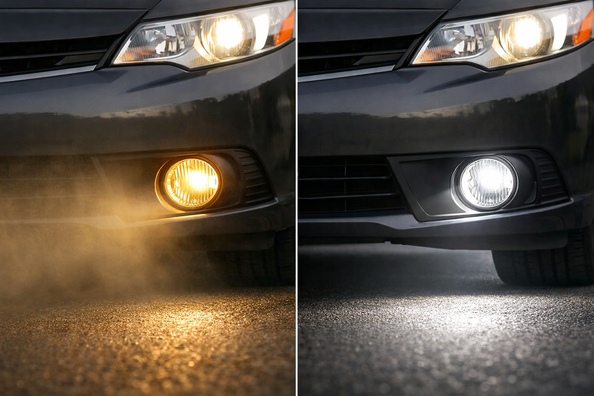
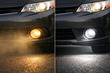
For everyday driving, halogen is usually the simpler and safer choice: less risk that the headlight will start aiming wrong, throw an error, or require modifying mounts. LED makes sense not just because it’s a newer technology, but because it can deliver lower power draw, longer service life, and less frequent replacement—however, only with proper compatibility and correct beam pattern.
The main mistake when choosing fog lights is looking only at lumens or a 6000 K color. For daily use, the beam shape, the exact bulb position in the housing, the light color for wet weather, and whether the specific solution actually works correctly in your optics matter more.
Essentially, you’re choosing between two approaches. The first is halogen: easy installation, predictable performance in the stock housing, lower entry cost—but more frequent replacement and higher power consumption. The second is LED: less load on the electrical system and potentially a much longer lifespan—but the result depends much more on bulb design, cooling, fitment in the housing, and the legality of such a solution for your specific car.
There’s also an important difference within LED itself. An LED bulb in a stock halogen fog light and a complete certified LED fog light are not the same thing. In the first case, you only change the light source; in the second, you replace the entire module with optics—and the second option more often delivers a predictable result when you want a real improvement.
| Option | Strengths | Weaknesses | Who it’s for |
|---|---|---|---|
| Standard H11 halogen | Low price, easy replacement, predictable beam in stock optics | Higher 55 W draw, shorter lifespan, more frequent replacement | Anyone who wants to install it and drive without modifications |
| Long-life H11 halogen | Same compatibility, but less frequent replacement; often warmer and more comfortable in wet weather | No magic boost in light output; consumption remains halogen-level | Daily driver, taxi, a car with difficult access to the bulb |
| LED bulb in stock fog light | Lower power draw, longer lifespan, less maintenance | Dependent on positioning, cooling, compatibility, and legality; possible fan noise | Those willing to verify compatibility rather than buying at random |
| Complete LED fog light | Better beam control, wider field of light, a more logical premium upgrade | Highest price | Anyone who wants not just a different bulb, but a different level of solution |
DD Tuning expert comment: The most common mistake is installing an LED bulb into a housing designed for a specific halogen filament and not checking the light source position relative to the reflector. The second typical misstep is choosing cool white light for rain and fog, then complaining not about brightness but about glare from wet roads and eye fatigue.
This is the basic solution with the lowest risk. A typical H11 runs on 12 V, draws 55 W, and delivers the familiar stock fog light behavior—assuming the optics are in good condition. For a daily car, that matters: you get not record numbers on the box, but a predictable low, wide beam without fitment surprises.
The downsides are also straightforward: heat, higher load on the electrical system, and shorter life. If you use fog lights often, standard halogen may need replacement noticeably sooner than you’d like.
An underrated option for everyday driving. It doesn’t make the light brighter by itself, but it often provides a longer lifespan without sacrificing compatibility. For a car where access to the fog light is inconvenient, this is more practical than chasing trendy labels.
Another plus is a warmer light character. In wet weather, this is often more useful than a cool tint that looks great on dry asphalt but reflects more strongly off water and snow.
The advantages are obvious: power consumption can be around 9.3–10 W, and the claimed lifespan is significantly longer than standard halogen. If the car drives a lot and changing bulbs is inconvenient, that’s a strong argument.
But this is also where the most pitfalls are. In fog lights, it’s not only the lumen output that matters, but the beam shape. If the LED bulb sits incorrectly or its geometry doesn’t match the housing, the light gets worse, with stray light or glare. Add possible fan noise, the need for space for cooling, and approval/legal questions—and it becomes clear why not every LED is worth buying.
This is the most expensive, but technically the most consistent way to switch to LED. When the module is designed as a single system, the chance of getting a correct, wide low beam is higher than with a random retrofit. That’s why premium LED makes the most sense in the format of a complete module, not just a “brighter” bulb.
There’s only one drawback—price. But if you want a truly new level of fog light performance rather than just a different bulb type, it’s a more logical investment.
For city use, daily short trips, and a driver who doesn’t want to deal with compatibility, halogen is better. If it’s important to replace the bulb less often but without experiments, it’s worth looking at a long-life H11 rather than the cheapest standard one.
For regular driving in rain, snow, and fog, what’s critical is not the LED or halogen label, but a warmer color and a correct wide beam. Cool white LED does not guarantee better visibility. For high mileage, commercial use, or difficult access to the fog lights, LED starts to look more appealing—but only after you verify fitment, cooling, and correct operation in your specific housing.
| Scenario | Best choice | Why |
|---|---|---|
| City driving, infrequent night trips | Standard or long-life halogen | Cheap, simple, no compatibility surprises |
| Daily driving in rain and wet weather | Long-life halogen or a warmer/yellow LED if it’s compatible | A warmer tint and correct beam are more useful than cool whiteness |
| High annual mileage | Quality compatible LED | Less maintenance and lower power draw |
| Difficult access to the fog light | Long-life halogen or a proven LED | The key is having to replace it less often |
| A real upgrade to the whole fog light system is needed | Complete LED fog light | You upgrade not only the bulb, but also the optics |
Paying extra for LED makes sense in three cases: high mileage, difficult access to the bulb, and the desire to reduce maintenance. Then you need to calculate not only the upfront price, but also how many times you’ll have to remove the fender liner, whether there’s space for cooling, and whether fitment issues will appear.
If you want a calm, stock-like scenario, it makes sense to look at higher-lifespan H11 halogen bulbs. If you want lower power draw and to deal with replacements less often, first check compatible LED bulbs instead of buying the first kit you see. If you’re still unsure about the fog light format itself, it’s useful to compare your choice with our fog light breakdown.
When you need a noticeably better result—not just a different bulb type—it’s more logical to invest in a complete LED module with proper optics rather than a random retrofit with unclear light distribution.
From a customer’s experience: a crossover driver often traveled on highways in the rain and wanted to switch to LED purely for brighter white light. After checking, it turned out that a cheap retrofit didn’t fit perfectly in his stock fog lights and created extra glare, so he ultimately chose a long-life H11 with a warmer tint. In his scenario, he was satisfied specifically with the even beam and less frequent replacement—not the trendy technology name.
For everyday driving, halogen usually wins on simplicity, price, and predictability. LED has real advantages in lifespan and power consumption, but it’s justified only when you’ve verified compatibility, bulb position, cooling, light color, and approval for your vehicle. In fog lights, the best choice isn’t what looks brighter on the packaging—it’s what works correctly on the road.
| ✔ | Halogen is simpler to install and usually fits the factory fog light without any surprises. This reduces the risk of poor light output, errors, and mounting modifications. |
| ✔ | For everyday driving, halogen provides predictable performance in the original optics and a lower upfront price. It is practical if you need a “install and go” option. |
| ✔ | A long-lasting halogen is convenient where access to the fog light is difficult. Less frequent replacement is often more important than a small gain in brightness. |
| ✔ | LED can consume less energy and last longer than halogen. For high mileage or frequent use, this reduces maintenance frequency. |
| ✔ | A full LED fog light controls the beam better than a random retrofit LED in the factory housing. If you want a real improvement, this is the more technically reliable path. |
| ✘ | An LED in a factory halogen fog light depends heavily on compatibility, fitment, and cooling. If the bulb sits incorrectly, the light can get worse and glare or dazzle may appear. |
| ✘ | Some LEDs have a fan, so additional noise is possible. In a quiet car, this may be noticeable. |
| ✘ | Cold white light is not the best choice for rain, snow, and fog. In wet weather, it is often reflected more strongly from the road and can tire the eyes. |
| ✘ | A cheap LED retrofit does not guarantee a better result and can sometimes work worse than halogen. This is especially risky if you do not check the position of the light source relative to the reflector. |
Shipping to EU
Wholesale and retail
Own warehouse
Опис продукту
Подарунки не надаються при оформленні покупки у кредит під 0,01% або при покупці частинами.