
16.08.2026
139
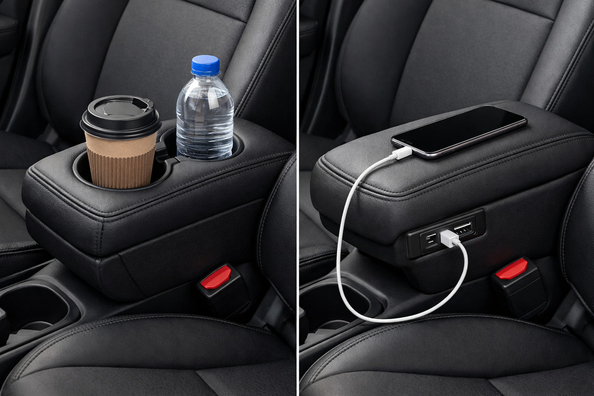
For everyday driving, an armrest with USB tends to win more often: your phone charges, the cable doesn’t lie across the console, and navigation works without constantly hunting for a wire. An armrest with a cup holder makes more sense when your top priority is having water or coffee within reach, and charging in the car is already handled separately.
The problem is that both options are often sold as universal, and that doesn’t guarantee a comfortable fit in your exact interior. So you should look not at the function name, but at the installation, mounting rigidity, how it behaves over bumps, the real benefit in daily use, and the price difference.
There’s no universally better option here. If you drive every day with your phone on charge, use navigation, give rides to passengers with gadgets, or simply don’t want to see a cable on the console, the USB version is the one that makes sense. If, on the other hand, the factory cup holders in your car are poorly placed or you’re used to taking a drink on the road, then the cup-holder version will be more useful.
The key difference is also in the risks. A cup holder adds convenience, but over bumps, in corners, and under hard braking, a drink can spill—especially a hot one. The USB version is safer in that sense, but it requires power, tidy cable routing, and checking that the housing won’t interfere with the handbrake or gear shifting.
| Option | Strengths | Weaknesses | Who it’s for |
|---|---|---|---|
| Armrest with cup holder | Drink within reach, simple use logic, usually a lower price | Spill risk, possible interference with the handbrake or gearbox, not all cups are held securely | For those who often carry coffee or water and already have decent charging in the cabin |
| Armrest with USB | Convenient charging, fewer visible wires, useful in the city and on trips | Requires power, charging speed depends on the specific version, installation is more demanding | For those who constantly use a phone, navigation, or charge multiple devices |
DD Tuning expert comment: The most common mistake is buying a universal armrest based on photos only and not measuring the distance between the seats, the handbrake travel, and the area around the gear lever. The second typical story is expecting fast charging from any USB badge without checking the power source and cable length. If the mount has play from the start, over time it almost always turns into squeaks.
This choice is about everyday convenience, not electronics. If your car’s factory cup holders are awkwardly placed or simply don’t exist, this type of armrest genuinely covers a daily need—especially on short city routes where you often take water or coffee with you.
The weak point is drink stability. On a smooth road everything may be fine, but on joints, potholes, and through corners the benefit quickly turns into a spill risk. It’s also worth checking the diameter: in some universal solutions the reference is around 76 mm, so a large cup or wide travel mug may sit insecurely.
Another point is ergonomics. These models are often longer in the body, so before buying it’s important to understand whether the cup will get in the way of your elbow, the gear lever, or the handbrake. If the car is a manual and the center tunnel is narrow, this is checked first.
This option is strong where your phone is constantly in use: maps, music, hands-free calls, charging a passenger’s gadget. Simpler models may have 2 ports and a built-in cable of about 1 m; larger ones can have up to 7 ports, but the housing is bulkier as well.
The main advantage is a cleaner console. The wire can be hidden or routed much more neatly than from the cigarette lighter across the cabin. For daily use this only looks like a small thing: when the cable doesn’t snag your hand, a cup, or the selector, the interior becomes more comfortable in real life, not just in photos.
The downsides are practical too. You need power, and “USB” by itself doesn’t guarantee the charging speed you need. The second risk area is installation: if the cable is pulled tight and the armrest is mounted loosely, over time it’s the on-the-move annoyance you’ll feel the most.
For city driving where your phone is constantly running navigation, the USB version is usually more useful. It doesn’t add a new liquid-related risk and fits better with short trips where you need to top up quickly and without fuss.
For someone who takes a drink on the road every day, the cup holder wins only under one condition: there truly isn’t a convenient factory spot for a cup in the cabin. If the factory cup holder is already fine, buying an armrest just for one more often doesn’t make sense—then it’s more practical to use the space for USB and small-item storage.
On long trips, the difference is even more noticeable. When there are several people in the car and each has their own phone, a USB solution looks more logical. But for short solo drives—especially if you already have a charging cable neatly set up—the cup-holder version can be a clearer and cheaper option.
| Scenario | What to choose | Why |
|---|---|---|
| Daily city trips with navigation | Armrest with USB | Your phone charges continuously, and the cable doesn’t lie on the console |
| Short routes with coffee or water | Armrest with cup holder | Drink within reach if the factory spot is inconvenient or missing |
| Long trips with passengers | Armrest with USB | Ports are more useful than another cup holder, especially for gadgets |
| Manual car with a close handbrake | More often USB, but only after test-fitting | Less chance that a cup or protruding holder will interfere with driving |
| Tight budget and a simple need | Armrest with cup holder | Simpler design if charging is already handled separately |
| The cabin already has good factory cup holders | Armrest with USB | It doesn’t duplicate a function—it adds new practical value |
It’s worth paying extra when the armrest will be used every day and you truly load it with function, not just want it “to have one.” If you only need a place for a drink, the basic cup-holder version is often enough. If charging, navigation, and a tidy console are the main priority, it’s more logical to look at the USB option. And if your cabin has a complex tunnel shape or you’re unsure about compatibility, it’s better to review all armrests right away and look for a stiffer or better-matched mount.
A more expensive solution is also justified if there are always multiple gadgets in the car, you often drive highways, or you want to minimize small irritants like a loose cable and plastic rattles. But the extra cost only makes sense after checking dimensions, not instead of it.
From a customer’s experience: A common scenario goes like this: at first a person looks for a cup holder because they constantly take coffee, but after test-fitting they realize the car already has a decent place for a cup, while the phone is always hanging on a wire by the selector. In the end they choose the USB version and are happy not with the “feature in the photo,” but with the fact that the cabin became more convenient every day. It happens the other way around too: if charging is already routed neatly and there are no factory cup holders, the simpler cup-holder option covers the need without overpaying.
For everyday driving, the armrest with USB is more often the more practical choice: it better solves the phone, navigation, and cable clutter story. An armrest with a cup holder is worth buying when having a drink on the road matters more to you than charging, and there truly isn’t a convenient factory spot for a cup in the cabin. In any case, the right choice is determined not by the feature name, but by installation, mounting rigidity, compatibility with your interior, and the absence of interference with the handbrake and gearbox. This material is based on real selection experience, practice, and real use scenarios.
| ✔ | The armrest with cup holder is useful for daily driving, when the phone is constantly on charge and navigation is in use. The cable can be routed more neatly, so it does not lie across the console or get in the way in the cabin. |
| ✔ | The armrest with cup holder is useful if the car’s factory cup holders are inconveniently placed or missing altogether. In that case, the drink can really be kept close at hand during short city trips. |
| ✔ | The USB version does not add the risk of spilling liquid over potholes, in corners, or during hard braking. It is more practical if there is often movement in the cabin or if you carry passengers with gadgets. |
| ✔ | The armrest with cup holder is usually simpler in design and often cheaper. If charging in the car is already solved separately, this may be the least complicated way to add one more useful function. |
| ✔ | For a cabin that already has proper factory cup holders, the USB version provides new value instead of duplicating an existing function. It is better suited when charging and keeping the console tidy are the main priorities. |
| ✘ | The armrest with cup holder is not very reliable on rough roads: the drink can wobble and spill. This is especially true for hot drinks and large thermal mugs. |
| ✘ | The universal cup holder does not always fit your cup by diameter. Large thermal mugs may sit insecurely or simply not be held firmly. |
| ✘ | The USB version requires power and does not guarantee fast charging on its own. Its installation is also more demanding, and the housing can sometimes interfere with the handbrake or gear shifting. |
| ✘ | Both options can turn out inconvenient if you do not check the cabin dimensions before buying. With a poor fit, the armrest starts to wobble, creak, and become annoying during everyday driving. |
Shipping to EU
Wholesale and retail
Own warehouse
Опис продукту
Подарунки не надаються при оформленні покупки у кредит під 0,01% або при покупці частинами.