19.07.2026
364
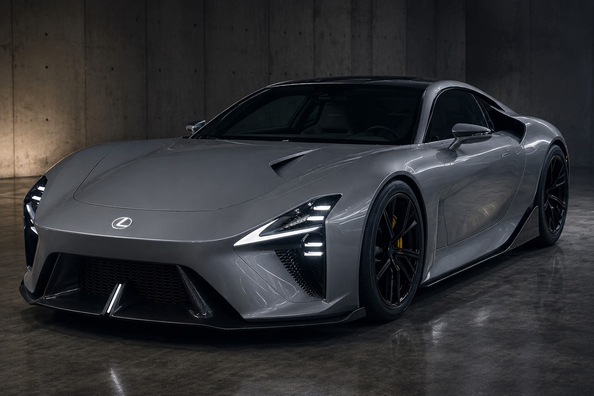

The Lexus LFA Concept today is a concept with a running prototype, not a confirmed production model. The same project was first shown to the public as the Lexus Sport Concept in August 2025; in December 2025 it received the LFA Concept name; and in July 2026 it made its first public run during a hillclimb. For the brand, this is a very important signal: the successor to the LFA idea exists not only as a static display mock-up.
The intrigue is that officially very little has been disclosed: it’s a two-seat electric sports coupe with specific dimensions, but without stated output, battery, weight, range, or a sales timeline. In other words, the emotional image is already there, but the technical spec sheet isn’t. If you need a reminder of why the LFA name draws so much interest, take a look at Lexus LFA 2010–2013, but the new concept should not be technically equated with that car.
Officially confirmed: the Lexus LFA Concept is an electric two-seat concept car that already exists as a running prototype. Its first public showing happened under the Lexus Sport Concept name; later the model was presented as the LFA Concept; and its drive at a speed festival proved the project has moved beyond a designer’s sketch.
By status, this is not a pre-production car in the classic sense. With no official confirmation of production, target markets, or specifications, it’s more accurate to call it a concept with a dynamic prototype.
| Stage | What has already happened | What it means |
|---|---|---|
| August 2025 | First public showing as the Lexus Sport Concept | The form and intent of the future sports car were already set |
| December 2025 | World premiere as the Lexus LFA Concept | The name and the electric concept were officially закреплено |
| July 2026 | First public run in motion | This is no longer a static show car, but a functioning prototype |
Officially confirmed that the car is based on an evolution of an existing architecture with a lightweight high-strength aluminum frame structure, and that the technical ideas are linked to the GR GT and GR GT3 projects. For an electric sports car, this is a logical path: a stiff foundation, a low center of gravity, and the ability to fine-tune weight distribution very precisely.
In the author’s view, the structure will be this model’s main trump card. If Lexus really brings the car to production, the deciding factors won’t be pretty silhouettes, but battery cooling, body rigidity, and the ability to withstand repeated loads without performance drop-off.
Officially confirmed only one thing: it’s a battery-electric vehicle. The manufacturer has not yet stated the number of electric motors, the type of drivetrain, battery capacity, power output, or charging speed.
Expected that the production version, if it happens, will get at least a very powerful dual-motor all-wheel-drive setup, because that format is currently the most realistic way to deliver both traction and stability for a heavy electric sports car. Rumors suggest Lexus could use a solid-state battery and electronic solutions such as steer-by-wire, but this has not been confirmed by the manufacturer.
DD Tuning expert comment: The most common mistake after the premiere of such concepts is to treat the show wheels, the body’s ride height, and even the track width as finalized production parameters. In practice, between the first run and the final car, the brakes, wheel offsets, ground clearance, and even arch geometry change. If you’re using the concept’s style as inspiration for your own car, you should choose not by photos, but by real dimensions and load rating.
On the outside, the LFA Concept is done in very correct proportions for this class: a long front end, a cabin pushed rearward, a very low roofline, and a wide, planted stance. It looks not like a city EV with big wheels, but like a full-fledged sports coupe where aerodynamics and visual mass serve one idea.
Inside, Lexus has officially shown a minimalist two-seat cockpit focused on the driver. This is an important point: Lexus clearly isn’t trying to make a “technology showcase” just for screens, but emphasizes handling and a sense of cohesion. I assume that in production some of the flashy solutions will be simplified, but the overall driver-focused architecture should remain.
In terms of hard numbers, the officially known dimensions are 4690 × 2040 × 1195 mm, wheelbase 2725 mm, and a two-seat cabin. That already hints at the car’s class: it’s wide, very low, and clearly designed not for versatility, but for speed and a “around the driver” seating position.
| What’s known | What’s expected | What’s unknown |
|---|---|---|
| Two-seat electric sports coupe | Low-volume production version | Whether there will be a production run at all |
| High-strength aluminum construction | Very high body rigidity and a low center of gravity | Curb weight |
| Dimensions 4690 × 2040 × 1195 mm, wheelbase 2725 mm | Wide track and large brakes | Production wheel and tire sizes |
| First public run has already taken place | Proven track endurance | Power, torque, acceleration, top speed |
| Only the electric layout is officially confirmed | Dual-motor all-wheel drive | Battery, range, charging, cell chemistry |
If the LFA Concept reaches the assembly line, it will have to be judged not against ordinary premium coupes, but against already-produced electric hypercars and very expensive grand tourers. The question isn’t only power, but whether Lexus can deliver its own character rather than just another very fast EV.
| Model | Format | Where Lexus could differ |
|---|---|---|
| Rimac Nevera | Extreme electric hypercar with a focus on numbers | Lexus will likely bet more on steering feel and a cohesive driver-focused character |
| Lotus Evija | Visually very light, yet radical electric hypercar | Lexus may end up closer to a fast road coupe than an almost track-only exhibit |
| Pininfarina Battista | Electric hyper-GT for a very narrow circle of buyers | Lexus could win not only on performance, but also on real-world usability |
Officially not announced are either the sales start date or the list of markets. According to preliminary information, a real appearance of a production version is possible no earlier than 2027, and perhaps later if Lexus waits for the required battery technology to be ready.
Rumors put the price range starting somewhere around $300,000 and potentially approaching $500,000. In my view, if the car really is low-volume and technically complex, the upper half of that corridor looks closer to reality. The most likely markets are Japan, the U.S., and some wealthy export markets where there is demand for expensive image-driven sports cars.
That’s why it’s important not to “fill in” the specs by inertia right now. The LFA name creates big expectations, but the manufacturer is still revealing the technical side in very measured doses.
From a customer’s experience: after the first on-the-move videos appeared, someone looked for wheels in the LFA Concept style for their current Lexus coupe and initially wanted to replicate the concept’s look one-to-one. In the end, the choice was made not by the picture, but by the real hub parameters, offset, and load rating, so the set fit without spacers and without risking the brakes. This is a typical example where the image of a future model inspires, but the practical decision still rests on precise data.
In the author’s view, the new LFA, if it reaches production, won’t be an attempt to replicate the old icon one-to-one, but an expensive low-volume electric sports car with a strong focus on handling, driver position, and thermal endurance. For now, what we have is a concept with a running prototype: the form, status, and direction are already clear, while Lexus has not yet revealed the key technical answers.
The main thing is not to confuse facts with expectations: officially confirmed are the electric architecture, dimensions, two-seat format, and the very fact of a moving prototype; everything else is either expected or exists only at the level of rumors. This piece is based on real selection experience, practical know-how, and real usage scenarios, where the difference between a beautiful concept and a finished production car is always decided in the details.
| ✔ | The concept has already been shown in motion, so this is not just a static mockup, but a working prototype. This gives a better sense that the project is truly developing rather than existing only as sketches. |
| ✔ | The two-seat layout and sporty proportions with a low stance and wide body have been officially confirmed. For a driver-focused car, this promises an emphasis on handling and the proper seating position behind the wheel. |
| ✔ | The foundation is said to be a lightweight, high-strength aluminum structure. For an electric sports car, this is a solid basis for body rigidity and more precise chassis behavior under load. |
| ✔ | Lexus has already shown that it is not chasing an overly screen-heavy cabin, but instead is making a minimalist cockpit with a focus on the driver. This can simplify interaction behind the wheel and preserve the sporty character. |
| ✔ | The officially confirmed dimensions give a clear idea of the car’s class even before production. This makes it possible to assess that the model is aimed at speed and sports coupe proportions, rather than versatility. |
| ✘ | There are still no key technical figures: power, battery, weight, range, or charging speed. Because of this, it is difficult to assess how competitive the concept will be in production. |
| ✘ | The production-model status has not been confirmed, and even the sales launch date has not been announced. There is a risk that the project will remain at the prototype stage for a long time. |
| ✘ | Without figures, it is impossible to understand the real track endurance and behavior under load. For an electric sports car, this is critical, because this is often where weak points are revealed. |
| ✘ | If the production version does arrive, it will likely be very expensive and produced in small numbers. This will immediately narrow the buyer pool to a very narrow segment. |
Shipping to EU
Wholesale and retail
Own warehouse
Опис продукту
Подарунки не надаються при оформленні покупки у кредит під 0,01% або при покупці частинами.