
































































 Author: Radomskyi Maksym Vasyliovych
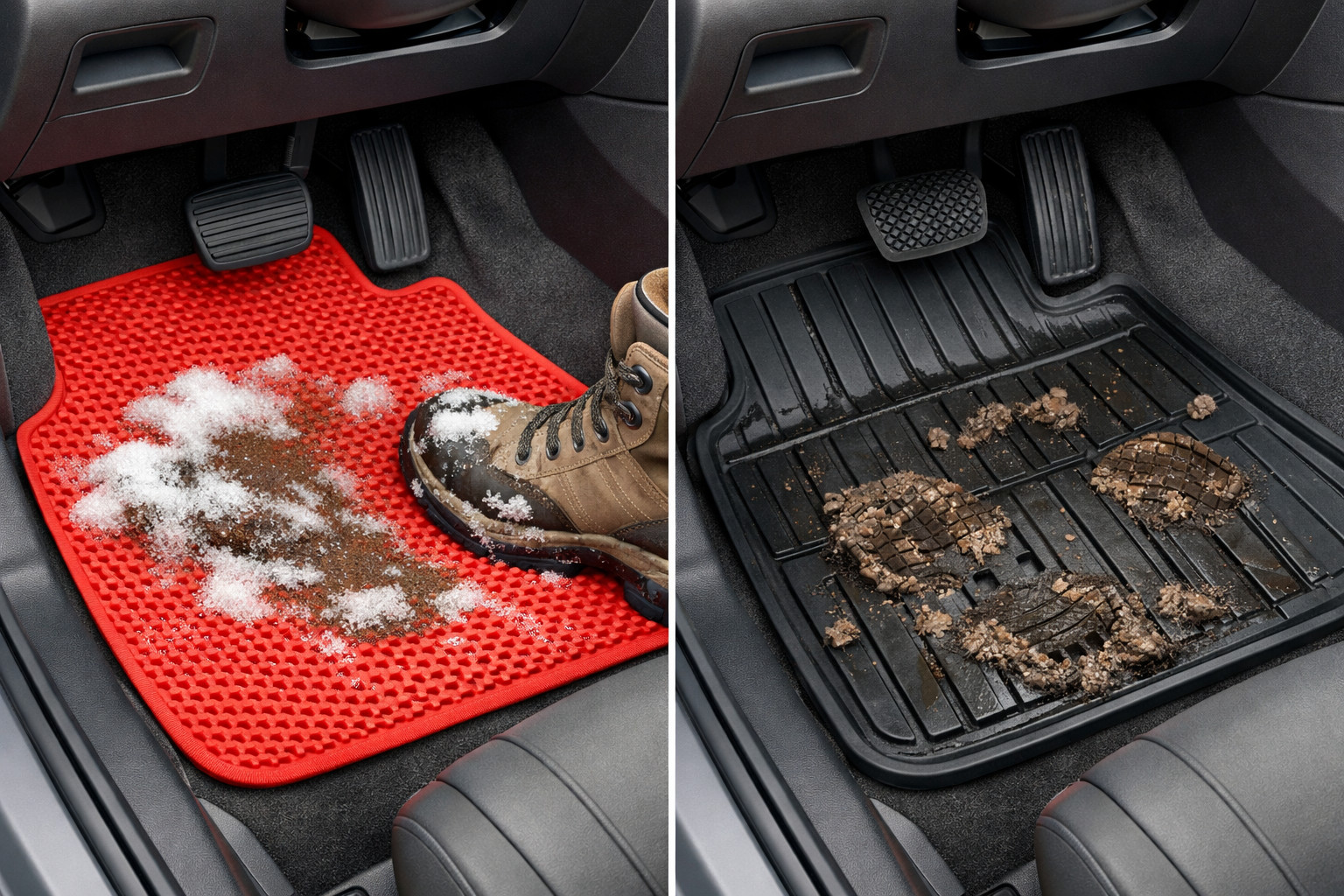
The “EVA or rubber” question is usually reduced to personal taste, but in winter what matters isn’t looks—it’s how the mat behaves with water, snow, sand, and around the pedals. In short: for city driving, wet snow, and quick everyday cleaning, EVA mats are more often more convenient; for very wet mud and large amounts of meltwater, high-quality rubber mats with tall sidewalls work better.
The main mistake when choosing is looking only at the material and not at the shape, sidewalls, and fixation. The wrong size, sliding under your feet, or one mat overlapping another is more dangerous than any debate about the “best” material.
Why this problem occurs
In winter, it’s not just water that gets into the cabin, but a mix of snow, salt, sand, and fine abrasive grit. One type of mat holds dirt better in its cells, while another collects a large amount of liquid into a solid “bath.” That’s why in some conditions the cabin stays drier with EVA, and in others rubber with a high edge performs better.
The second reason for the confusion is that under the word “rubber” very different compounds are sold, and under the word “EVA” you’ll find mats with different stiffness, thickness, cell depth, and template quality. So you should compare not the material name, but your specific driving scenario and the specific mat shape.
Main causes
- Different type of contamination. Fine wet snow and sand are easier to contain in EVA cells, while liquid mud and meltwater in large volumes are easier to hold back with a deep rubber tray.
- Low sidewalls or weak geometry. Even a good material loses if water escapes over the edge near the door sill or under the left footrest area.
- Incorrect size. Universal or inaccurately trimmed mats slip more often, leave areas exposed, or sit too close to the pedals.
- Lack of proper fixation. If the driver’s mat isn’t secured to the factory clips or hooks, it can fold up and interfere with driving.
- Inappropriate care. Dirt that dries in the cells makes EVA harder to wash, and “shine” products on rubber often make the surface more slippery.
How to understand what’s causing the issue in your case
- Look at what exactly accumulates under your feet: sand and slushy snow, or already clear water in a puddle.
- Check where the cabin gets dirty first: in the center of the mat, along the edges, near the left footrest area, or in the heel pad zone.
- Inspect the sidewalls and outline: if there are water marks under the mat, the problem is more often the shape than the material.
- Make sure the driver’s mat is secured and does not enter the pedal area. After installation, press the pedals through their full travel and check that nothing catches.
- Recall your routine: city and short trips or rural roads, highway, construction site, frequent mud. This affects the choice more than any material advertising.
DD Tuning expert comment: most often customers make a mistake not with the material, but with the configuration. They buy a universal mat, ignore the mounts, or place a new mat on top of an old one. For winter, three things matter: an accurate template, a proper edge in problem areas, and checking that the driver’s mat doesn’t shift when getting in.
Symptoms, causes, and what to do (table)
| Symptom | Likely cause | What to do |
|---|---|---|
| Wet underfoot, but the mat looks clean on top | Water is getting under the edge due to weak shape or a low sidewall | Check the outline, especially near the door sill and the left footrest area; switch to a vehicle-specific mat with better geometry |
| Dirt smears across the entire cabin area | The surface doesn’t localize sand and wet snow | For city use, switch to EVA with proper cells, or shake out the rubber mat more often |
| A puddle is standing in the mat | Large volume of meltwater, low capacity reserve | For harsh winter and mud, choose rubber with tall sidewalls and a solid tray |
| The edge curls up or the mat slides forward | Inaccurate size or lack of fixation | Do not use such a mat in the driver’s position; replace it with a vehicle-specific one with mounting points |
| Slippery surface | Poor material choice or treatment with a shine product | Thoroughly wash the mat without “gloss,” assess traction in your footwear; replace if needed |
| After washing, the mat is inconvenient to clean | Dirt has dried in the cells or relief pattern | Don’t let it build up—wash earlier; if you don’t have time for care, it’s easier to live with a rubber tray |
What actually helps
- Choose the mat for your scenario. City, short trips, salt and wet snow—more often in favor of EVA. Mud, frequent trips out of town, lots of meltwater—more often in favor of rubber.
- Go for vehicle-specific fit, not universal. In winter, the difference in templates is noticeable immediately.
- Pay attention to sidewalls and problem areas. The edge by the door, the heel pad zone, and the left footrest area are especially important.
- Remove and dry regularly. Even the best mat won’t help if you put it back into the cabin wet and dirty.
In practice, what works best isn’t “one material for every case,” but the right combination of shape, fixation, and usage pattern. That’s why a good EVA often wins in the city, while good rubber wins in harsh winter conditions.
What almost doesn’t work or only helps briefly
- Buying the cheapest universal “winter” set without checking the fit.
- Randomly trimming the mat if it ends up reaching the pedals or losing the edge in a critical zone.
- Placing a new mat on top of an old one.
- Treating the rubber surface with shine products to make it “look better.”
- Trying to solve a water issue when the real cause is lack of fixation or incorrect geometry.
When a mat is slippery, slides under your feet, or lets water past the edge, cosmetic measures won’t save it. Either you need a different type, or you need a different shape.
When accessories or replacing elements makes sense
Replacement makes sense when you already understand your scenario. If the main issue is daily slush, sand, and quick cleanup, it’s logical to look at EVA mats. If you often have a lot of water, heavy snow, and dirty shoes after trips out of town, it’s more rational to choose rubber mats.
A separate case is when everything seems fine, but water escapes over the edge in a tricky area. Then it’s worth paying attention to 3D EVA with sidewalls, where the issue is solved not by a different material, but by different geometry.
Solutions: when they work and when it’s not worth spending money (table)
| Solution | When it works | When it’s not worth spending money |
|---|---|---|
| EVA mats | Daily city driving, wet snow, sand, need to quickly shake out and rinse | If your routine constantly involves lots of liquid mud and water, and the model has weak sidewalls |
| Rubber mats with tall sidewalls | Very wet winter, rural areas, construction sites, large volumes of meltwater | If the heavy weight, smell, or the need to regularly pour out water is annoying |
| Switching from universal to vehicle-specific | When the mat slides, curls up, leaves areas exposed | There’s no point saving money if the problem has already shown up near the pedals |
| Version with better sidewalls | When the main leak goes along the edge rather than through the center of the mat | Won’t help if the cause is lack of fixation or the wrong size |
| Washing, drying, checking mounts | As regular prevention for any type of mat | Won’t solve design problems of cheap or inaccurately made mats |
From a customer’s experience: a driver was looking for something “so it doesn’t float underfoot in winter” for daily city driving. After an unsuccessful universal set, he chose vehicle-specific EVA and was satisfied specifically because of quick cleaning from wet snow and sand. In another case, for a car that constantly drives through muddy yards and on the highway, rubber mats with a tall edge worked better, because the main problem there wasn’t snow crumbs but water and mud.
Conclusion
For winter, dirt, and daily driving, there’s no universal winner. EVA is more often more convenient where you need to contain wet snow and sand, avoid smearing dirt around the cabin, and quickly get everything back in order. Rubber more often wins where you need maximum capacity for water and dirt.
The final choice should be made by three criteria: your driving scenario, fit accuracy, and the presence of proper fixation. That’s what—rather than the material name—determines the result and safety. This material is based on real selection experience, practice, and real usage scenarios, not abstract promises.
Pros and cons
EVA mats are convenient for the city, wet snow, and sand: they trap fine dirt better in the cells and are easier to shake out or rinse quickly. This is useful for daily short trips, when quick cabin cleaning matters.
Rubber mats with high edges hold a larger amount of meltwater, slushy mud, and dirt better after trips outside the city. In harsh winter conditions, they work like a deeper tray and overflow less.
Model-specific mats with a precise pattern and proper fixing are safer than universal ones because they shift less and do not move into the pedal area. This is especially important for the driver’s side.
For the problem of water running along the edge, a mat with better geometry and higher edges in critical areas may be more useful than switching materials. In other words, the solution can be matched to the specific leak location.
Universal or inaccurately trimmed mats often shift, leave exposed areas, and can ride up toward the pedals. The article directly calls this more dangerous than the difference between EVA and rubber.
EVA mats are less suitable for situations with a lot of liquid slush and water if the edges are weak. In this mode, they may not be able to hold back the volume of meltwater in time.
Rubber mats can be less convenient if their weight, smell, or the need to pour out water often is annoying. Also, treating them with shine products can make the surface more slippery.
If dirt has dried in the cells or texture, EVA becomes inconvenient to clean. Without regular washing and drying, even a good mat loses practicality.