10.07.2026
505
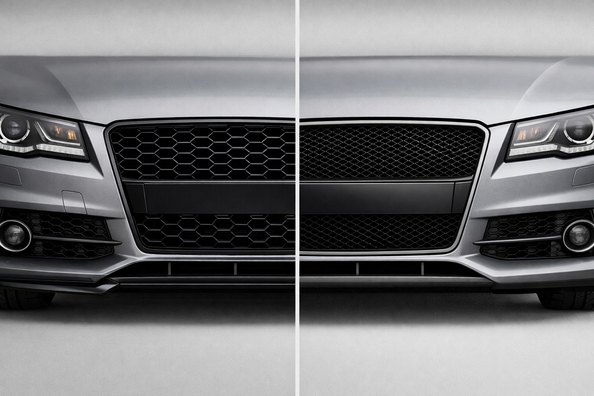

If you need not just a different “face” for the car but reliable daily use without surprises, the practical choice is usually the factory grille with a quality mesh or a precise vehicle-specific solution. This option more often keeps the correct geometry, doesn’t conflict with mounts, cameras, or radars, and less often requires rework after purchase.
A tuning grille makes sense when appearance matters more to you than easy installation, or when the factory part is damaged and you’re replacing the assembly anyway. But what matters here isn’t the catalog picture—it’s three things: how it fits the car, whether it creates noise at speed, and whether it blocks airflow where the car needs proper cooling.
Basically, you’re choosing between two approaches. The first: keep the factory grille and add a mesh to protect the radiator from stones, insects, and debris. The second: fully replace the front grille with a tuning one—often with a different pattern, different mounting points, and sometimes a different fit relative to the bumper and sensors.
Practicality here is measured not by looks but by the number of compromises. A factory grille with mesh usually maintains OEM compatibility better. A tuning grille looks more expressive, but more often brings trimming, camera relocation, sensor checks, and the risk of small issues that show up only after installation.
Electronics deserve separate attention. If there’s a camera, radar, sensor-equipped emblem, or active shutters in or near the grille, any non-standard obstruction must be assessed much more carefully. And one more important point: a winter grille cover is not a full replacement for a regular protective mesh, because it’s appropriate only in severe cold—not year-round.
| Option | Strengths | Weaknesses | Who it’s for |
|---|---|---|---|
| Factory grille with quality mesh | Easier compatibility, less risk with cameras and sensors, usually quieter, cheaper to implement | You need to choose the right mesh density and installation location; cheap mesh can sag or tear | For a daily driver—city, highway, long trips without extra modifications |
| Tuning grille | Changes the look more noticeably, can be a good solution when replacing a damaged factory part, sometimes comes with a finished design without a separate mesh | More often requires fitting, may make noise or sit with gaps, more difficult for cars with a camera, radar, and shutters | For those who consciously put appearance above easy installation, or who want a high-quality vehicle-specific replacement |
DD Tuning expert comment: the most common mistake is buying a grille by photo, not by the mounting design and the car’s equipment. The second typical miss is installing a very fine mesh as close as possible to the radiator, then being surprised by higher temperatures in the heat or noise on the highway. If the car has a camera or radar, you should check not only the fit but also system operation after installation.
This is the most rational option when the factory grille is intact and your goal is to add protection without changing the front-end concept. You keep the OEM mounts, the native air intake geometry, and much less often run into conflicts with the camera, radar, or decorative elements already engineered by the manufacturer.
The weak point of this approach is DIY execution. If the mesh is too fine, mounted too close to the radiator, or fastened poorly, you can end up with reduced airflow, rattles, and short service life. Adhesive or no-drill fasteners are also sensitive to installation temperature: on cold plastic they gain strength worse, so rushing here hurts.
A tuning grille wins where you need a different front-end look, not just protection. If it’s a quality kit made for a specific model, it can fit neatly and not create problems. This is especially logical when the factory grille is already cracked, scratched, or has broken mounting points.
But this is also where hidden costs most often appear. In practice, such grilles often require test fitting, trimming, relocating the camera, emblem brackets, or separate mesh fixation. If the fit is inaccurate, you get gaps, misalignment, whistling at speed, and extra vibrations. For cars with adaptive cruise, a front camera, or active shutters, this is no longer cosmetic—it’s a higher-risk area.
For city driving, everyday trips, and normal highway use, the factory grille with properly selected mesh almost always wins. It provides the necessary minimum protection and doesn’t turn a simple task into a fitting project.
For bad roads, gravel, and long routes, what matters isn’t tuning as such, but strong protection in front of the radiator. Here again the factory setup with good mesh or an OEM vehicle-specific grille more often wins, because the priority is durability and ease of maintenance.
A tuning grille becomes the better choice in two cases: when you’re deliberately building the car’s visual image, or when you find a high-quality vehicle-specific replacement that truly follows the OEM mounting logic. If the car is used in heat, with a trailer, under high load, or has a lot of electronics up front, the conservative option is safer.
| Scenario | Best choice | Why |
|---|---|---|
| Daily city car | Factory grille with mesh | Less hassle with installation, enough protection from debris and insects, easier to keep quiet operation |
| Highway, gravel, frequent long trips | Factory grille with durable mesh | The key here is radiator protection and service life, not a design change |
| Car with camera, radar, active systems | Factory or precise vehicle-specific solution | Lower risk of errors around sensors and mounts |
| Heat, towing, high loads | The most open and proven option possible | Too dense a blockage can harm cooling, so temperature control matters more than looks |
| Exterior refresh, project car | High-quality tuning grille | More complex installation is justified if the visual result truly matters |
A more expensive option is justified when you have a complex front end: a camera, radar, shutters, an expensive bumper, or you don’t want to modify the part after purchase. In that case it’s better to look at either ready-made radiator grilles, or first understand whether a simple protective setup is enough via the material about aluminum radiator mesh. If the budget is moderate and you want to keep the OEM base, it’s also useful to compare this with DIY grille modification.
Paying extra also makes sense when you need not just protection, but a clean result without DIY traces. With cheap universal solutions, the savings most often get burned on fitting, new fasteners, and re-installation. With an expensive but precise kit, you’re paying not so much for decor as for predictability.
From a customer’s experience: the owner of a crossover initially wanted an aggressive tuning grille because it looked convincing in photos. After checking against the equipment, it turned out there were a camera and sensors up front, so he kept the factory grille and installed a quality mesh. As a result, he got radiator protection without fitting, without extra noise, and without electronics errors.
If you judge by practicality rather than visual impact, in most cases the factory grille with quality mesh—or a precise vehicle-specific solution for a particular car—wins. A tuning grille is justified when appearance is truly your priority, or when you’re replacing a damaged factory part and you’re ready for fitting, sensor checks, and temperature monitoring after installation.
This conclusion is based on real selection experience, installation practice, and real-world usage scenarios: for a daily driver, compatibility, quiet operation, and predictable service life matter more than a loud design. So the basic recommendation is simple: want less risk—keep the factory logic and add protection wisely; want to change the car’s face—choose a tuning grille only when you understand the cost of that change not only in money, but also in modifications.
| ✔ | A factory grille with a high-quality mesh usually fits the car more easily: the original mounts and geometry are retained, and there is less risk of conflicts with the camera or radar. This is especially convenient for everyday use, when you do not want to modify anything after purchase. |
| ✔ | Such an option is usually cheaper in the end, because it does not require complex fitting, sensor relocation, or removing the bumper again. In real use, this means fewer hidden costs. |
| ✔ | A properly chosen mesh provides normal protection for the radiator from stones, insects, and debris without replacing the grille entirely. For city driving, highways, and long trips, this is a practical solution without unnecessary changes to the front of the car. |
| ✔ | A tuning grille may be appropriate if the factory part is already damaged or if you really need a different front-end look. In that case, it solves not only the aesthetic issue but also replaces a worn element. |
| ✔ | A quality model-specific tuning grille can fit neatly and without rough modifications if it is made specifically for a particular car. This reduces the risk of gaps, misalignment, and strange noises after installation. |
| ✘ | A tuning grille more often requires fitting: trimming, drilling, relocating the camera, or separate mesh mounting may be needed. Because of this, installation becomes more complicated and takes longer. |
| ✘ | If the fit is inaccurate, gaps, misalignment, whistling at speed, or vibrations may appear. Such problems are not always visible right away, but they show up after installation. |
| ✘ | For cars with a camera, radar, active shutters, or other electronics at the front, a tuning grille carries a greater risk. Any non-standard obstruction or change in fit may affect how the systems work. |
| ✘ | A mesh that is too dense or installed incorrectly can worsen airflow and cooling, especially in hot weather, under load, or in traffic jams. In other words, radiator protection here can easily turn into a temperature problem. |
Shipping to EU
Wholesale and retail
Own warehouse
Опис продукту
Подарунки не надаються при оформленні покупки у кредит під 0,01% або при покупці частинами.