 Author: Radomskyi Maksym Vasyliovych
If the car is used every day and the main concern is easy entry and cleaner trousers, then in most cases wide flat side steps work best. If you want even less dirt on your clothes and don’t want to lose ground clearance, the best logic is retractable electric steps: you need them only when getting in, and then they tuck away. Tubular steps are chosen mostly because of the lower price or for lifted vehicles, while heavy-duty rock sliders make sense when off-road protection is the priority rather than city comfort.
The mistake is that steps are often chosen only “by looks.” In reality, everyday convenience and clean clothing are influenced more by step width, distance from the body, how slippery it is in the rain, mounting quality, noise, maintenance needs, and how much dirt gets thrown onto the doors and the step itself.
What the choice is really about
It’s simple: the more stable your footing and the less the element sticks out into constant road grime, the lower the chance of dirtying your pant leg. For the city, a wide platform that supports the whole foot wins. For the cleanest possible scenario, a retractable design wins, because it doesn’t hang under the doors all day.
But there’s no universal option. A wide fixed step is comfortable, but in winter and slush it quickly collects dirt itself. A narrow tube is less of a “shelf” for debris, but you more often end up stepping with the edge of your foot. A heavy-duty step takes hits, but as a city step it usually loses out to regular running boards.
What criteria to compare by
- Step width. Flat steps are usually wider, so your foot is more stable. On tubular steps, the support is often narrower.
- How far it protrudes from the body. If it sticks out farther, it’s easier to step on, but it collects dirt more actively and contacts clothing more often.
- Behavior in rain and snow. For a daily driver, it’s not only the shape that matters but a truly anti-slip surface.
- Installation. Some kits install without drilling; simple systems can take from a few dozen minutes to about an hour and a half. Electric steps are more complex because of wiring and setup.
- Noise and vibrations. Poor mounting, especially on tubular solutions, can sometimes create extra rattles.
- Service life and care. The fewer moving parts, the easier life is. Electric steps require the mechanism to be kept clean and need periodic servicing.
- Price. Tubular steps are usually cheaper, wide flat ones are mid-range, retractable and heavy-duty options are more expensive.
Quick comparison of options (table)
| Option | Strengths | Weaknesses | Who it’s for |
|---|---|---|---|
| Wide flat side steps | Stable footing, convenient for families, simpler than electric, comfortable day to day | Get dirty faster in slush, can reduce ground clearance | City crossovers, SUVs, vehicles with frequent entry for kids and older passengers |
| Tubular side steps | Usually cheaper, more compact, often suitable for lifted vehicles | Narrower support, can be more slippery when wet, mounting quality matters more | Those who want a budget option or don’t like bulky steps |
| Retractable electric steps | Cleanest scenario for clothing, don’t hang down permanently, interfere less with ground clearance | High price, more complex installation, sensitive to dirt in the mechanism | For daily comfort on a tall vehicle when budget isn’t the main criterion |
| Heavy-duty rock sliders | Protect the body and rocker on harsh off-road terrain, strong construction | Less convenient as a step, heavier, more expensive, unnecessary for typical city driving | Those who regularly drive over rocks, ruts, and actually use the vehicle off pavement |
If you set aside the extreme scenarios, for everyday use the choice most often comes down to a wide flat option versus a retractable electric one.
DD Tuning expert comment: Most often people look at the tube shape or the pad design, but don’t check whether the whole foot will fit and whether it will be slippery in wet weather. The second common mistake is not confirming the mounting for a specific body, wheelbase, or cab type. For a city vehicle, a slightly wider, more stable step is more practical than a narrow “pretty” option you end up stepping on with the edge of your foot.
Detailed breakdown of each option
Wide flat side steps
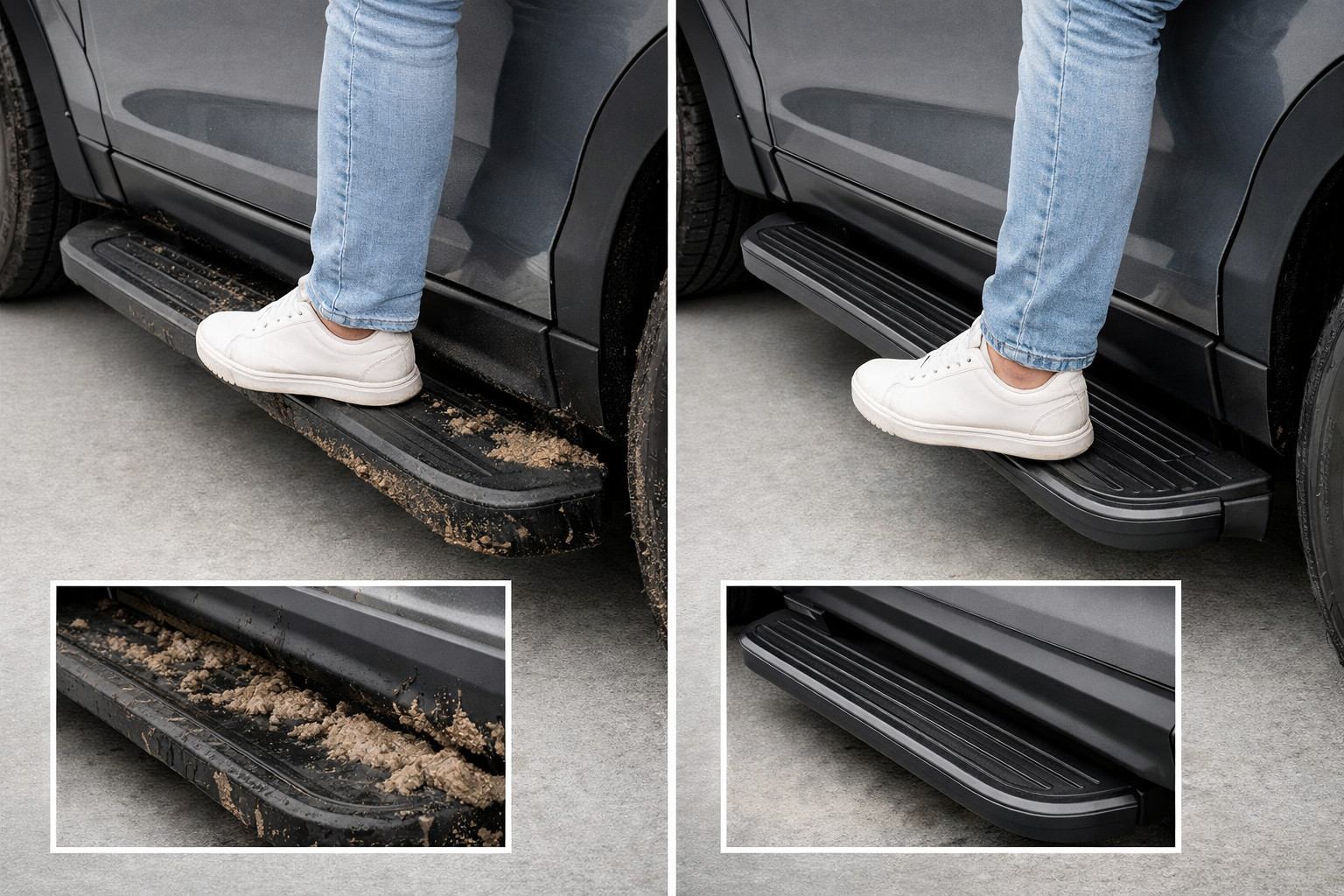
This is the most straightforward format for a daily driver. A typical width of 102–178 mm provides a proper platform for your foot, making entry and exit noticeably easier than with a tube. That’s why these steps are usually more convenient for kids, older passengers, and vehicles that people get into many times a day.
The downside is practical too: a wide shelf collects water, snow, and mud. In other words, they make you rub against the body less often, but they get dirty faster themselves. If the car drives through slush and dirt roads, you’ll need to wash them more often.
Tubular side steps
This is a compromise on price and looks. The diameter on these solutions can be relatively small, so the foot support is more modest and the sense of stability is worse than with a flat platform. On lifted vehicles they’re still useful because they reduce step-up height, but in rain and snow a narrow tube loses to a wide step.
Another nuance is installation. It’s specifically with tubular solutions that mistakes in mounting or insulation sometimes create noise and vibration. So the problem isn’t the shape itself, but how the kit sits on the specific vehicle.
Retractable electric steps
This is the best option if the goal is minimal dirt on clothing without sacrificing convenience. The step appears when the door opens and then retracts, so it isn’t hanging all the time in the stream of water and grime. In practice, this is especially noticeable on tall crossovers and SUVs.
But you have to honestly accept the downsides: higher price, more installation time, wiring, sensors, and a mechanism that needs to be kept clean. If the vehicle regularly drives through sticky mud without care, an electric step will need attention more often than a simple fixed kit.
Heavy-duty rock sliders
This isn’t about comfort, it’s about protection. They’re justified when the rocker panel can genuinely land on a rock, a rut, or a stump. As a step they’re usually rougher and less convenient, and in the city they often turn out to be just extra weight and overspending.
For an everyday scenario, rock sliders are worth considering only if you consciously accept less comfort in exchange for strength. If off-roading is occasional, it’s almost always an excessive choice.
Which option is better for different scenarios
For normal city driving, two options are the most logical. If you need a balance of price, convenience, and simplicity—choose wide flat steps. If you want maximum comfort and cleaner clothing—choose retractable electric steps.
Tubular steps are worth getting when the budget is limited or when the vehicle is already lifted and you simply need an extra point of support. Heavy-duty steps make sense only where their strength is used regularly, not “just in case.”
Use case and what to choose (table)
| Scenario | Best choice | Why |
|---|---|---|
| City vehicle, daily trips, family | Wide flat side steps | The most convenient and stable entry without complex mechanics |
| Tall SUV, keeping clothes clean matters | Retractable electric steps | The step appears only during entry and collects less dirt |
| Lifted vehicle, limited budget | Tubular side steps | A cheaper solution that still reduces step-up height |
| Frequent trips onto rocks, ruts, harsh off-road | Heavy-duty rock sliders | The top priority here isn’t comfort, but protection of the rocker panel |
| Rain, winter, slippery footwear | Wide flat side steps with a pronounced anti-slip surface | More contact area means less chance of slipping than on a narrow tube |
If you’re hesitating between two options, don’t ask “which looks better,” but “how often do I actually step on it, and under what conditions does that happen.”
Common mistakes when choosing
- Choosing a narrow step for a tall vehicle for family use. It looks neat in photos; in real life your footing is unstable.
- Ignoring installation. The same type of step can feel fine or be annoying with noise depending on the mounting.
- Confusing city comfort with off-road protection. A rock slider doesn’t become more convenient just because it’s stronger.
- Not accounting for the dirty season. A wide fixed step is comfortable, but it needs washing more often.
- Expecting electric steps to be completely hassle-free. They’re genuinely convenient, but the mechanism needs cleaning, especially after winter and mud.
When a more expensive solution makes sense
Paying extra is justified in two cases. The first is when the vehicle is tall, used daily, and entry comfort truly matters: then a retractable electric step makes a noticeable difference. The second is when the vehicle regularly sees harsh off-road conditions: there, an expensive heavy-duty step saves the body, not just adds looks.
If you want to look at basic city solutions, start with side steps. For a vehicle that truly works off pavement, it’s more logical to look at heavy-duty side steps. And to reduce how much dirt flies onto the doors and lower body, along with steps it often makes sense to add mud flaps right away.
From a customer’s experience: Most often, for a daily vehicle a person comes in for tubular steps because they’re cheaper and seem neater. After clarifying body height, family setup, and the fact that a child is constantly getting in, the choice shifts to a wide flat option or an electric step. The satisfaction later isn’t in “prettier tuning,” but in not having to search with your foot every time for a narrow point of support.
Conclusion
If you need a short answer: for everyday use, wide flat side steps are the most convenient, and for minimal dirt on clothing—retractable electric steps. Tubular steps are worth it as a budget or more compact compromise, and heavy-duty rock sliders only for real off-roading. This conclusion is based not on catalog promises, but on real selection experience, practice, and real use scenarios where what matters isn’t the names of the designs, but how they behave day to day.
How it works
- Determine the main use case First, understand what matters most to you: comfortable everyday entry and exit, cleaner clothes, or off-road protection. For city driving and family trips, the best choice is solutions that provide stable foot support.
- Compare 4 types of side steps in practice Wide flat side steps provide the most convenient step for everyday use. Tube steps are more budget-friendly but less stable; retractable electric side steps keep clothes cleaner the least; heavy-duty rock sliders are needed primarily for tough off-road use.
- Assess width, protrusion, and anti-slip properties Check whether your foot fits fully, not just by the edge. The wider and more stable the surface is, and the better it works in rain and snow, the lower the chance of dirtying your pants or slipping.
- Consider installation and maintenance Simple fixed kits are usually easier to install, while electric side steps require wiring, sensors, and a clean mechanism. If you do not want extra maintenance, choose a design without moving parts.
- Choose an option for your budget and car For a city car, wide flat side steps are most often the best choice. If minimizing dirt on clothes is important and the budget allows it, retractable electric side steps make more sense; tube steps are a budget compromise, and heavy-duty steps are only for real off-road use.
- Check compatibility before buying Do not rely on appearance alone: it is important to verify the mounting for a specific body, wheelbase, or cab type. Poor mounting can cause noise, vibrations, or an inconvenient step even with a side step that looks fine.
Pros and cons
Wide flat running boards are the most convenient for everyday use: it’s easier to place your whole foot on them, and getting in and out feels noticeably more stable than with a narrow tube step.
Retractable electric running boards keep clothes cleaner because they stay tucked away while driving and don’t hang constantly under the doors in dirt and water.
For families, children, and elderly passengers, wide flat running boards are more practical because they offer a larger support area and less chance of placing a foot on the edge.
Tube running boards can be a reasonable compromise if a lower price matters more or if you need a solution for a lifted vehicle.
Heavy-duty rock sliders are useful where the vehicle regularly drives over rocks and ruts: they really protect the body and sill from impacts.
Wide flat running boards quickly collect water, snow, and dirt, so in slush they need to be washed more often.
Retractable electric running boards are more expensive and more difficult to install, and they also require a clean mechanism and periodic maintenance.
Tube running boards have a narrower support surface, so your foot stands less stably, and in rain and snow they can be more slippery.
Heavy-duty rock sliders are less convenient as a step in the city, heavier, and usually unnecessary if off-road driving is rare.