
19.02.2026
581
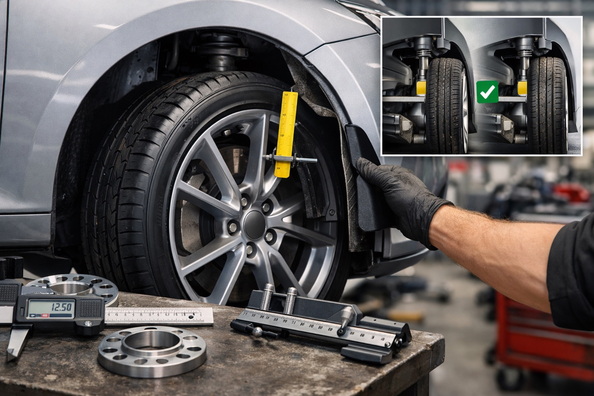
Many car enthusiasts dream of stylish rims and wide wheels but often face a problem: the tires start rubbing against the body. Proper wheel fitment is the key to safe driving without unwanted rubbing. In this article, we’ll look at how to choose the right diameter, width, and offset (ET) of rims, and whether spacers are needed so the wheels look impressive and don’t rub against the arches.
We’ll explain what the main wheel parameters mean (diameter, width, offset ET, spacer) and how their selection affects vehicle handling. You’ll learn how changes in offset or wheel width can impact safety and what to do to prevent tires from touching suspension parts or fenders.
Our company specializes exclusively in forged wheels, and you can buy forged wheels from us.
Rim diameter is the size of the wheel from edge to edge through the center, usually measured in inches (for example, R16 means a 16-inch rim). When choosing a larger rim diameter, lower-profile tires are usually installed to keep the overall wheel diameter close to stock. This is important because a significant increase in overall wheel diameter can reduce clearance in the wheel arch and cause the tire to rub against the liner or body over bumps.
Larger wheels also affect vehicle performance: they may slightly reduce acceleration and fuel efficiency due to higher weight and altered rotational inertia. In addition, excessively large wheels can alter speedometer readings. Automakers usually recommend that the total wheel diameter with the tire differ from the stock size by no more than about 3%. This way, you’ll maintain accurate speedometer readings and avoid clearance issues in the arches.
Rim width (measured in inches, e.g., 6J, 7J) determines how wide a tire can be mounted on it. A wider rim allows for a wider tire, improving grip and appearance. However, excessively wide wheels may not fit within the stock wheel arches. If you increase rim width without changing the offset, the wheel will become wider both inward and outward equally—its edges will be closer to both the suspension and the fender.
It’s important to match the tire width to the rim width. Typically, the tire is slightly wider than the rim so its sidewalls protrude a bit. A tire that’s too wide for a narrow rim will bulge and may rub against the body, while a tire that’s too narrow for a wide rim will stretch (the so-called “stretch”)—a technique some tuners use to fit wheels into arches, but it reduces comfort and handling.
Below is an approximate table of rim and tire width compatibility for passenger cars:
| Rim width (J) | Minimum tire width | Optimal tire width | Maximum tire width |
|---|---|---|---|
| 6.0" | 175 mm | 185-195 mm | 205 mm |
| 7.0" | 195 mm | 205-215 mm | 225 mm |
| 8.0" | 215 mm | 225-235 mm | 245 mm |
| 9.0" | 235 mm | 245-255 mm | 265 mm |
As we can see, as rim width increases, the recommended tire width also increases. Maintaining these proportions is important: if you install a tire much wider than the rim, it may touch the body during suspension travel or steering. Wider wheels (rim + tire) may also require a different offset to avoid sticking out too far.
Rim offset (ET) is the distance between the wheel’s centerline and the mounting surface that contacts the hub, measured in millimeters. This parameter is also known as offset or “backspacing.” Simply put, ET shows how far the rim is “sunk in” or “protrudes” relative to the hub. The larger the ET value (positive offset), the deeper the wheel sits in the arch (closer to the suspension). A smaller or negative ET means the wheel sticks out more (closer to the fender edge). The manufacturer calculates this parameter for each car model; you can find it in the documentation or on the stock rims.
A small deviation in offset is acceptable—usually +/-5 mm from the stock value causes no serious issues. But changing ET by tens of millimeters can have negative effects. If you install rims with a smaller ET, the track width (distance between wheels on an axle) increases, pushing the wheel outward. The car will look wider and more stable, but too small an ET will make the wheel stick out of the arch and risk rubbing the fender. Too large an ET, on the other hand, moves the wheel inward: the track narrows, and the inner side of the wheel may touch the shock absorber, spring, or brake caliper.
Let’s compare how different offsets affect wheel fitment:
| Large offset (ET) | Small offset (ET) |
|---|---|
| Wheel sits deeper in the arch (closer to suspension) | Wheel sticks out (closer to fender) |
| Narrower track | Wider track |
| Increased clearance to fender, reduced inside | Reduced clearance to fender, increased inside |
| Minimal risk of fender rubbing | Possible rubbing on fender edge during suspension travel |
| May rub suspension if rim is too recessed | Minimal risk of suspension contact |
Therefore, balance is key. When changing rim width, you must also consider offset. For example, if the stock rim is 7J ET40 and you replace it with 8J ET30, the new wheel becomes 1 inch (~25 mm) wider. Half of this extra width goes outward (~12 mm), and the 10 mm smaller offset pushes it out even more. As a result, the outer rim edge moves about 22 mm closer to the fender. This may be too much—without body or suspension modifications, the tire will likely rub the arch over large bumps or full load.
Manufacturers allow small offset tolerances, but they’re limited. As mentioned above, a difference of up to ~5 mm is usually safe. Sometimes 10–15 mm is acceptable if confirmed by other owners or tuning shops, but such experiments are at your own risk. Always check actual clearances: between the wheel and shock/suspension on the inside, and between the tire and fender edge on the outside.
Spacers are special plates or rings installed between the rim and the hub. They effectively move the rim outward, reducing the effective offset. Why use them? Spacers are applied when you need to widen the track or when a new rim has too large an ET and touches the suspension. They also help fit certain tuning rims that would otherwise interfere with the brake caliper or other parts.
Within reasonable limits, quality spacers can solve fitment issues. For example, a 5–10 mm spacer can compensate for excessive offset and return the wheel to the correct position. However, spacers also have drawbacks: first, they add another joint between the hub and wheel, which can cause vibration if not perfectly made or installed. Second, very thick spacers (20 mm or more) push the wheel far outward, increasing load on suspension and bearings just like rims with small ET. Always use longer bolts or studs with spacers to ensure proper nut engagement.
Thus, spacers are a last resort. It’s better to choose rims with the correct offset than to fix it with spacers. If you must use them, choose high-quality, precisely machined spacers of the correct diameter (preferably hub-centric) and don’t forget to use bolts of proper length.
Any change in wheel parameters affects not only appearance but also vehicle behavior. Wheels that are too wide or protruding can alter aerodynamics and rolling resistance, as well as increase load on suspension components. Below are the main consequences of incorrect rim and tire selection:
Finally, here are a few tips to help you avoid wheel rubbing issues:
Properly selected wheels will make your car more attractive, but most importantly, they won’t harm the suspension or cause trouble. By paying attention to rim diameter, width, and offset, and installing quality tires, you’ll ensure perfect wheel fitment without any rubbing while maintaining smooth handling and driving safety.
Shipping to EU
Wholesale and retail
Own warehouse
Опис продукту
Подарунки не надаються при оформленні покупки у кредит під 0,01% або при покупці частинами.