
































































 Author: Radomskyi Maksym Vasyliovych
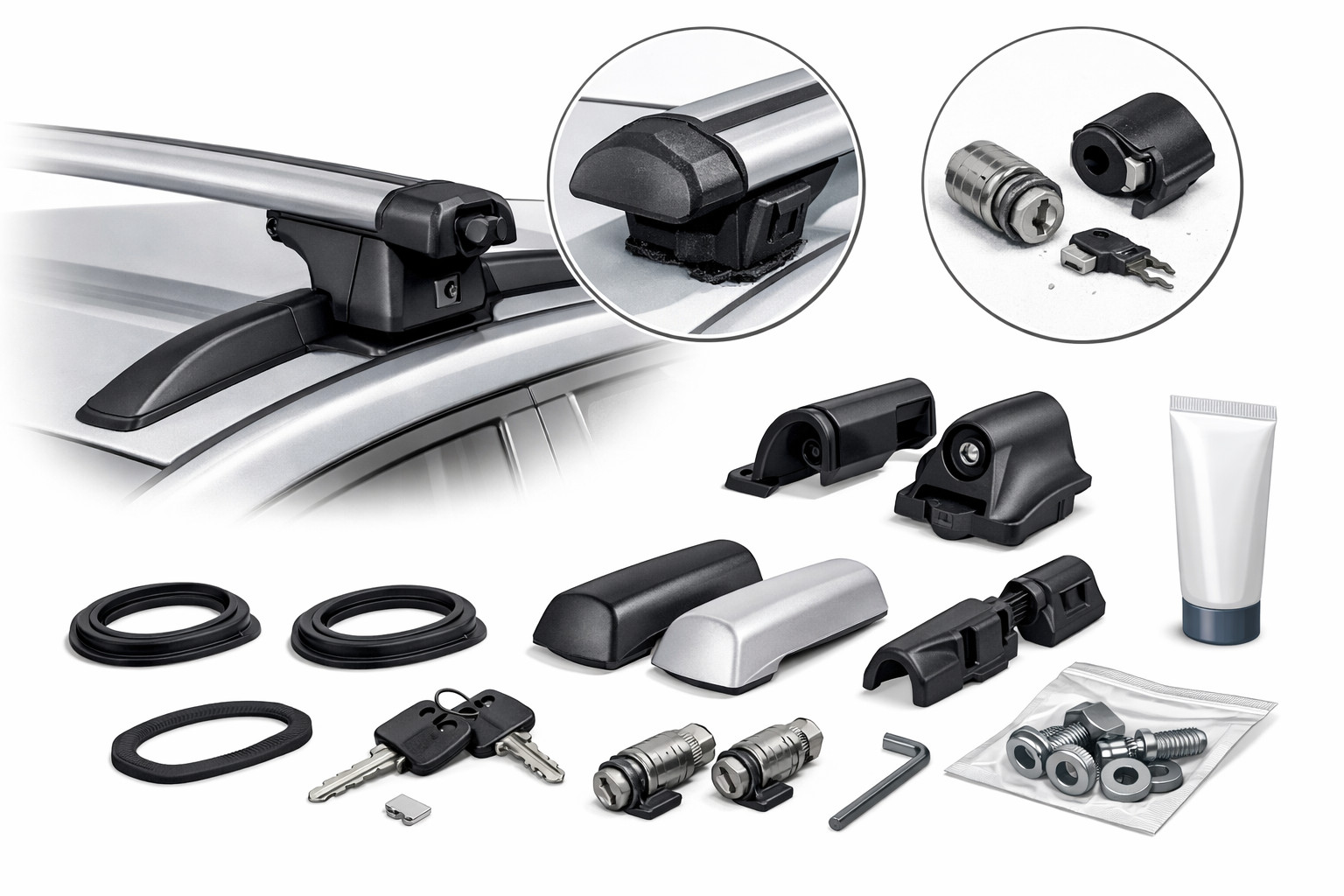
In a roof rail set, it’s usually not the metal bars that wear out first, but the small parts that damp vibration, close channels, and keep a tight fit: rubber profiles, pads, covers, end caps, lock cylinders. That’s exactly why you get whistling, play, rattling, and the feeling that “the rails aren’t the same anymore,” even though the load-bearing part may still be fine.
The practical approach is simple: don’t “treat” the whole assembly with sealant or glue—find the specific small part that has lost its shape, stiffness, or retention. It usually makes sense to keep end caps, rubber inserts, mounting pads, and lock spares on hand, and to do a basic check regularly—especially after winter, chemical washes, and the first few kilometers after installation.
Why this problem happens
Roof rails and crossbars work in harsh conditions: airflow, moisture, salt, UV, dirt, and constant micro-vibrations. Metal tolerates this longer, but rubber and plastic age faster, dry out, harden, or wear down at contact points.
The second reason is the design. On raised rails, integrated systems, and T-slot platforms, the load on small components is different, so the “first consumable” also differs. Somewhere the seal fails faster, somewhere an end cap, and somewhere a clamp pad or channel cover.
The third reason is maintenance done on a leftover basis. If the assembly hasn’t been removed for years, hasn’t been washed after salt, and the tightening hasn’t been checked, small parts wear out unnoticed—and the owner only notices when noise or play appears at speed.
Main causes
- Aging rubber and plastic. Seals and pads lose elasticity, which leads to vibration.
- Lost or improperly seated end caps. An open end or channel almost always makes noise in the airflow.
- Loose fastening. After installation, carrying cargo, or temperature swings, the assembly can “settle” slightly.
- Dirt, salt, and moisture under trims. They not only accelerate wear, but also prevent a tight clamp.
- Wear of locking elements. The cylinder and key aren’t forever: if the mechanism starts to bind, people force it, and the problem compounds.
It’s worth keeping the small consumables in reserve—not an abstract “universal repair kit.” For these systems, roof rail components, spare parts for a roof rack for standard rails, and compatible solutions for a roof rack for integrated rails are usually useful.
How to understand what the cause is in your case
Start not with disassembly, but with a quick hands-on check. On a dry, clean car, grab each mounting point separately and do a light “shake test” in different directions. If there’s micro-play only at one spot, the issue is more often local: a pad, clamp, cover, or rubber insert.
Next, inspect the ends of the crossbars and any open channels. If the whistling appears mostly at speed and is barely noticeable in the city, the culprit is often not the clamp itself but a gap in the airflow: a partially seated cap, missing strip in the slot, or an insert that has shifted.
Check the locks separately. If the key goes in tightly, the cylinder turns in jerks, or it doesn’t provide stable locking, it’s no longer “just a lubrication” issue. Clean the assembly first, then assess whether there is mechanical wear.
DD Tuning expert comment: the most common mistake is trying to eliminate noise by simply tightening everything indiscriminately. It’s easy to over-clamp a joint, deform a pad, or ruin the clamping geometry. It’s better to first find which element is moving or letting air through, and only then tighten or replace the part.
Symptoms, causes, and what to do (table)
| Symptom | Likely cause | What to do |
|---|---|---|
| Whistling after 70–90 km/h | Missing end cap, open channel, rubber insert not fully seated | Inspect ends and slots, refit or replace the cap or rubber strip |
| Slight play by hand | Mounting pad has settled or the clamp has loosened | Clean the assembly, check pad seating, tighten to spec, replace worn parts |
| Rattling over small bumps | Damaged plastic part or a trim piece vibrating | Remove the decorative piece, check retainers, replace the damaged part |
| Squeaking after rain or a car wash | Dirt under the rubber, friction from dried-out trim | Rinse, dry, apply the correct lubricant for the material |
| Key operates tightly or doesn’t lock | Dirty or worn lock cylinder | Clean, use a dry lubricant, replace the cylinder or key if worn |
What actually helps
The best results come from replacing the specific worn part. If a rubber profile has shrunk or torn, it needs to be replaced—not compensated by tightening neighboring bolts. If an end cap fell off, it needs to be refitted or replaced, because no sealant will restore the correct end geometry.
Regular maintenance also works: a monthly inspection of fasteners, a re-check after the first 50 km after installation or reinstallation, and once a year—a full removal and reinstall with cleaning of the mounting areas. This helps catch the issue before it becomes noise or a damaged joint.
Proper lubrication by material type also really helps. Plastic and rubber surfaces need one approach, metal threaded parts another, and locks need dry lubricant so they don’t attract dust and dirt.
What almost doesn’t work or only helps briefly
Glue, epoxy, double-sided tape, DIY spacers, and random soft inserts give a short-lived effect if the problem is an aerodynamic gap or a worn seating surface. At first the noise may disappear, but then the material either flies off or starts rubbing even worse.
It’s also a bad idea to simply over-tighten all the fasteners. If an elastic part is already tired, over-tightening doesn’t fix it—it only masks the problem for a short time and can damage the assembly. Also avoid using threadlocker everywhere without need: future service will become harder.
When accessories or replacing elements makes sense
It makes sense when the cause is local and clear. If the whistle comes from an open slot—you need an insert or cover. If the clamping joint has play—look at pads, trims, clamps. If the system works fine but is often removed and installed, it’s smart to keep small parts on hand—the ones most often lost or aged.
A minimum spare set for those who really use roof rails: end caps, rubber profiles, mounting pads, a spare key or lock cylinder. This is especially justified before the vacation season, trips with cargo, and for vehicles that require specific parts for a particular rail type.
Solutions: when they work and when you shouldn’t spend money (table)
| Solution | When it works | When you shouldn’t spend money |
|---|---|---|
| Replacing the end cap | If there’s whistling, the end piece is missing, or the cover has play | If the noise comes from the clamp or pad and the ends are intact |
| New rubber insert or profile | When the old insert has shrunk, shifted, or doesn’t cover the channel | If the cause is incorrect installation of the whole system |
| Replacing the mounting pad | When there is local play, misalignment, or compression marks | If the seating area or metal part is already deformed |
| Cleaning and correct lubrication | For squeaks, a binding lock, winter grime, or after chemical washes | If the part is cracked, has lost its shape, or doesn’t latch |
| Glue or temporary tape | Only as a short-term field fix until proper repair | For permanent use, high-speed trips, and a loaded roof rack |
From a customer’s experience: an owner came in complaining about a whistle and suspecting the entire roof set needed replacement. During inspection, it turned out the issue was one end piece and a dried-out rubber insert in the slot. After replacing the small parts and re-checking the tightening, the noise disappeared, and a full system replacement wasn’t needed.
Conclusion
In roof rail systems, small rubber and plastic parts typically wear out first—not the load-bearing metal itself. That’s why the smartest approach is to inspect the assembly regularly, check for play by hand, control tightening, wash after salt, and replace the exact part that has lost its shape or retention.
Keeping caps, rubber profiles, pads, and lock elements on hand is genuinely useful if you use the roof system often. This material is based on real selection experience, practical work, and real usage scenarios—not on theory about a “magic” universal repair.