 Author: Radomskyi Maksym Vasyliovych
If your hood keeps catching chips and insect residue, it’s usually not one problem but two different ones. On the highway, the leading edge of the hood takes hits from stones and road debris, and in hot weather insects, sap, and other organic matter dry quickly and start damaging the clear coat—especially if the car sits in the sun.
It’s not magic, it’s a sequence of actions: remove insects quickly and correctly, don’t delay touching up chips, and install physical protection where the car actually takes impacts. Everything else either helps only partially or just postpones repair.
Why this problem happens
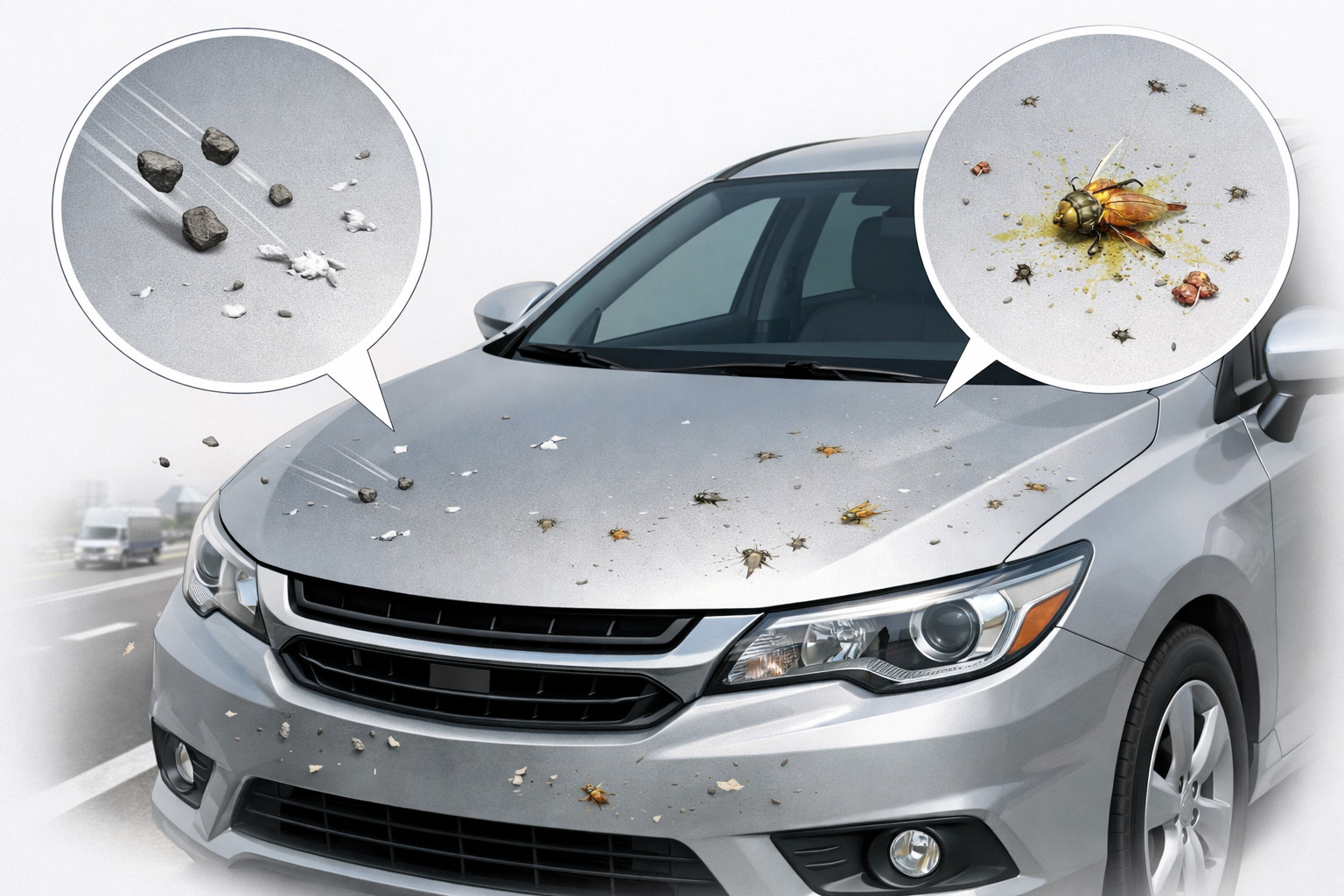
The leading edge of the hood sits in the direct impact zone. At speed, small stones fly out from under the wheels of vehicles ahead and hit the hood edge, bumper, and mirrors. The higher the speed and the shorter the following distance, the greater the load on the paintwork.
With insects, the mechanism is different. They don’t break through the paint, but their remains—especially in summer—dry quickly, heat up in the sun, and can leave stains, dullness, or localized etching of the clear coat. If you then rub it with a dry cloth or a stiff sponge, scratches get added on top of the chemical damage.
Main causes
- Frequent highway driving at speed, especially behind trucks and crossovers with wide tires.
- Short following distance to the vehicle ahead, so debris hits without losing energy.
- Heat and sun, when insect residue dries literally within hours.
- No physical protection on the leading edge of the hood and adjacent areas.
- Improper care: wiping dry, scrapers, aggressive polishing around chips.
- Delaying repairs, when a small chip has time to expose metal and start corrosion.
How to tell what’s causing it in your case
First wash and dry the hood, then inspect it from the side under raking light. If you see tiny dots with sharp edges, often with a dark center or exposed metal, those are impact chips. If there are yellowish, brown, or dull spots without paint breakthrough, the cause is more often insects and organic deposits.
Look at where the defects are located. If most of the damage is on the first 5–15 cm of the hood and also on the bumper and mirrors, highway use is to blame. If the marks appear after summer evening drives and clearly get worse after parking in the sun, the issue is more that insects aren’t washed off right away.
Also check for scuffing under an already installed deflector or trim piece. Repeating streaks, hazy spots near supports, or dirt under the mounts mean the accessory is either installed incorrectly or is working against your paint.
DD Tuning expert comment: The most common mistake is trying to solve everything with a single ceramic coating or polishing. It won’t stop chips, and excessive polishing around damage only eats into the clear coat. The second typical mistake is installing a universal deflector without checking the mounting and compatibility with existing protection.
Symptoms, causes, and what to do (table)
| Symptom | Likely cause | What to do |
|---|---|---|
| Small white or dark dots on the leading edge of the hood | Impacts from stones and road debris | Touch up fresh chips; for prevention, consider protective film or a deflector |
| Yellow, brown, or dull marks after highway driving | Dried insects, sap, organic deposits | Work on a cool surface, apply an insect remover for a few minutes, then rinse off without scrapers |
| A rust-colored dot inside a chip | Exposed metal and the start of corrosion | Don’t wait for repaint season—seal the chip as soon as possible |
| Scratches and haze without chips | Wiping dry, stiff sponge, improper cleaning | Stop scraping mechanically; wash with proper chemicals and a soft microfiber |
| Striped damage under the edge of an accessory | Dirt under the deflector or incorrect mounting | Remove it, clean, check supports and compatibility; if needed, abandon this solution |
| More chips appear specifically after long trips | High speed and short following distance | Change driving habits, increase following distance, protect the most vulnerable area |
What actually helps
Fast insect removal. Not after the weekend, but the same day as the trip or at the nearest car wash. It’s best to work out of direct sun: apply the cleaner, let it dwell for a few minutes, and rinse. This reduces the risk of clear-coat etching and the need to rub the surface.
Timely chip touch-up. If the damage has reached bare metal, the priority isn’t aesthetics—it’s stopping corrosion. This is especially important in winter, when salt, moisture, and dirt get into chips.
Protective film on the hood. This is a real physical barrier, not just a slick coating. Such film is tenths of a millimeter thick, so it can actually take minor impacts, insect marks, and light scratches. If the edge of a partial install bothers you, it’s more practical to wrap the whole hood rather than only the front strip.
Hood deflector. It can reduce the number of insects and some impacts on the leading edge, but the result depends on the hood shape, windshield angle, mounting type, and installation accuracy. On some cars the difference is noticeable; on others the owner gets more noise than benefit.
A proper following distance on the highway. This is free protection that often does more than cosmetic coatings.
What almost doesn’t work or helps only briefly
Ceramic coating as protection from chips. It makes washing easier, adds chemical resistance, and attracts less dirt, but it doesn’t become an impact shield. For stones, it’s simply not enough.
Polishing chips. You can’t erase a chip with polishing. You can only slightly smooth the edges, but overworking with a machine removes the thin clear-coat layer and sometimes makes the problem more expensive.
Scrapers, dry wipes, stiff sponges. They remove not the insects, but the top layer of gloss. After a few such cleanings, the hood looks worse even without new chips.
Cheap universal trims without a precise fit. If dirt moves between them and the hood or the supports vibrate, the paint can suffer from the accessory itself.
When accessories or part replacement make sense
If the car regularly runs on the highway and the hood still has no serious damage, it makes sense to look toward a hood deflector. This is relevant when you need a bolt-on barrier and you’re willing to verify whether a specific solution matches your hood shape.
If the goal is to cover the leading edge or supplement protection with separate elements, take a look at hood trim covers. But here, a precise fit, cleanliness during installation, and following the instructions are critical—otherwise dirt under the edge will start working like an abrasive.
When the edge is already battered, there’s corrosion, old repairs, or the hood has been repainted multiple times, sometimes it’s better not to mask the consequences but to solve it decisively—through repair or by selecting a hood for restoration. Accessories protect a sound part, but they don’t heal already damaged metal.
Solutions: when they work and when it’s not worth the money (table)
| Solution | When it works | When it’s not worth spending money |
|---|---|---|
| Insect remover and quick wash after highway driving | When the issue is organic marks, dullness, sticky residue | When the hood already has open chips down to bare metal |
| Touch-up for small chips | When you need to quickly seal metal and stop corrosion | When the damage is widespread, old, or has rust-lifted edges |
| Protective film on all or part of the hood | When the car often drives on the highway and you need a real impact barrier | When the hood already has a lot of rust, blistering, or poor repair geometry |
| Hood deflector | When you want fewer hits on the leading edge and fewer insects, and the model has good aerodynamics for this accessory | When you’re not ready to tolerate possible noise, monitor the mounting, or there are doubts about compatibility with existing protection |
| Ceramic coating | When the priority is easier washing, fewer chemical stains, and better maintenance | When you expect it to stop stones and chips |
| Polishing | When there are surface marks from improper washing | When you’re trying to use it to remove chips or deep clear-coat etching |
From a customer’s experience: a driver did a lot of intercity trips and complained that after every two or three drives new dots appeared on the hood, and in summer there were also dried insects. At first he wanted to just polish the edge, but after inspection fresh chips down to metal were visible. In the end we sealed the damage, changed the post-highway wash approach, and selected protection tailored to long-trip use—not “something universal.”
Conclusion
If your hood keeps catching chips and insects, don’t look for one magic cause: usually there are both highway impacts and improper or delayed care. The real savings here aren’t in polishing for shine, but in quickly removing organic residue, sealing fresh chips immediately, and installing physical protection where it’s truly needed.
A deflector or trim cover makes sense not for every car, and ceramic coating does not replace an impact barrier. So the right solution depends on your routes, speeds, the hood’s condition, and whether there’s already other protection on the body. This material is based on real selection experience, hands-on practice, and real use scenarios—not theory from a catalog.
How it works
- Inspect the hood after highway driving Wash and dry the hood, then look at it from the side in oblique light. Small spots with exposed metal will point to stone chips, while yellow or dull patches without paint breakthrough will indicate insect remains and organic residue.
- Identify exactly where the damage appears If the defects are concentrated on the front 5-15 centimeters of the hood, the bumper, and the mirrors, the cause is most likely highway driving and short following distance. If the marks become worse after summer trips and parking in the sun, the problem is more that insects are not washed off right away.
- Remove insects without dry rubbing It is better to apply insect remover to a cool surface, let it work for a few minutes, and then rinse it off. Do not use scrapers, dry wipes, or hard sponges, as they add scratches.
- Cover fresh chips with touch-up paint If the damage has reached the metal, do not put off repair until the painting season. Quick touch-up is needed not for appearance, but to stop corrosion, especially in winter, when salt and moisture get into the chips.
- Install physical protection where an impact barrier is needed For regular highway trips, protective film over the entire hood or over the area of the most impact makes sense. A hood deflector can also help, but only if it is compatible with the car’s shape, properly installed, and does not create dirt under the mounting points.
- Do not rely on solutions that do not stop stones Ceramic coating makes maintenance easier, but it does not protect against chips. Polishing does not remove chips, and trying to 'rub them out' can only take off an unnecessary layer of clear coat.