10.10.2026
36
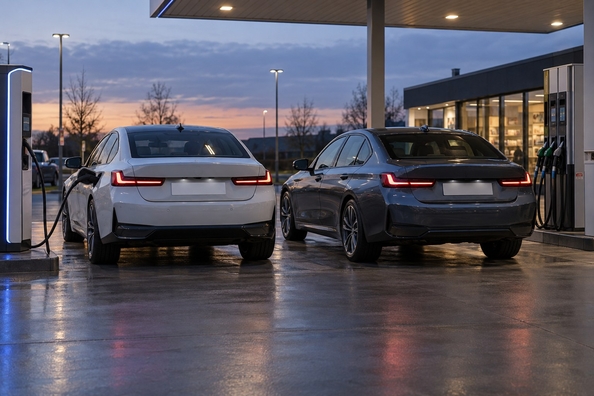

The eighth-generation BMW 3 Series comes in two versions with the same Neue Klasse design: the petrol G50 sedan (318, 320, M350 xDrive, all with a 48-volt mild-hybrid system) and the electric BMW i3 (i3 40 xDrive and i3 50 xDrive). BMW officially unveiled both on 30 September 2026, but under the same look there are different platforms and factories: the i3 is built in Munich on a new electric architecture, while the G50 is built in Dingolfing on an evolved version of the current one. The key difference for the buyer: the petrol “3” is 410 kg lighter and has a larger trunk, while the electric one is more powerful as standard and can travel up to 912 km under WLTP.
Contents
BMW says it outright: the 3 Series design is the same for all drivetrain types. Up front there are narrow horizontal “kidneys” merged into a single unit with twin headlights, plus vertical daytime running lights; in profile, a “shark nose,” a long hood, and door handles hidden in the body; at the rear, flat three-dimensional lights that extend onto the fenders. It is hard to tell the cars apart from the side on the street: the petrol version has hidden exhaust outlets (on the M350 xDrive there are four exposed ones), while the electric one has none at all.
The cabin is shared as well. Both cars get the Panoramic iDrive system: Panoramic Vision projection along the lower edge of the windshield, a 17.9-inch central display, BMW Operating System X with an Amazon Alexa+ based voice assistant, and wireless Apple CarPlay and Android Auto. We covered the petrol version in detail in our review of the new BMW 3 Series G50, and the electric one in our review of the new BMW i3 2027. Here, we focus only on what helps you choose between them.
Under the body, these are two different cars. The BMW i3 is built on the Neue Klasse platform with a flat high-voltage battery in the floor and 800-volt electrics—its center of gravity is low and the floor is flat. The petrol G50, according to BMWBLOG, sits on an evolved version of the CLAR architecture used by its predecessor, the G20. BMW itself explains that the different architecture requires different overall dimensions, wheelbases, overhangs, and track widths, so the cars only look identical in photos.
| Parameter | BMW 3 Series G50 (petrol) | BMW i3 (electric) |
|---|---|---|
| Platform | evolved CLAR | Neue Klasse, 800 V |
| Plant | Dingolfing, from November 2026 | Munich, from August 2026 |
| Length | 4 765 mm | 4 760 mm |
| Width | 1 850 mm | 1 865 mm |
| Height | 1 455 mm | 1 480 mm |
| Wheelbase | 2 860 mm | 2 897 mm |
| Trunk | 450 l | 420 l + 31 l front |
| Wheels | 18–20″ | 19–21″ |
| Weight | 1 680 kg (320) | 2 090 kg (i3 40 xDrive) |
The BMW i3 dimensions are from BMW’s Canadian press release; the petrol version’s are from the U.S. press release and ADAC; weights are according to BMWBLOG. The EV has a 37 mm longer wheelbase, is 15 mm wider and 25 mm taller, while the petrol sedan has a trunk that is 30 l larger. The most important number in the table is weight: the battery adds about 410 kg to the i3.
In the base versions, the EV wins: the least powerful i3 is more powerful than the petrol 320 by 163 hp. At the top of the range, it is a tie: the M350 xDrive with an inline “six” accelerates to 100 km/h in 4.1 s, quicker than the i3 50 xDrive (4.7 s), and until the i3 M60 xDrive arrives in 2027 it remains the quickest “3” of the new generation.
| Version | Powertrain | Power | Torque | 0–100 km/h |
|---|---|---|---|---|
| BMW 318 | 2.0 l, 4 cyl., turbo, 48 V | 115 kW / 156 hp | — | 9.5 s* |
| BMW 320 | 2.0 l, 4 cyl., turbo, 48 V | 155 kW / 211 hp | 330 N·m | 7.4 s |
| BMW M350 xDrive | 3.0 l, 6 cyl., turbo, 48 V, all-wheel drive | 326 kW / 443 hp | 580 N·m | 4.1 s |
| BMW i3 40 xDrive | two electric motors, all-wheel drive | 275 kW / 374 hp | 520 N·m | 5.4 s |
| BMW i3 50 xDrive | two electric motors, all-wheel drive | 345 kW / 469 hp | 645 N·m | 4.7 s |
*The 318 acceleration figure is according to BMWBLOG. For the UK specification, BMW quotes 0–62 mph (≈100 km/h).
The BMW i3 40 xDrive battery has a capacity of 82.8 kWh and delivers up to 710 km under WLTP; the i3 50 xDrive has 108.7 kWh and up to 912 km. At a high-speed charging station, the i3 40 can take up to 300 kW and adds up to 209 miles (≈336 km) of range in 10 minutes; the i3 50 up to 400 kW and up to 263 miles (≈423 km). That is the level where a road-trip charge takes roughly as long as a coffee stop at a gas station—but only at chargers with the appropriate power.
The petrol “3” saves fuel thanks to its 48-volt starter-generator: for the UK specification, the 320 emits 169 g CO₂/km and the M350 xDrive 187 g/km. There is no diesel in the new generation; BMW promises a plug-in hybrid during 2027. For those who often travel long distances in areas with few high-power chargers, the petrol G50 remains the simpler choice.
The difference between the petrol 320 and the electric i3 40 xDrive in the UK price list is less than £3,000, while the EV comes with all-wheel drive and 163 hp more. The most expensive model in the lineup is not electric, but the petrol M350 xDrive.
Petrol 3 Series G50 — for those who drive long distances without charging stations on the route, value lower weight and a larger trunk, and want a classic sedan with an internal combustion engine on a well-known architecture. The M350 xDrive is for drivers who care about the sound of an inline “six” and the best dynamics in the range.
Electric BMW i3 — for those who can charge at home or at work: as standard it is more powerful, has all-wheel drive, a flat cabin floor, and a rated range of up to 710–912 km. Keep in mind: in winter, real-world range will be lower than the rated figure, and the extra 410 kg of mass is felt in tire wear.
If you currently drive the previous generation, our review of the BMW 3 Series G20/G21 is a good introduction.
There are no model-specific accessories for the new G50 or the electric i3 yet: the cars are only just going on sale, and due to different dimensions, overhangs, and track widths, parts from the predecessor do not fit. But for the current BMW 3 Series G20/G21 (2018–2026), the choice is large: GBT body kit sets in the M-Sport style for pre-facelift and facelift (their bumpers are made of polypropylene), rear diffusers, EVA and textile floor mats, and clip-in window deflectors. You can have a body kit installed at the network of certified DD Tuning service centers—your nearest one can be recommended by a manager.
We ship via Nova Poshta throughout Ukraine.
Shipping to EU
Wholesale and retail
Own warehouse
Опис продукту
Подарунки не надаються при оформленні покупки у кредит під 0,01% або при покупці частинами.