
































































 Author: Radomskyi Maksym Vasyliovych
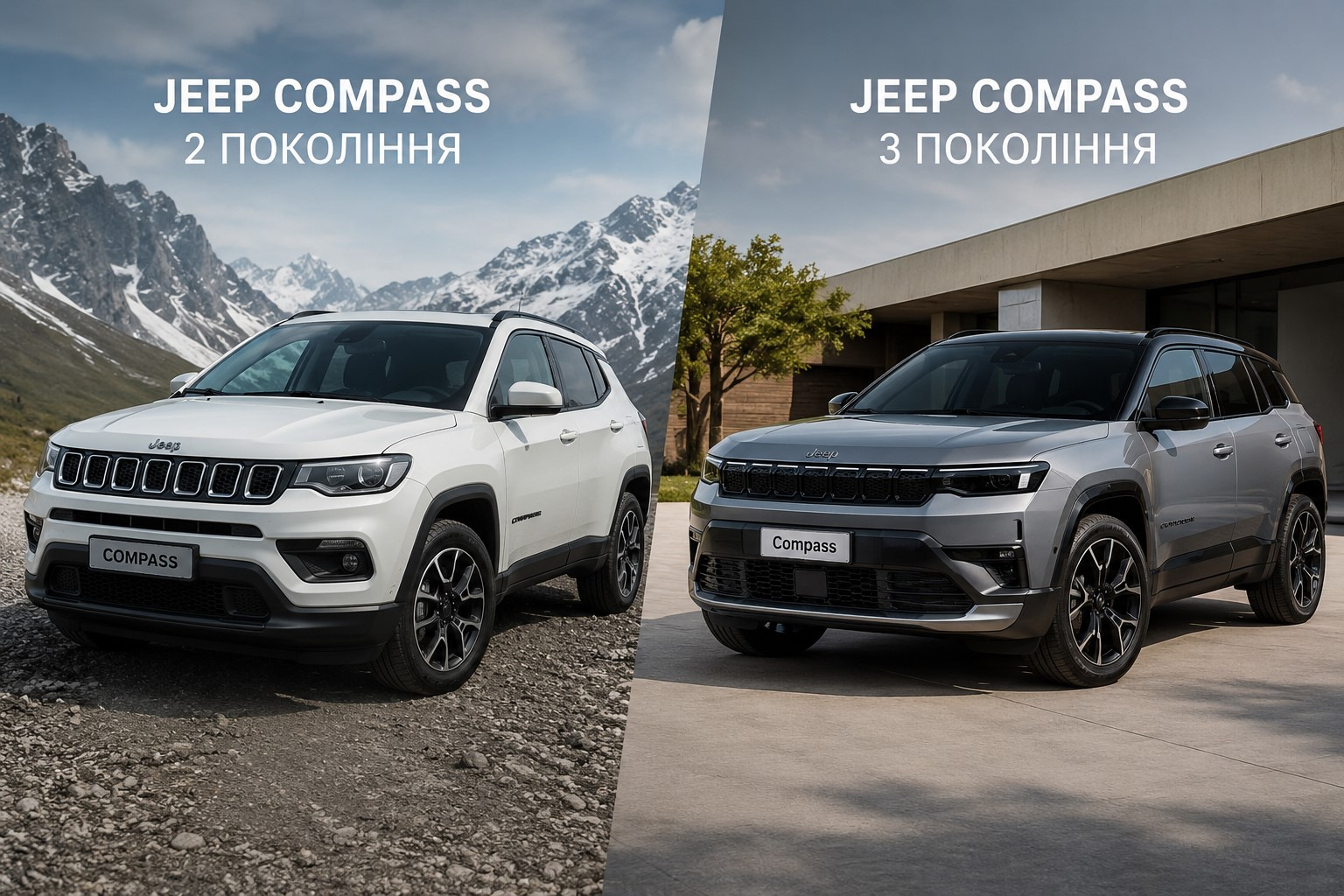
The main difference between Jeep Compass 3 and Compass 2 isn’t in the styling, but in the mission. The third generation is larger, quieter, more tech-forward, and noticeably more practical in everyday life. The second generation wins with a lower entry price, a more city-friendly compact body, and strong Trailhawk and 4xe versions if you need rough-road ability or a smart buy on the used market.
If you boil the choice down to one sentence: for highways, family use, long trips, and modern electrification it makes more sense to pay extra for Compass 3; for budget, urban driving, proven accessory compatibility, and truly harsh operating conditions, Compass 2 is often the more rational pick.
What the choice is really about
Compass 3 is a different class of experience, not just a newer Compass. It has a longer and wider body, a much longer wheelbase, a trunk up to 550 L, more small storage spaces inside, a more modern interface, and a broader electrified lineup. This matters not in photos but in real life: kids’ stuff, suitcases, a 40/20/40 rear bench, and calmer behavior at highway speeds.
Compass 2 looks weaker on paper, but not in every scenario. It’s cheaper to buy, easier to live with, shorter and narrower in the city, and Trailhawk and 4xe versions are still strong where approach angles, ground clearance, water fording, or towing matter. So the choice isn’t “old vs new,” but “more comfort and tech vs lower costs and more practical ruggedness.”
Which criteria to compare by
- Practicality. Compass 3 has more space, a larger trunk, and a more flexible rear row. This is one of the strongest arguments in its favor.
- Noise and ride comfort. The new generation is better suited for highways: a longer wheelbase, better aerodynamics, and a calmer acoustic background. Compass 2 is more often perceived as noisier and harsher.
- Durability and predictability. Compass 2 already has well-known weak points: noises, transmission jerks on some cars, and minor electronics quirks. Compass 3 doesn’t yet have much accumulated long-term history, so “new” doesn’t automatically mean proven longevity.
- Price. Compass 2 wins on entry budget, especially used. Compass 3 asks for more money upfront, and expensive electrified versions only make sense if you actually use their advantages.
- Installation and compatibility. For Compass 2 it’s easier to find proven solutions for mounts, protection, mats, roof/load systems, and other accessories. For Compass 3 the catalog is still growing, and for a plug-in hybrid or EV version, readiness to install charging at home or work becomes a separate factor.
Quick comparison of options (table)
| Option | Strengths | Weaknesses | Who it suits |
|---|---|---|---|
| Compass 3 generation | Roomier cabin and trunk, quieter ride, modern driver-assistance systems, strong electrified lineup, better highway suitability | Higher budget, little long-term durability data, multimedia may not always be perfectly quick, the range of exact-fit accessories is still smaller | Families, those who drive a lot on highways, plan to keep the car long-term, or want a more modern interior and electrification |
| Compass 2 standard versions | Lower entry price, more compact body for the city, simpler used-market choice, more proven accessory and installation solutions | Less space, noisier, more modest ride smoothness, simpler interior, known minor electronics and transmission-behavior quirks | Those looking for a rational city buy and who don’t want to overpay for newness |
| Compass 2 Trailhawk or 4xe | Strong geometry for bad roads, good ground clearance, better towing capability, 4xe offers an EV mode for short daily trips | Older platform, smaller trunk on 4xe, shorter electric range compared with the new generation, the condition of a specific car needs careful checking | Those who need off-road ability, a country house run, a trailer, snow, and broken roads without stepping up to an expensive new body |
Detailed breakdown of each option
Compass 3 generation
Its main advantage isn’t power, but the basic architecture. The car has grown in all key dimensions, gained a longer wheelbase, and as a result feels more mature on the move. For family use this means more second-row space, better cargo organization, and fewer compromises on long trips.
An important nuance: the base hybrid of the new generation doesn’t deliver a dramatic jump in performance versus the Compass 2 e-Hybrid. So buying Compass 3 purely for the horsepower figure isn’t worth it. Its real strengths are quietness, a more modern interface, easier daily use, and more promising EV versions. The downsides are fair too: there’s no long-term durability track record yet, and with any new model, the range of proven compatibility and installation solutions always builds up gradually.
Compass 2 in standard versions
This is a rational choice if the main goal is not to overpay. The body is shorter and narrower, which makes it easier in the city, and on the used market it opens up more options for the same money. If you drive alone or as a couple, without big family requirements, a basic Compass 2 can cover your needs without the feeling that the car is “too small.”
The problem is that the savings aren’t free. On the highway it’s worse isolated from noise, the suspension and overall ride feel are simpler, and on some cars typical minor complaints about the transmission and electronics have already accumulated. On the plus side, it’s exactly this generation that makes it easier to find proven accessories and straightforward installation without trimming, adapting, or waiting for new templates.
Compass 2 Trailhawk or 4xe
This isn’t just “another Compass 2,” but a separate argument in its favor. Trailhawk still looks very convincing on bad roads, and 4xe adds strong torque and the option of short electric trips if you charge regularly. Plus, the older 4xe has a better towing rating, which for some owners matters more than a large screen or over-the-air updates.
But here you should look not at the trim name, but at your use case. If you need a large family car for daily life, the second-generation 4xe loses to the new Compass 3 on space and trunk capacity. If the car will live on broken roads, tow a trailer, or often go places where you’d hate to risk a new expensive body, this option may turn out to be the smartest.
Which option is better for different scenarios
For city use and a limited budget, Compass 2 looks more grounded. It’s more compact, cheaper to get into, and its weak points are already more or less understood. If the car won’t constantly carry a family and luggage, the extra cost of Compass 3 may not be felt every day.
For highways, family use, long trips, and fleet/company use, Compass 3 looks better. It’s the sum of factors: quietness, a longer wheelbase, more usable volume, and more modern ergonomics. This is the case where a new generation doesn’t give just one advantage, but a whole package of small improvements that add up to comfort.
For a country house, snow, ruts, a trailer, and generally tougher use, don’t write off Compass 2 Trailhawk or 4xe. And if you won’t be charging a plug-in hybrid or EV version, part of the point of an expensive Compass 3 disappears—then you should choose either the base new hybrid, or honestly go back to the cheaper second generation.
Use case and what to choose (table)
| Scenario | Best choice | Why |
|---|---|---|
| Daily city driving, parking, moderate annual mileage | Compass 2 | Smaller size and lower budget matter more than the added space and tech |
| Family, highway driving, vacation trips | Compass 3 | Bigger trunk, calmer ride, more second-row space, and a more comfortable cabin |
| Bad roads, snow, outdoor trips | Compass 2 Trailhawk or 4xe | Strong geometry, higher ground clearance, and less psychological barrier to hard use |
| You have charging at home or work and want electrification | Compass 3 | The new generation offers significantly stronger electric use cases than the old 4xe |
| You need to tow a trailer within the class | Compass 2 4xe | Its towing capability is higher than on known versions of the new generation |
| Long-term ownership with an emphasis on daily comfort | Compass 3 | It delivers more tangible everyday value, not just a better-looking spec sheet |
Common mistakes when choosing
- Looking only at the model year. The newer Compass 3 isn’t better for everyone; if your use is strictly urban and the budget is tight, Compass 2 can be the more logical option.
- Overestimating the horsepower number. With base hybrids, the main difference isn’t acceleration, but acoustic comfort, space, and equipment.
- Buying a plug-in hybrid or EV version without charging. Without regular charging, expensive electrification pays off much worse.
- Ignoring durability as a criterion. The older generation has known quirks; the newer one lacks long-term statistics. Both factors should be considered rather than declaring a winner in advance.
- Not accounting for accessory installation and compatibility. There are more solutions for the second generation and they’ve been tested for years; for the third, you need to check exact fit more carefully.
- Comparing a standard Compass 2 to Trailhawk or 4xe as if it were the same car. In practical terms, these are versions with different purpose and content.
When the more expensive option makes sense
Paying extra for Compass 3 is justified when you really use its advantages: carrying a family, frequent highway driving, planning long ownership, having charging for an electrified version, or simply not wanting to put up every day with a noisier, tighter cabin. If the car will live mostly in the city, without charging and without regular long trips, the more expensive option may not pay back in everyday impressions.
If you’re already leaning toward the new generation, it makes sense to look right away at compatible solutions specifically for Jeep Compass 2025. For daily use, the most practical place to start is with what actually takes on dirt and wear: floor mats and a trunk mat. On an expensive new car, that’s not a small thing—it’s a way to keep the cabin and cargo area in good shape longer without makeshift universal solutions.
Conclusion
Compass 3 is the better choice if you need a more modern, more spacious, and quieter crossover for daily life and highway driving. Compass 2 is a strong, rational option when budget, compact size, proven accessories, and bad-road-focused versions matter. Remember the simple point: the new generation wins on comfort and practicality; the old one wins on entry price and applied ruggedness in the right trims.
Pros and cons
Compass 3 is noticeably more spacious: it has a larger cabin, a 550 l trunk, and a more comfortable rear row for family trips and longer journeys.
On the highway, the new generation offers better comfort: a longer wheelbase, quieter ride, and a calmer acoustic environment than the Compass 2.
Compass 3 is more practical for everyday use thanks to a more modern interface, more storage spaces in the cabin, and better cargo organization.
For those considering electrification, the Compass 3 has a broader and stronger electrified lineup than its predecessor.
The Compass 2 has strong Trailhawk and 4xe versions that are well suited for bad roads, snow, towing a trailer, and tougher use.
Compass 3 is more expensive upfront, so the extra cost may not be justified if the car will be used mostly in the city and without regular long trips.
The new generation still has little long-term durability data, so its reliability is not yet as predictable as that of the already well-known Compass 2.
For the Compass 3, the range of proven accessories and installation solutions is still shorter than for the second generation.
The basic hybrid of the Compass 3 does not offer a big leap in performance compared with the Compass 2 e-Hybrid, so it is not worth buying it just for acceleration.