25.05.2026
248
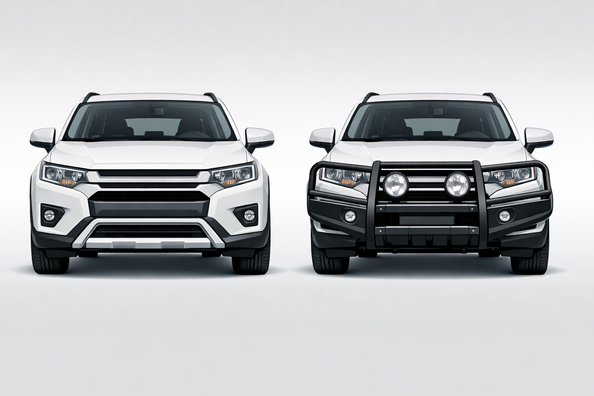

For a daily driver, the mistake is usually not that the owner wants to “reinforce the front end”, but that they confuse a light front guard with a full-size bull bar. The former is designed for minor city contact and parking, the latter makes sense where there are bad roads, animals on the highway, or harsher operating conditions. On a modern car, it’s not the name that matters, but compatibility with airbags, front sensors, the camera, and the radar.
In the city, a massive steel guard often brings more compromises than benefits: it adds weight, increases overall length, and can interfere with electronics. So the right question is: what exactly do you want to protect, what conditions do you drive in, and will the chosen option disrupt the vehicle’s factory safety logic.
The confusion starts with terminology. In everyday speech, people call almost any tube up front a bull bar, even though a light front guard and a full-duty heavy-duty version are different in weight, geometry, and purpose. A light guard covers the lower part of the front end and suits minor contact, while a bull bar covers the front more broadly and higher up.
The second reason is that cars themselves have changed. Where there used to be more “metal and plastic” up front, now there are often parking sensors, a camera, a radar, and components that affect correct operation of safety systems. Because of this, what was a normal solution for an older SUV can be unnecessary or problematic on a modern crossover.
DD Tuning expert comment: the most common mistake is choosing front protection by photo, tube diameter, or the word “heavy-duty”, without checking the car’s trim. On vehicles with front sensors and radar, even a small offset can trigger false signals. The practical right approach is: first look at the electronics and driving scenario, and only then at the product’s shape.
| Symptom | Likely cause | What to do |
|---|---|---|
| Front sensors give false alerts, especially after rain | A guard element is within the signal reflection zone or positioned too close | Check compatibility with your exact trim; in problematic cases, change the design or remove it |
| The car has become less convenient in the city | Excess length and weight of a full bull bar | For daily use, switch to a compact front guard or keep the stock front end |
| Concerns about airbags | Universal or random product without confirmed integration with the vehicle’s systems | Choose only vehicle-specific solutions with verified compatibility |
| Cruise control, camera, or automatic braking works inconsistently | The viewing/working zone of the front sensors is blocked or distorted | Don’t look for a “workaround”—remove the cause: a different guard or no installation |
| The guard looks “strong”, but brings almost no benefit in the city | The wrong type was chosen for the route | Focus not on looks but on everyday conditions: city—lighter option, harsh conditions—full |
For a city car, a simple rule usually works: if you need protection from minor contact, it makes more sense to look at a compact front guard rather than a full bull bar. Lower weight and a smaller profile fit daily use better.
The second truly useful step is checking compatibility not just with the model in general, but with the specific trim level. If there are sensors, a camera, or a radar up front, a random universal product is a weak idea. After installation, it’s worth separately checking parking and front systems in dry weather and after rain.
A full bull bar is justified when the vehicle regularly drives on poor roads, in areas with a risk of animal strikes, or actually operates in tougher conditions. In other words, it’s useful not by itself, but for a specific scenario.
An accessory makes sense when it solves a specific task. If you need protection from minor city contact, check the front guards category. If you’re still comparing formats and want to understand the difference between lighter and more massive solutions, it’s convenient to start with bull bars and side steps.
If the vehicle truly runs difficult routes and you need tougher protection, then it makes sense to look at heavy-duty bumpers. But for a daily driver, replacing a heavy or poorly installed front guard with a compact vehicle-specific option is often smarter than trying to “put up with” extra weight and conflicts with electronics.
| Solution | When it works | When it’s not worth spending money |
|---|---|---|
| Compact front guard | City car, minor parking bumps, confirmed sensor compatibility | If you need real protection for harsh roads and animal-strike risk |
| Full bull bar | Regular out-of-town driving, tough conditions, justified need for wider and higher protection | If the car spends almost all its time in the city and parking convenience matters |
| Vehicle-specific solution matched to trim | On modern cars with front sensors, a camera, or a radar | It may not save money only at the start, but it’s cheaper than the consequences of a bad install |
| Universal product | Only on simpler cars without complex front electronics—and only after checking compatibility | On modern crossovers and pickups with a sensor-heavy front end, it’s most often an unnecessary risk |
| No installation | When the benefit is purely visual and your route is typical city driving | Not suitable if the vehicle truly operates in conditions where front protection is needed for the job |
From a customer’s experience: the owner of a city crossover was looking for “something stronger up front”, but after checking it turned out the car has front sensors and a radar, and the trips are almost entirely urban. Instead of a full bull bar, he chose a compact vehicle-specific front guard and separately checked sensor operation after installation. As a result, he got protection from minor contact without constant parking compromises.
For a daily driver, the difference is simple: a light front guard is a solution for the city and minor contact, while a full bull bar is a tool for tougher conditions where a wider and higher level of protection is truly needed. If the car is modern, the main selection criterion is not looks or the name, but compatibility with airbags, sensors, the camera, the radar, and normal behavior in everyday use.
The practical takeaway is this: for the city, a compact vehicle-specific solution—or even the stock front end—is most often enough, and spending money on a massive bull bar is often not justified. This material is based on real selection experience, practical work, and real usage scenarios where it’s important not just to “put a tube on the front”, but not to ruin the car’s safety and convenience.
| ✔ | Compact front protection is better suited for the city: it is designed for minor parking contacts and does not add unnecessary bulk. For daily driving, this is more practical than installing a full bull bar just in case. |
| ✔ | A model-specific solution for a particular trim level helps preserve the operation of the airbags, sensors, camera, and radar. This is especially important for modern cars, where the front end is already packed with electronics. |
| ✔ | Before choosing, you can quickly tell whether you need such protection at all: just assess your routes, the presence of sensors, and the real risks. This helps you avoid overpaying for a design that offers no benefit in city conditions. |
| ✔ | A full bull bar makes sense in more demanding conditions — on poor roads, when there is a risk of contact with animals, or in tougher use. In other words, this is not a universal solution, but one for a specific task. |
| ✘ | A massive steel bull bar adds weight and increases the front-end dimensions, which makes the car less convenient for everyday parking. In the city, this often creates more inconvenience than real benefit. |
| ✘ | If the trim level is not taken into account, the guard may interfere with parking sensors, the camera, or the radar. The result is false alerts or unstable operation of safety systems, especially after rain. |
| ✘ | Universal solutions not tied to a specific car model and its electronics are risky here. They may fit the mounting points, but still conflict with the factory safety logic. |
| ✘ | A rigid front end is not always safer overall, as it can reduce pedestrian safety and bring unnecessary trade-offs for everyday use. For a city car, this is often an unjustified price to pay for external "strength". |
Shipping to EU
Wholesale and retail
Own warehouse
Опис продукту
Подарунки не надаються при оформленні покупки у кредит під 0,01% або при покупці частинами.