15.07.2026
237
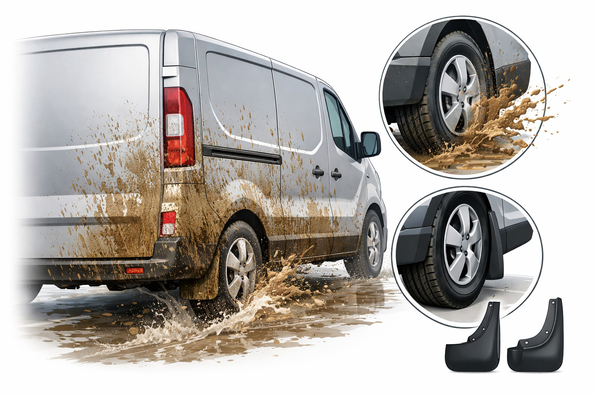
If your Renault Trafic quickly splashes dirt onto the sills, sides, and rear doors after rain, it’s usually not a fault but a combination of wheel spray and airflow turbulence around the tall body. On the Trafic this is helped by about 160 mm of ground clearance, a large side surface area, and a long rear overhang of 968 mm: water from the road doesn’t just fly downward—it gets picked up and carried along the body by the airflow.
That’s why there isn’t one “magic” part that fixes it—what works is the right sequence: understand exactly where the dirt is coming from, rinse the wheel arches and liners, and only then choose mud flaps and arch protection for your specific body. Otherwise you can spend money and end up with only a little less dirt in the same places.
The Trafic has typical van aerodynamics: the front wheels throw water and sand onto the sills and the lower part of the doors, while the rear of the body creates a low-pressure zone that pulls wet dirt onto the tailgate area. The taller the body and the longer the wheelbase, the more noticeable this becomes on highways and in rainy weather.
The wheel arches also play a role. If there’s already a layer of wet sand, leaves, and small debris inside, the wheel keeps throwing it out again and again. So sometimes the vehicle gets dirty not only from the road, but also from what has long been accumulating behind the wheel-arch liner.
DD Tuning expert comment: The most common mistake Trafic owners make is installing the first universal kit they find, without considering the body and mounting points. The second typical mistake is fitting mud flaps onto a dirty arch where sand and leaves are already sitting behind the liner: in that case the accessory reduces new spray but doesn’t remove the source of recurring dirt. If the vehicle is a cargo version and often drives on wet highways, it’s better to check both the front and rear axle right away.
| Symptom | Likely cause | What to do |
|---|---|---|
| Dirt on the sills and lower part of the front doors | Spray from the front wheels; missing or weak front mud flaps | Check the front arch; install front mud flaps for your body |
| Rear doors and bumper get heavily splashed | Turbulence behind the body; no rear mud flaps | Fit rear mud flaps, especially on the cargo version |
| After washing, sand quickly starts flying out of the arch again | Debris buildup behind the liner | Remove the liner, rinse the arch, check drainage and clips |
| One side is dirtier than the other | Local damage to the liner or fasteners | Inspect the liner; replace clips or the part itself |
| After installing an accessory, there’s almost no change | Wrong size or the problem area was misidentified | Verify body compatibility and determine whether the issue is front, rear, or inside the arches |
The first thing that delivers a noticeable result is proper front and rear mud flaps for your specific Trafic version. On this model it’s not just for looks: OEM-style sets have a decent material thickness and block the main spray stream from the wheel.
Second—clean arches and an intact liner. If the liner is packed with dirt, new mud flaps will only reduce new spray, while old debris will still get washed out. For vehicles that drive on poor roads, this is a must.
Third—protection for the arch edge if abrasive dirt constantly hits there. This doesn’t always solve overall body cleanliness, but it reduces sandblasting on the paint and covers vulnerable areas.
Simply washing the vehicle more often is fighting the symptom. The body looks clean until the first wet drive, but the contamination pattern doesn’t change.
Short universal mud flaps also often have a weak effect: they don’t block the real spray plume on the Trafic. The other extreme is overly long and stiff ones. In winter they can collect snow and ice, and on uneven roads they may work worse than expected.
Don’t expect deflectors or cosmetic trims to replace mud flaps. They may help with other tasks, but they don’t eliminate the wheel-spray source of dirt.
If the vehicle doesn’t have an OEM set or has weak equivalents, it’s logical to start with mud flaps for Trafic. This is the basic solution when dirt is coming from the wheels rather than due to arch damage.
When the arch edge is constantly taking sand hits and the liner is working at its limit, it makes sense to look at arch trims. They don’t replace mud flaps, but they add protection where the finish suffers most.
If you want to compare options for your model and avoid picking universal solutions at random, it’s worth browsing model-specific mud flaps. And if the liner is cracked, clips are missing, or there’s misalignment after repairs, restore the factory arch geometry first and only then install accessories.
| Solution | When it works | When it’s not worth spending money |
|---|---|---|
| Front mud flaps | Dirt hits the sills, front doors, lower part of the side panel | If the main dirt settles only on the rear doors and tail section |
| Rear mud flaps | Rear bumper, doors, and body corners get heavily splashed | If the problem is only at the front or the arch is clogged with debris |
| Front + rear set | The vehicle gets dirty along its entire length after highway driving in rain | If liners haven’t been checked and there’s obvious liner damage |
| Cleaning arches and liners | There’s sand, leaves, wet buildup behind the liner | Won’t give full effect if there are no mud flaps at all |
| Arch protection or replacing the liner | There’s sandblasting on the arch edge, cracks, lost clips, part misalignment | If the arches are intact and the dirt source is clearly only the wheel spray stream |
| Long stiff universal mud flaps | Only when they match the shape and ground clearance exactly | If the vehicle is driven in winter, in ruts, or predictable compatibility is needed |
From a customer’s experience: On a long Trafic after rain, the most annoying things were dirty sills and fully gray rear doors after just one highway trip. We didn’t start with expensive trims—we started by washing the arches, checking the liner clips, and installing a body-specific set of front and rear mud flaps. After that the sides became noticeably cleaner, and the arches stopped collecting the wet dirt that used to constantly fly outward.
On the Renault Trafic, dirt after rain most often appears due to the van’s normal spray-and-turbulence pattern, not because of a single malfunction. A practical order of actions is: identify the dirty zone, clean the arches and liners, check the wheel-arch liners, and only then install front, rear, or a full set of mud flaps.
The best results come from solutions chosen for your specific body and usage—not universal parts “just so something hangs there.” This material is based on real selection experience, practical work, and real use cases where the difference is made not by one part, but by the right combination of cleaning, intact arches, and compatible accessories.
| ✔ | It explains why the Renault Trafic gets dirty after rain mainly along the sills, side panels, and rear doors: the cause is not only the road, but also the turbulence around the tall body. This helps avoid looking for a nonexistent “fault” and instead immediately check the wheel arches and mud flaps. |
| ✔ | There is a clear diagnostic algorithm: first determine where the dirt appears, then check the arches, liners, and clips, and only after that choose accessories. This approach reduces the risk of buying a part that will not solve the problem. |
| ✔ | It separately explains when front mud flaps are needed, when rear ones are needed, and when a full set is required. This is practical because it lets you choose a solution for a specific dirt area rather than fitting everything at once. |
| ✔ | There is an emphasis on cleaning the arches and checking the wheel liners if wet sand, leaves, or gaps and sagging have accumulated behind the liner. This is important because sometimes the clogged arch itself becomes the source of repeated dirt buildup. |
| ✔ | Weak solutions are pointed out: short universal mud flaps, cosmetic trims, or simply frequent washing do not provide a lasting effect. This helps avoid unnecessary spending on ineffective options. |
| ✘ | The material does not provide specific sizes or part numbers for mud flaps, so the fit still has to be selected separately for your body version. For some owners, this means extra time spent checking compatibility. |
| ✘ | An effective solution often starts with removing the liners, washing the arches, and checking the clips, and that is no longer a quick “install and go” process. For an owner without tools or experience, such diagnostics may be inconvenient. |
| ✘ | The text explicitly says that overly long and rigid universal mud flaps can cause problems in winter and on rough roads. In other words, a poor accessory choice can make operation worse rather than better. |
| ✘ | Even after installing mud flaps, the result will not be complete if the arches are clogged with dirt or the wheel liner is damaged. In other words, for a real effect you often need to do several jobs at once, not limit yourself to one purchase. |
Shipping to EU
Wholesale and retail
Own warehouse
Опис продукту
Подарунки не надаються при оформленні покупки у кредит під 0,01% або при покупці частинами.