 Author: Radomskyi Maksym Vasyliovych
This upgrade plan is for a Nissan X-Trail T32 owner who, after purchase, wants to protect the trunk and the top edge of the rear bumper from everyday wear without unnecessary expense. The scenario is simple: bags, a cart, tools, fuel cans, sports gear, wet clothes or equipment shouldn’t quickly ruin the factory trunk lining and the paint on the bumper.
The logic is: first we block dirt, moisture, and scratches, then we tidy up the small stuff, and we leave decorative pieces for last. For the 7-seat version this is especially important, because the shape and usable trunk volume are different, so accessories need to be chosen for the specific configuration.
What this upgrade needs to handle
In the X-Trail T32, the trunk often works as a universal compartment for everything—from kids’ items to dirty household cargo. So the right upgrade should solve not one but three tasks at once: contain dirt and spills, protect the rear bumper edge from scratches, and keep small items from rolling around in the trunk.
The factory felt looks good on a clean car, but it isn’t very practical. If the 5-seat version has a larger trunk, then in the 7-seat version (with the third row folded) the usable space is smaller, and the “universal accessory” mistake happens more often. That’s why what matters here isn’t catchy names, but exact geometry for your body version.
What to upgrade first
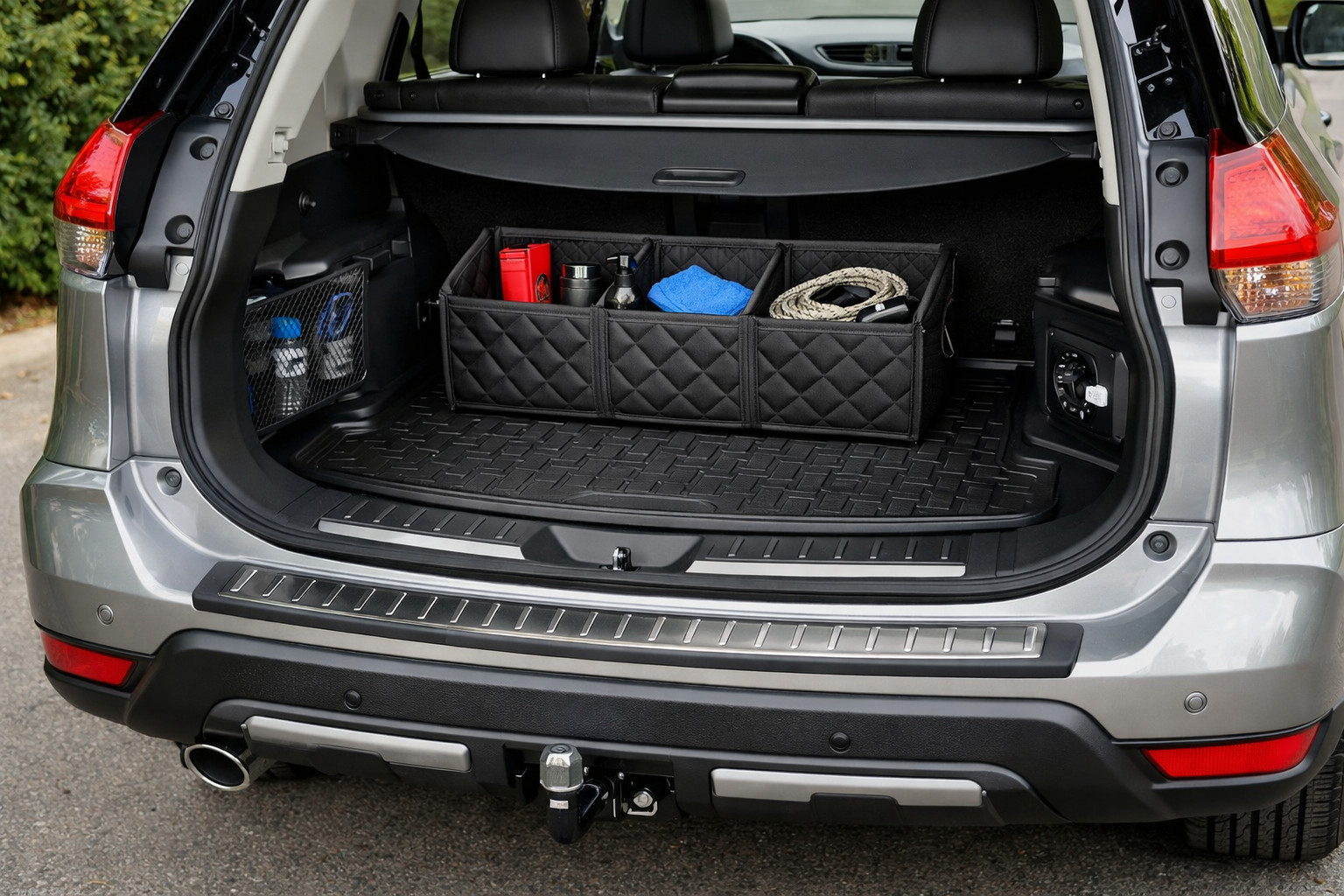
The first step for most owners is the same: a tray/liner for the trunk with a high lip. It takes on water, sand, snow, stains from bags, marks from cart wheels, and prevents all of that from soaking into the factory covering.
The second step is protecting the top edge of the rear bumper. This area gets the first scuffs when you pull a bag toward you, set down a box, or pull something heavy over the threshold. If you load the trunk regularly, it makes sense to install a bumper protector right after the trunk tray, rather than waiting for the first chips.
If you need a temporary solution while waiting for a model-specific accessory, you can throw in a thick cover or an old blanket. But it’s only temporary protection: it won’t replace a lipped tray when it comes to spills and wet dirt.
Upgrade: why it’s needed, who benefits (table)
| Upgrade | Why it’s needed | Who really benefits |
|---|---|---|
| Tray/liner with a high lip | Holds moisture, dirt, sand, and small spills; protects the factory felt | Almost everyone who carries anything more practical than a few dry shopping bags |
| Protector for the top edge of the rear bumper | Reduces scratches and scuffs during loading and unloading | Family cars; those who carry a cart, boxes, a carrier, or tools |
| Trunk cargo net | Secures bags, bottles, car chemicals, and other small items | Those whose trunk use is mostly urban: groceries, small household cargo |
| Organizer bag | Organizes a compressor, gloves, tow strap, first-aid kit, small sports gear | Those who want order without constantly scattered items |
| Rigid trunk divider | Separates the cabin from unsecured cargo during hard braking | Those who carry a dog or work cargo; usually unnecessary for regular shopping bags |
DD Tuning expert comment: The most common mistake on the Nissan X-Trail T32 is buying a noticeable bumper protector but leaving the trunk without a raised-lip liner. After a short time, the bumper edge looks better, but the felt is already stained and worn. The second typical mistake is choosing accessories without уточнення whether the car is 5-seat or 7-seat: it looks similar from the outside, but the trunk difference is noticeable.
What makes sense to add in the second stage
Once the basics are covered, the logical second stage is adding a net or an organizer. It’s not as critical a purchase as a tray or a bumper protector, but it’s what removes the feeling of clutter: washer fluid, pump, wipes, tow strap, and gloves stop rolling around the trunk.
A rigid divider only makes sense for a specific use case. If you carry a dog, tools, or unsecured cargo, it’s useful. If your trunk is mostly groceries, vacation luggage, and kids’ bags, the divider is usually too expensive and doesn’t deliver proportional value. Also, such an element doesn’t mean you can carelessly pile in heavy cargo.
What’s more about comfort or appearance
After basic protection, you can look at items that affect neatness and a finished look. This includes decorative trims, textile protective mats for a dry trunk, or stiffer trim options if you want a cleaner-looking loading area.
But it’s important not to mix up roles. For the scenario “groceries, kids’ items, tools, trips out of town,” a functional tray is more useful than any decorative chrome. Looks make sense when the basics have already addressed real wear—and not instead of it.
What people often buy for nothing
- A universal trunk mat that needs trimming. On the T32 it often fits imprecisely, can slip, and doesn’t cover the problem areas.
- A rigid divider without a dog or work cargo. For a normal everyday scenario, it’s overpaying.
- Decorative elements before protection from water and dirt. The car looks tidier, but the practical problem remains.
- Any accessory without checking the 5- or 7-seat configuration. On the 7-seat version, compatibility mistakes happen especially often.
A separate mistake is buying for someone else’s photos or reviews instead of your own scenario. If you don’t carry a dog and don’t work with tools every day, you don’t need the whole arsenal of trunk accessories at once.
What to install first, what to postpone, what isn’t mandatory (table)
| Scenario | What to install first | What you can postpone | What isn’t mandatory |
|---|---|---|---|
| Daily shopping and family trips | Trunk tray and bumper protector | Net or organizer | Rigid divider |
| Country house, fishing, dirty gear | High-lip tray and bumper protection | Organizer for small items | Decorative trims |
| 7-seat version | Model-specific accessory for the exact configuration and a bumper protector | Net after checking that it doesn’t interfere with how you pack items | Random universal mats |
| Dog or unsecured work cargo | Trunk tray and bumper protection | Divider as a second step | Chrome for looks |
A ready upgrade plan for this scenario
- Define your real use case: city, family car, country house, dog, tools, 5 or 7 seats.
- For the first purchase, get a model-specific tray/liner for the trunk with a lip.
- Next, install protection for the top edge of the rear bumper if you regularly load items over the threshold.
- After a week or two of use, you’ll understand whether you need a net or an organizer for small items.
- Leave the divider only for a separate use case. If the mat or tray slips, solve it with a non-slip underlay rather than replacing it with a random universal accessory.
When it makes sense to choose more expensive solutions
A more expensive solution is justified when you need an exact fit without trimming and proper protection for the actual problem areas. For this scenario, it’s worth looking at model-specific rubber trunk mats and separate rear bumper protectors, rather than universal equivalents.
If your bumper edge постоянно contacts a stroller, boxes, or heavy bags, it makes sense to choose a stiffer option for the edge itself—a protector with a bend. This is a logical choice for a newer car or when you want to preserve the paint without constant polishing. For the 7-seat version, the extra cost is justified only after verifying the exact configuration.
From a customer’s experience: After buying a Nissan X-Trail T32, the owner initially wanted to install only a bumper protector because that’s where scratches show up fastest. In the end, he started with a tray and bumper protection, and bought the organizer later, once he got tired of collecting the compressor and washer fluid bottle from all over the trunk. The biggest difference came from the basic pair: the floor stayed cleaner, and the bumper edge stopped getting scuffed.
Conclusion
For the Nissan X-Trail T32, the smartest order is: first a trunk tray, then protection for the top edge of the rear bumper, then a net or organizer, and only if specifically needed—a divider. Anything purchased before this base purely for looks often turns out to be secondary in a practical scenario.
This material is based on real selection experience, practical know-how, and real usage scenarios: what truly takes the wear, what helps in everyday use, and what you can safely postpone—or not buy at all.
How it works
- Define your use case and configuration First, understand exactly how you use the trunk: daily shopping, family trips, the cottage, tools, or transporting a dog. Be sure to consider whether you have a 5-seat or 7-seat version, because they require different accessory fitment.
- Install a trunk tub or tray For your first purchase, choose a model-specific high-lip tub. It will protect the factory lining from water, sand, snow, dirt, and minor spills that damage the trunk the fastest.
- Protect the upper edge of the rear bumper After the tub, install a cover on the top edge of the rear bumper. This area is the most common one to get scratched when loading bags, boxes, a stroller, or tools over the sill.
- Add a net or organizer for small items Once the basic protection is in place, assess whether you need a net or an organizer bag. They help secure a washer fluid bottle, pump, gloves, a tow strap, and other small items so they do not roll around in the trunk.
- Use a divider only for a specific task A rigid divider makes sense if you regularly carry a dog or unsecured work cargo. For regular shopping and family trips, it is usually unnecessary, so you can skip it.
- Leave decorative solutions for last Install decorative trim and other appearance items only after you have covered protection against dirt and scratches. For Nissan X-Trail T32, a practical base is more important than universal or simply stylish accessories.
Pros and cons
A tub or tray with a high edge really catches water, sand, snow, and small spills, so the factory cargo area covering wears out less. This is especially useful if wet or dirty items are often carried in the trunk.
A rear bumper top edge protector reduces scratches during loading and unloading. It is practical for a family car when a stroller, boxes, or tools are regularly carried over the sill.
A net or organizer helps clear up the chaos in the trunk and secures small items so they do not roll around while driving. It is convenient for city trips, shopping, and everyday cargo.
A rigid partition is useful in specific cases when a dog or unsecured work cargo is carried in the trunk. It separates the cabin from the items during hard braking.
Model-specific accessories with an exact fit for the 5- or 7-seat version provide a better fit without trimming. For the X-Trail T32, this matters because universal solutions often fit imprecisely.
A universal trunk mat may fit inaccurately, slide around, and not cover problem areas. As a result, it protects the trunk worse than a model-specific tray.
A rigid partition for regular shopping, children's items, or vacation trips usually does not justify its price. Without a separate use case like a dog or work cargo, it is more of an unnecessary purchase.
Decorative trims by themselves do not solve the problem of dirt, moisture, and wear in the trunk. If installed before the basic protection, their practical benefit will be limited.
For the 7-seat version, there is a risk of choosing the wrong fit, even if the accessory seems suitable from the outside. This complicates the purchase and may force you to look for a replacement.