18.08.2026
305
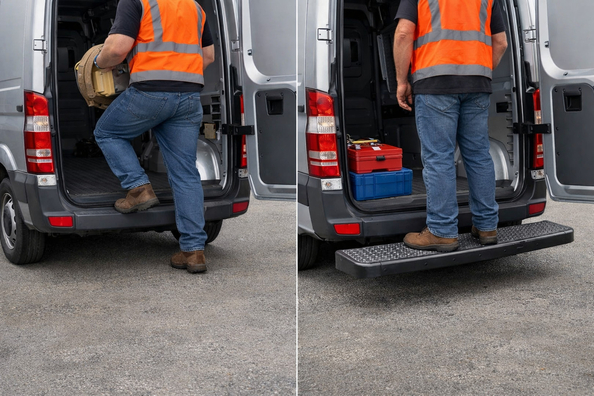

A rear step for a van isn’t for everyone. It pays off when people get in through the rear doors every day, carrying tools, boxes, or gear. If rear access is occasional, and a towbar, departure angle, or bike rack matters more, the step often becomes an unnecessary extra.
So the choice here isn’t between a cheap and an expensive model, but between different working scenarios. It’s important to assess how often you actually step on it, whether there are rear sensors and a camera, how low the van sits, and whether you’re ready to live with extra weight, noise, or a more complex installation.
The main question is simple: is your rear area a working zone or not. For delivery, a service van, a camper, or a mobile workshop, a step reduces fatigue and makes boarding and unloading safer. But if the rear doors open once a week, there’s little benefit.
The second layer of choice isn’t the type of metal, but compatibility. A wide or deep design can conflict with the towbar, parking sensors, camera, or your available departure angle. That’s exactly why for one van the best option is a simple narrow step, and for another it’s better to skip it altogether.
Also check compatibility with the towbar, sensors, and camera separately. For a van this isn’t a minor detail: sometimes it’s the rear equipment—not the step itself—that determines what you can install without compromises.
| Option | Strengths | Weaknesses | Who it suits |
|---|---|---|---|
| Simple fixed bolt-on | Cheaper, lighter, often easier to install, usually quieter | Narrower foothold, less comfort in rain and mud | Those who use the rear doors regularly, but without heavy daily loads |
| Wide full-width | Convenient across the full width, better support for both feet, more stable in slippery weather | Protrudes further to the rear, more often conflicts with a towbar and sensors | Delivery vans, crew vans, campers with frequent rear access |
| Folding commercial | Deeper platform, highly practical for cases and tools, good strength reserve | Heavier, more complex, may get noisier over time | Service and cargo vans with intensive daily work |
| Retractable | Doesn’t stick out all the time, lower step, affects vehicle geometry less | More mechanics, needs maintenance, usually more expensive | Campers and city vans where neatness and clearance matter |
| Premium integrated | Better compatibility in well-designed kits, large working width, tidy integration | Much more expensive, doesn’t pay off without daily use | Those who work through the rear doors постоянно and don’t want compatibility compromises |
DD Tuning expert comment: the most common mistake is buying the widest step and only after installation discovering a conflict with the towbar or sensors. The second typical story is underestimating weight and mounting rigidity: even a good design starts to rattle if it’s installed with misalignment or if you don’t re-torque the hardware after the first trips. For a van, it’s important to look not at photos, but at what’s already hanging at the back and how the vehicle is actually used every day.
The most rational entry-level option. It’s usually cheaper than complex systems, lighter, and less prone to noise. If the kit is made for a specific body, installation is often simpler and without extra modifications—but you should verify this for the exact vehicle, not assume it in advance.
The downside is that the foothold is often narrow. For occasional access to the cargo area, that’s enough. But when you step into the van a hundred times a day in wet footwear, the difference versus a wider platform is felt immediately.
This is a work-focused solution, not just a convenience add-on. The usable width of these models is typically large, so you can step into the van without aiming for a small step. On slippery surfaces such a step is noticeably more practical, especially when your hands are full of boxes.
The compromise is obvious: the wider the design, the more often it interferes with other rear equipment and the more it reduces your geometry margin. For a van with a towbar or frequent trips on rough roads, this can be critical.
A good choice for service vehicles that load heavy cases, tools, or equipment. These steps usually have a deeper platform, more serious brackets, and better support for work footwear. That’s why they make sense where the van earns money through daily use.
The trade-off is weight, a more complex design, and gradual play developing if the joints get packed with dirt or aren’t maintained. If the vehicle often runs empty and the rear doors are opened rarely, this class is often overkill.
The point of a retractable step is that it gives you an easy step up, but doesn’t protrude permanently to the rear. For city driving, a camper, or a vehicle where the departure angle matters, that’s a strong argument. When the step is hidden, there’s less chance of snagging it.
But you pay for that neatness with more complex mechanics. This solution is more sensitive to salt, dirt, and missed maintenance, so it’s worth choosing only when the geometry advantage is genuinely important to you.
This segment makes sense when you need not just a step, but full compatibility with rear equipment and constant daily use. In well-thought-out kits you can get a wide working area, a tidy fit, and fewer compromises with factory components.
But it’s easy to overpay here. If the van isn’t used through the rear doors постоянно, the difference between a simple fixed step and an expensive integrated design often doesn’t come back in comfort or service life.
In short, the best step is the one you actually use every day and that doesn’t create new problems. For commercial use, wider and deeper solutions win. For mixed use, a simple fixed step is often enough. For vehicles with geometry requirements or rear equipment, the key isn’t the type, but compatibility.
| Scenario | What to choose | Why |
|---|---|---|
| Courier or service van, many openings per day | Wide full-width or folding commercial | Less fatigue, more stable step, easier to work with cargo |
| Mobile workshop with heavy cases | Folding commercial | Deeper platform and better support under load |
| Camper or family van with frequent everyday rear access | Retractable | Easy step without a постоян rear protrusion |
| Van with a towbar, sensors, or a bike rack | Compatible integrated or no step | The key is not to interfere with OEM equipment and to avoid постоян conflicts |
| Occasional use of the rear doors | Simple fixed or no step at all | Complex and expensive solutions don’t provide a noticeable benefit |
A more expensive step makes sense in three cases: the van genuinely works through the rear doors every day; there’s already equipment at the back and you need precise compatibility; or it’s critically important to keep the rear geometry without a constant protrusion. Then you’re not paying for status—you’re paying for platform width, rigidity, quieter operation, and fewer installation compromises.
In that situation, it makes sense to look right away at rear steps, and if main access to the cabin or cargo area is via the side—compare them with side steps. And if you’re still unsure whether your rear area is truly a daily working zone, first check against the real-need criterion.
There’s no point paying more if the rear doors are opened only from time to time. In that mode, more complex mechanics bring more cost and more chances of noise than real benefit.
From a customer’s experience: an owner of a service van initially wanted a wide full-width step because it seemed the most reliable. After checking, it turned out there was already a towbar and sensors at the back, so they chose a more compact compatible solution with less protrusion. In daily work it provided a solid step without постоян parking errors and without hitting the ramp.
A rear step for a van is truly needed when the rear doors are part of daily work, not just a backup entrance. For regular loading, wider or commercial solutions most often win; for mixed use, a simple fixed one is enough; and for vehicles with a towbar, sensors, or geometry requirements, compatibility becomes the deciding factor. This material is based on real selection experience, practice, and real-world use cases, so the main advice is simple: first define how your van is used, and only then choose the design.
| ✔ | A step is genuinely useful for a van that is used every day through the rear doors: it reduces fatigue and makes getting in and unloading safer. For delivery vehicles, service vans, or mobile workshops, this is a practical solution, not a decorative option. |
| ✔ | A simple fixed model is usually cheaper, lighter, and quieter than more complex options. If you need basic access to the body without heavy daily loads, this is the most rational entry-level choice. |
| ✔ | A wide full-width step is more convenient when your hands are full of boxes or tools. It provides a more stable footing, especially in rain and on slippery surfaces. |
| ✔ | A fold-down commercial step is well suited for intensive work with heavy boxes and equipment. It has a deeper platform and sturdier brackets, which is important for service and cargo vans. |
| ✔ | A retractable step does not stick out at the rear all the time, so it gets in the way less on city vehicles and campers. It also helps preserve better geometry and ground clearance. |
| ✘ | If the rear doors are opened rarely, a step often becomes an unnecessary expense. In this mode, complex models do not provide any noticeable benefit, but they add weight and cost. |
| ✘ | Wide and deep designs may conflict with a tow hitch, parking sensors, or a camera. For a van, this is not a small issue, because compatibility is often more important than the step’s convenience itself. |
| ✘ | More complex folding and retractable solutions are heavier and require maintenance. If they are not looked after or are installed crookedly, play, noise, and rattling appear over time. |
| ✘ | A narrow step can be inconvenient for daily work, especially in wet shoes or bad weather. In practice, saving on width often means worse comfort during frequent use. |
Shipping to EU
Wholesale and retail
Own warehouse
Опис продукту
Подарунки не надаються при оформленні покупки у кредит під 0,01% або при покупці частинами.