18.04.2026
571
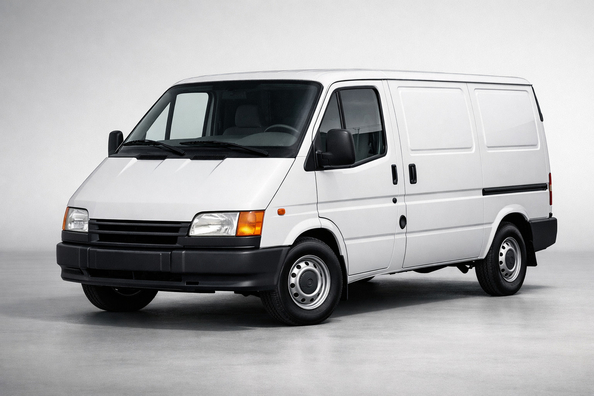

Ford Transit 1991-2000 still makes sense if you need a big, simple work van rather than a quiet modern vehicle packed with electronics. Its value today lies in space, repairability, and the huge number of versions for cargo, people, or a camper project.
But you don’t buy an old Transit for the model name—you buy it for the condition of a specific example. The body, wiring, fuel system, steering, and suspension decide everything: if the metal has already started to go, a cheap purchase quickly stops being cheap.
In the 1990s, the Transit was a basic European commercial van: lots of bodies, lengths, and passenger variants. Today it suits small businesses, tradespeople, service crews, and anyone looking for an affordable base for a camper. It won’t suit those who want modern quietness, brisk overtaking with a weak diesel, and factory-level corrosion resistance.
The 1991-2000 period is usually split into the 1991-1994 version and the updated 1994-2000 vehicle; different catalogs can be confusing, calling it either a fourth generation with a facelift or a separate generation. In practice, what matters is this: in 1991 the Transit received a revised body structure, new front suspension, and updated diesels, and after the 1994 update it became quieter, better equipped, and safer. In 1995-1998 they refined the dashboard, seat belts, ABS, brake force distribution, and the immobilizer. In 2000 an all-new Transit arrived.
The key engine for this model is the 2.5 L diesel. Naturally aspirated versions are found with 68, 70, and 80 hp; turbodiesels with 85 and 100 hp; and from 1998 in some markets a 115 hp variant with an intercooler appeared. For work without overloading, even the naturally aspirated engine is enough, but for highway use and full loads it’s better to look at a turbodiesel.
Petrol versions are rarer: depending on the market, the 2.0-liter engine has 78, 88, or 97 hp, and in some markets and certain bodies there is also a 2.9-liter V6. Gearboxes are mainly 4- or 5-speed manuals, less often a 4-speed automatic. For a specific vehicle it’s best to check the version code, because the same Transit doesn’t always mean the same engine.
This isn’t one vehicle in terms of size—it’s a whole lineup. In 1995 spec sheets you’ll find both the shorter 120C van and a noticeably longer base version, so you need to focus on the exact variant, not a single averaged figure.
| Parameter | What’s known |
|---|---|
| Model period | 1991-2000; in 2000 the Transit changed completely |
| Engines | Petrol 2.0 L with 78/88/97 hp, more rarely 2.9 V6; diesel 2.5 L with 68/70/80/85/100 hp, from 1998 in some markets 115 hp |
| Gearboxes | 4- or 5-speed manual, 4-speed automatic on some versions |
| Wheelbase | 2815, 2840, 3020, or 3570 mm depending on the body |
| Example dimensions | 4620×1970×2220 mm for the 120C 2.5 D or 5368×1974×2669 mm for one of the base versions from 1995 |
| Drive | Rear-wheel drive is confirmed for mid-1990s base vans |
| Weight | Curb weight 1717 kg; gross weight up to 2800 kg on some versions |
| Payload | Up to 1270 kg for the 120C 2.5 D version |
| Cargo compartment volume | 6600 L for the 120C 2.5 D |
| Turning radius | 13.8 m for one of the 1995 versions |
| Fuel tank | 55 or 68 L depending on the variant |
| Ground clearance | There is no single confirmed value: in open spec sheets it is often missing |
| Real-world consumption | Approximately 7.8-10.7 L/100 km based on owners’ logs |
In terms of suspension, the Transit is utilitarian and tough, but tired examples often have issues with steering, power steering, bushings, electrics, and fuel leaks. An empty van can feel harsh, but under load it behaves more logically.
After the 1994 update the cab became quieter, and in 1995 the instrument panel and climate controls were redesigned. For some passenger versions they gradually added three-point seat belts, ABS, airbags, later brake force distribution and traction control. But at its core it’s still an old commercial vehicle, so in comfort and safety it lags far behind newer vans.
In daily life the Transit is valued for space, simple mechanics, and relatively straightforward repairs. When buying, it matters more to look at sills, arches, the bottoms of doors, jack points, the condition of the wiring and fuel lines, than at the mileage number. If you need the vehicle for cargo and highway use, weak naturally aspirated diesels may disappoint; if it’s for city work, service duty, or a camper build, their simplicity often outweighs the slow dynamics.
| Strengths | Weaknesses |
|---|---|
| Large cabin and useful cargo volume | Body corrosion is the main buying risk |
| Simple mechanics and clear maintenance | Weaker diesels feel sluggish under load |
| Wide choice of versions for work or conversion | Electrics, steering, and suspension are often already worn out by age |
| After 1994, better sound insulation and equipment | In quietness and safety the model is outdated |
| Decent real-world economy for an old diesel van | Many specifications depend heavily on market and body |
From an owner’s perspective, the main plus is that the Transit actually hauls and lets you live with simple tech. The main minus is that age shows up not in one area but in several at once, so buying without checking the body and underside almost always turns into expenses.
With an old Transit, what makes sense isn’t decorative tuning but things that simplify daily work and help preserve the body a bit. Curated solutions for the model are available on the accessories page for Ford Transit 1991-2000.
Deflectors, trims, and small exterior decor make sense only after the body, sealing, and mechanicals are sorted. For this model, tuning is justified only when it adds durability or convenience.
The Ford Transit 1991-2000 still has life in it if you need an honest work van with a large interior volume rather than modern comfort. The most sensible choice is a body-sound example, preferably from later years and with a turbodiesel if the vehicle will be used beyond city driving.
If you need quietness, better safety, and fewer age-related surprises, it’s more logical to look at a newer Transit. This material is based on real selection experience, practical know-how, and real usage scenarios, so the conclusion is simple: the old Transit is worth considering only when you choose the right version and the metal is still alive.
| ✔ | The large interior space and good cargo volume make the Transit practical for work, transport, and even camper conversions. |
| ✔ | Simple mechanics and straightforward servicing make repairs easier and reduce dependence on complex electronics. |
| ✔ | There are many versions of the model in terms of length, body, and engine, so it’s easier to choose a vehicle for a specific task. |
| ✔ | After the 1994 update, the cabin became quieter and the equipment better, which is noticeable in later examples. |
| ✔ | The real fuel consumption for an old diesel van looks moderate if the vehicle is in good condition. |
| ✘ | Body corrosion is the main risk, and on older examples it can quickly make a purchase unprofitable. |
| ✘ | Weaker naturally aspirated diesels pull sluggishly under load, especially if the vehicle is often driven on the highway. |
| ✘ | Over time, the electrics, steering, suspension, and fuel lines often wear out, so buying without a thorough inspection is risky. |
| ✘ | In terms of noise, safety, and overall comfort, the model is already noticeably behind newer vans. |
Shipping to EU
Wholesale and retail
Own warehouse
Опис продукту
Подарунки не надаються при оформленні покупки у кредит під 0,01% або при покупці частинами.