04.05.2026
345
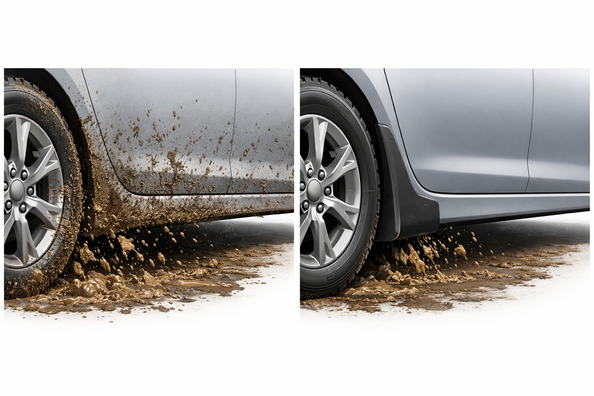
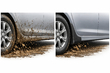
When your doors and sills are constantly covered in mud, the reason is usually not that the car “gets dirty badly,” but a specific spray trajectory coming off the front wheels. Water, sand, and small stones fly backward and upward along the sill, hit the lower edge of the doors, and on some body designs even reach the area near the front edge of the door seal.
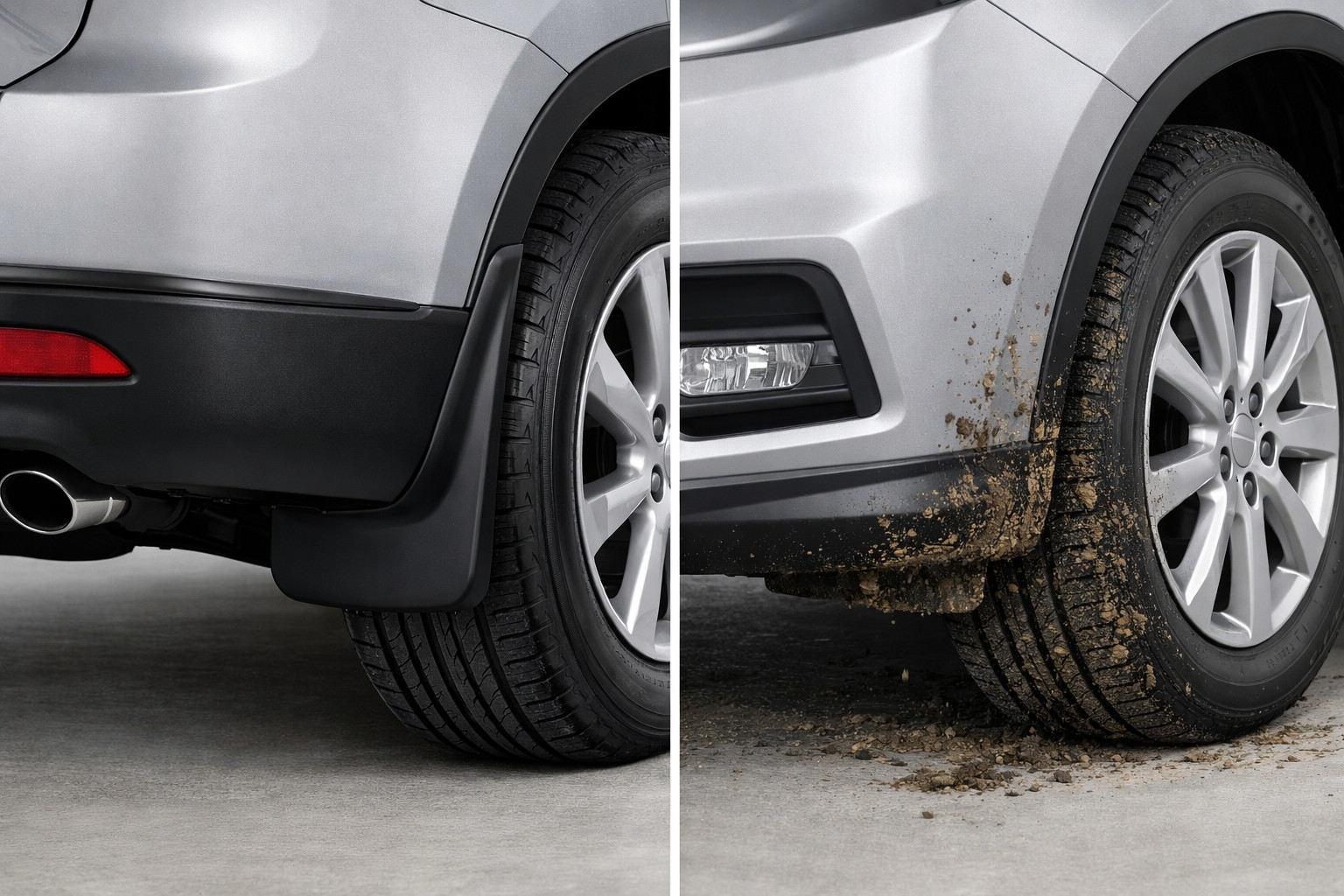
That’s why mud flaps here aren’t cosmetic—they’re a local barrier. They really do reduce the amount of dirt on the sills and doors, especially at the front, but they won’t keep the side of the car perfectly clean. A separate story is the black vertical streaks at the bottom of the doors after rain: this is often water draining out, not necessarily a fault.
On a wet road, the main “dirt thrower” is the front wheel. It lifts a plume of water and abrasive particles, and then the car’s aerodynamics press that flow against the side. That’s why the sill, the lower part of the front doors, and the area right behind the front wheel arch suffer the most.
The pattern depends heavily on speed, season, and the vehicle’s shape. In rain and slush the flow is denser, on the highway the effect is much stronger than in the city, and cars with more exposed sides, wider tires, more wheel poke, or a lifted suspension usually get dirty faster.
After a wash, drive 5–10 km on a wet road and see where the first dirt appears. If the strip starts right behind the front wheel and runs rearward along the sill, the wheel spray is to blame. If the most noticeable marks are thin black vertical streaks from the lower edge of the door, look at the door drains—not only the mud flaps.
Another simple reference is the conditions where the problem is worst. If it’s tolerable in the city but after a rainy highway run the sills are instantly black, that’s a typical aerodynamic pattern. If dirt concentrates near the front edge of the door and the seal area, the flow is likely bypassing that zone from the side. If after installing mud flaps there’s less dirt but it hasn’t disappeared completely, that’s a normal result—not a sign the accessory “doesn’t work.”
DD Tuning expert comment: the most common mistake is expecting mud flaps to completely remove dirt from the side of the car. The second typical mistake is choosing a universal kit that’s too short without considering the arch shape and wheel offset. When selecting, it’s better to look not only at basic compatibility, but also at wheel width, distance to the tire, and mounting points—otherwise the effect will be weak or paint rubbing may appear.
| Symptom | Likely cause | What to do |
|---|---|---|
| The sill and lower part of the front doors are dirty even after a short drive on a wet road | Plume of water and sand from the front wheel | Install front mud flaps of the right shape and size; check whether the wheel spray is too exposed |
| Dirt hits exactly the area between the front doors and the sill | The flow bypasses the front edge of the door or the seal | Focus on front model-specific solutions; check the fit of components near the arch and the door edge |
| After rain, black vertical streaks are visible from the bottom of the doors | Water exits through drain holes in the doors | Don’t mistake this for a failure; rinse the lower door edge and check that the drains aren’t clogged with dirt |
| After installing a mud flap, wet dirt accumulates behind it | Poor installation or a design that creates a pocket for debris | Reinstall; check the fasteners; wash the area behind the mud flap regularly and monitor the paintwork |
| The rear doors and bumper are still dirty, even though the front is better | Rear mud flaps have less effect on this body style | Don’t expect the same result from rear mud flaps as from front ones, especially on cars with a short rear overhang |
Front mud flaps matched to the specific wheel-arch geometry—or close to the OEM design—work best. They intercept part of the flow before dirt starts running along the sill. The front pair most often delivers a noticeable result in rain, slush, and on roads with small stones.
Good maintenance habits also help: wash not only the body, but also the area behind the mud flaps and the lower edge of the doors. This matters not so much for cleanliness itself, but to prevent salt, sand, and moisture from building up under the accessory. If your car runs wider wheels or rims with a large offset, it’s worth factoring in from the start that even a good kit will work worse than on the stock setup.
A bad bet is relying only on rear mud flaps if most of the dirt is hitting the front doors and sill. On many body styles with a short rear overhang, they add only a small extra effect and don’t solve the main problem.
Overly small universal flaps that sit far from the tire or don’t cover the plume also work poorly. Don’t assume that installation alone solves it forever: if the mud flap sits crooked, rubs the paint, or constantly packs dirt behind it, it creates a different problem. Regular washing without changing the flow trajectory doesn’t fix the cause either—it only removes the result until the next drive.
If your car drives daily in rain, slush, on dirt roads, or over broken city streets, mud flaps almost always make sense. It’s not a way to make the side of the car sterile, but a way to reduce the amount of abrasive material hitting the sill and the lower edge of the doors.
When you want the most precise fit, factory mounting holes, and predictable geometry, it makes sense to look at original mud flaps. If the sill is already scuffed by sand and shoes, door sill plates are also appropriate—but it’s important to understand the limit: they protect the sill surface from contact and fine abrasion; they don’t redirect the water flow from the wheel.
Replacement or reinstallation is needed when the current mud flap sits too low, rubs the tire, pulls away from the body, or collects a dirty pocket behind it. In that condition, the accessory no longer helps to its full potential and can damage the finish.
| Solution | When it works | When it’s not worth spending money |
|---|---|---|
| Front model-specific or original mud flaps | When most of the dirt flies from the front wheels onto the sill and lower door area | When you expect a perfectly clean side or you have an incompatible body kit with no proper fitment |
| Rear mud flaps | When you need to slightly reduce dirt behind the rear arch or on the bumper | When the main problem is the front doors and sills, especially on a body with a short rear overhang |
| Door sill plates | When you need to protect the sill paintwork from scratches and sand | When you want to reduce the actual water-and-dirt flow from the wheel |
| Regular cleaning of the area behind the mud flaps and the door drains | When accessories are already installed and you need to prevent salt, sand, and moisture buildup | When this is the only measure instead of properly selecting the right mud flaps |
| Reinstalling or replacing a poorly chosen kit | When there is paint rubbing, misalignment, excessive gap to the body or tire | When the current kit is installed correctly and delivers the expected result |
From a customer’s experience: a crossover owner came in with a typical complaint—after every rain the sills and the lower part of the front doors were black, even though the car was washed regularly. After selecting front mud flaps for the specific arch, there was noticeably less dirt in the sill area, but thin black streaks from the bottom of the doors sometimes remained. After inspection it turned out this was a normal trace from the door drains, not a sealing defect, and expectations from the accessory became more realistic.
Persistent dirt on doors and sills most often has one basic cause: the front wheels throw water and abrasive material toward the sill, and the body airflow carries it along the side. Front mud flaps really do work when selected and installed correctly, but their job is to reduce contamination, not eliminate it completely.
To avoid wasting money, first look at the dirt pattern: a strip from the arch, dirt near the front edge of the door, or vertical streaks from the drains are different scenarios. This material is based on real-world selection experience, practice, and real usage cases, so the main advice is simple: identify the source of the dirt first, and only then choose a solution.
| ✔ | Front mud flaps really reduce the amount of dirt flying onto the sills and the lower part of the front doors. This is most noticeable in rain, slush, and on roads with fine gravel. |
| ✔ | The issue can be diagnosed by the pattern of dirt: a streak from the front wheel, vertical run marks from the bottom of the doors, or dirt near the front edge of the door indicate different sources. This helps avoid replacing parts blindly. |
| ✔ | OEM or model-specific mud flaps are better suited for cars with the factory wheel arch geometry and proper mounting points. With this fit, the effect is more stable and the risk of rubbing is lower. |
| ✔ | Regular cleaning of the area behind the mud flaps and the lower edge of the doors helps prevent the build-up of salt, sand, and moisture. This reduces additional wear and dirt under the accessory. |
| ✔ | Sill trims are useful where there are already scuffs from sand or shoes. They protect the paint on the sill from scratches, even if they do not change the dirt trajectory. |
| ✘ | Mud flaps do not remove dirt completely, but only partially reduce it. If you expect a “sterile” side, the result will be disappointing. |
| ✘ | Rear mud flaps on many body styles have a weaker effect, especially if the main problem is the front doors and sill. They do not solve the main flow from the front wheels. |
| ✘ | Too short or universal flaps work poorly if they are far from the tire or do not cover the spray of water. In that case, the dirt hardly changes course. |
| ✘ | Poor installation can create a pocket for wet dirt or even rub the paint. Then the accessory no longer helps, but adds a new problem. |
Shipping to EU
Wholesale and retail
Own warehouse
Опис продукту
Подарунки не надаються при оформленні покупки у кредит під 0,01% або при покупці частинами.