
































































 Author: Radomskyi Maksym Vasyliovych
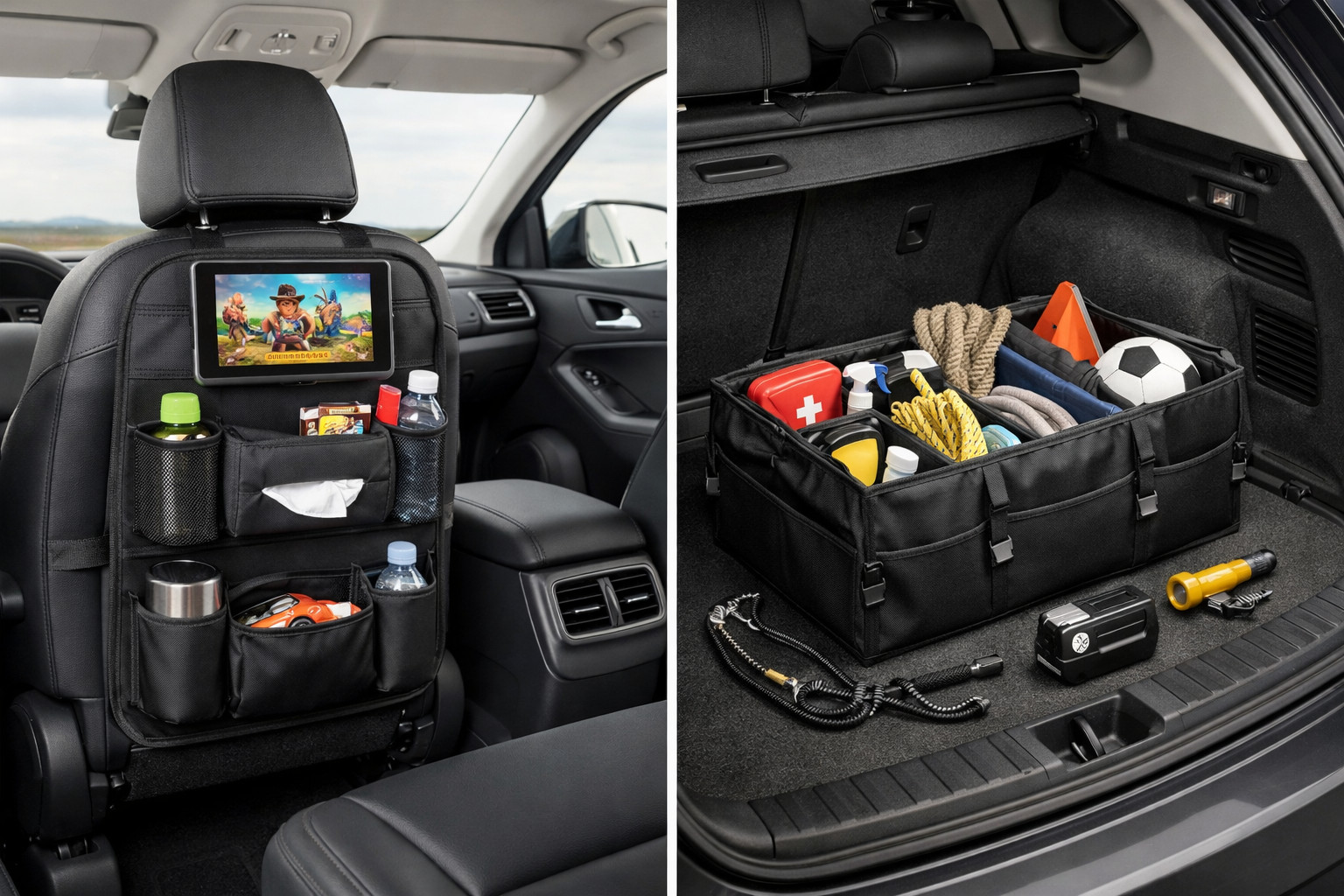
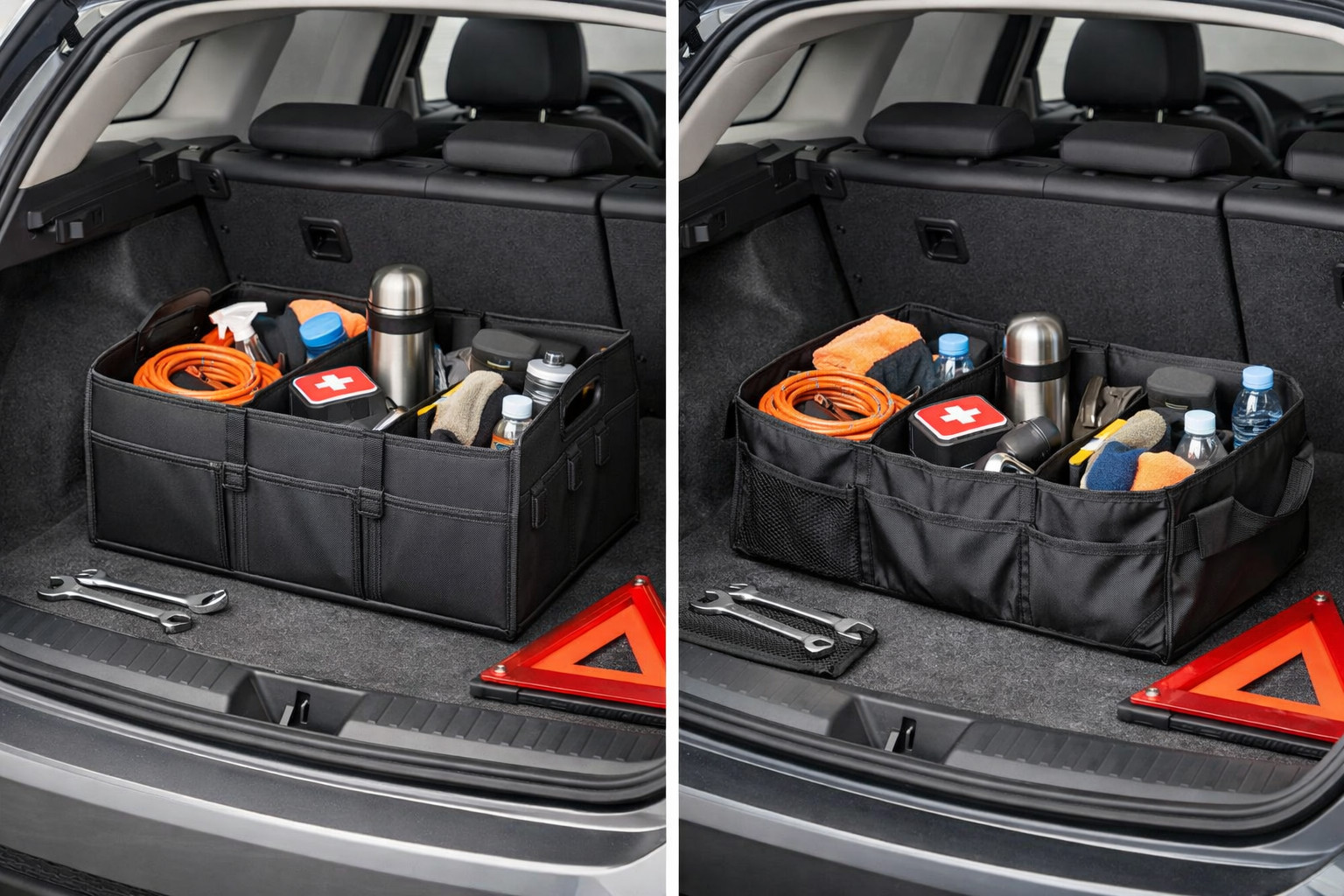
For a daily-driven car, the most convenient option is often not a fully rigid box, but a soft or semi-rigid foldable trunk organizer with a rigid bottom, a lid, and proper fastening. It adapts better to groceries, small items, car chemicals, and a seasonal kit in the trunk—and when you need to carry boxes, a suitcase, or a stroller, you can quickly fold it down or remove it.
A fully rigid plastic organizer follows a different logic: it holds its shape better, is easier to wash, and is better suited for bottles, jerrycans, tools, or fragile items. So the choice here isn’t “better” versus “worse,” but flexibility for everyday use versus maximum stabilization in dirty or heavy-duty scenarios.
What the choice is really about
If the car is used daily, the organizer should not only hold your stuff—it should also stay out of the way of the trunk itself. That’s why an overly rigid box often loses in typical city use: it takes up a fixed volume even when empty and handles weekly changes in what you carry less well.
A soft bag or a framed foldable trunk organizer works better when today you have groceries, tomorrow sports gear, and the day after a jerrycan, a brush, and a bag of small items. But if you regularly carry liquids, tools, glass bottles, or anything dirty, the advantage shifts to a rigid solution that’s easier to clean and does a better job of preventing the contents from tipping over.
Another important point: the line between soft and rigid has long been blurred. In practice, many of the best models are hybrids—fabric bodies with a rigid bottom, reinforced wall inserts, and a lid.
What criteria to compare by
- Installation and securing. For a daily car, Velcro to the trunk carpet, a non-slip bottom, straps, or carabiners are decisive. Without these, even a good organizer will slide around.
- Noise. In a sedan this is less critical because the trunk is isolated. In a hatchback, wagon, or crossover, any unsecured rigid box will start to annoy much faster.
- Durability. It’s better judged not by promises, but by bottom stiffness, seams, zippers, handles, and fastening quality. Weak hardware is usually the first thing to fail.
- Practicality. It matters whether the organizer can be folded, how easy it is to carry, whether it has a lid, and how easy it is to shake out debris and wash the bottom after winter.
- Price. Paying extra makes sense not for “premium,” but for rigid inserts, a lid, water-resistant material, higher load capacity, and better mounting.
For most passenger cars, a convenient working capacity range is roughly 20–60 L. Bigger isn’t always better: an oversized trunk organizer takes up half the trunk even when it’s only half full in reality.
Quick comparison of options (table)
| Option | Strengths | Weaknesses | Best for |
|---|---|---|---|
| Soft organizer | Easy to fold, adapts to irregularly shaped items, convenient for daily groceries and small items | Holds shape worse, can slide without mounting, offers less protection for fragile items | Anyone who wants order without losing usable trunk space |
| Framed foldable trunk organizer | Balance of flexibility and stability, rigid bottom, often has a lid and sections, folds flat | More expensive than a simple soft bag; cheap models may have weak walls and hardware | Most daily drivers, family cars, and crossovers |
| Rigid plastic organizer | Holds shape well, easy to wash, convenient for tools, bottles, car chemicals, and dirty items | Doesn’t fold, takes up space even when empty, can rattle without securing, less flexible for groceries | Anyone who constantly carries heavy, wet, fragile, or technical items |
DD Tuning expert comment: Most often, people don’t get the type wrong—they get the size and mounting wrong. They buy a big box “for future needs,” and then it either slides around or blocks normal access to the trunk. If your car is a hatchback or wagon, look first at securing, bottom stiffness, and a lid—and only then at the number of pockets.
Detailed breakdown of each option
Soft organizer
This is the most flexible format for an everyday set of items. It handles shopping bags, gloves, chargers, wipes, a first-aid kit, small tools, and oddly shaped purchases better. Its strong point is compactness when folded: when you need to carry something large, you simply move the organizer aside.
The downsides are obvious too. If the walls are too soft and the bottom is thin, the organizer starts to collapse, loses its shape, and becomes annoying after just a few weeks. For bottles, jars, chemicals, and fragile items, a fully soft option isn’t the best.
Framed foldable trunk organizer
This is the most practical compromise. These models usually have a rigid bottom, sections, sometimes a lid, external pockets, and a folding mechanism to a flat state. They hold their shape better than soft bags, but don’t consume the trunk the way a plastic box does.
This type most often covers everyday tasks without unnecessary compromises. If the material is water-repellent, the bottom is dense, and there’s Velcro or non-slip inserts underneath, such an organizer is equally convenient for weekly groceries, a winter kit, and trips out of town.
Rigid plastic organizer
Its advantage is that it honestly does the technical job: it keeps its shape, isn’t afraid of moisture, and is easier to wash after jerrycans, oil, dirty tools, or wet items. If it’s important that glass bottles or liquids stand upright, a rigid box is the more logical choice.
But for a typical city car, it’s often an overkill solution. It doesn’t fold, has a fixed volume, and without additional mounting can create noise. In a car where the trunk constantly lives in “groceries today, suitcase tomorrow” mode, it’s not always convenient.
Which option is better for different scenarios
For daily city use, where the trunk needs to remain flexible, a framed foldable trunk organizer works best. It keeps things tidy but doesn’t turn the trunk into storage with a permanent rigid box.
If you have a hatchback, wagon, or crossover where everything is audible from the cabin, priority shifts toward models with a lid, secure mounting, and a dense bottom. In these body styles, it’s not the organizer itself that’s irritating—it’s the rattling in turns.
Rigid plastic is worth choosing when the set of items is stable: car chemicals, work tools, bottles, jerrycans, small equipment. But if your trunk sees different scenarios every day, a soft or framed format will be more convenient in almost everything.
Use-case scenario and what to choose (table)
| Scenario | Best choice | Why |
|---|---|---|
| Daily city driving, groceries, small items | Framed foldable trunk organizer | Holds its shape but folds when you need free trunk space |
| Small sedan, minimal items | Soft organizer | Doesn’t overload the space and takes minimal room when folded |
| Hatchback or wagon where quiet matters | Framed organizer with Velcro and a lid | Less noise, better fixation, items don’t fly around on bumps |
| Tools, car chemicals, jerrycans, bottles | Rigid plastic organizer | Easier to wash, heavy and dirty items stay in place better |
| Family car, weekend trips | Semi-rigid multi-compartment organizer | Lets you separate kids’ items, groceries, a first-aid kit, and small things |
| Winter, moisture, snow, mud | Rigid or framed with a water-resistant bottom | Less moisture absorption, easier cleanup after the season |
Common mistakes when choosing
- Choosing by liters instead of dimensions. You need to look at width, height, and whether it blocks access to the storage well, spare tire, or trunk threshold.
- Ignoring mounting. Without Velcro, straps, or a non-slip bottom, the organizer will slide around regardless of price.
- Mixing up daily use with technical use. For groceries and small items you don’t need a big plastic box, and for bottles and tools an overly soft bag doesn’t work best.
- Overpaying for the number of pockets. If there are too many pockets and access is awkward, it’s not order—it’s extra fuss.
- Underestimating material and hardware. Weak zippers, a thin bottom, and soft handles wear out faster than the fabric itself.
- Not considering the car body style. What lives fine in a sedan can constantly rattle and annoy in a hatchback.
When a more expensive option makes sense
A more expensive organizer makes sense when you use it constantly rather than occasionally. If there are always heavy items, liquids, tools, or a winter kit in the trunk, paying extra for a rigid bottom, a lid, water-resistant material, and proper mounting quickly becomes justified.
The second case is when you need not just a “box for chaos,” but a neat everyday solution. In that situation, it’s worth looking not at the cheapest segment, but at organizer bags with a frame and folding. If water, dirt, and snow regularly appear in the trunk, it makes sense to add an EVA trunk mat right away. And for the dirtiest or work scenarios, instead of fabric—or together with it—more practical can be plastic trunk liner.
From a customer’s experience: in a crossover they carried groceries, kids’ items, car chemicals every day and occasionally folding tools. They first tried a plastic box, but it constantly took up space and rattled on uneven roads. After switching to a framed foldable trunk organizer with a rigid bottom and a lid, the trunk stayed manageable: items don’t roll around, and when something large needs to be carried, the organizer folds in a minute.
Conclusion
For a daily-driven car, the most convenient option in most cases is a soft or semi-rigid foldable organizer with a rigid bottom, a lid, and proper mounting. It’s better adapted to real life, where what you carry keeps changing, and you don’t want to occupy the trunk with a rigid box permanently.
A rigid plastic organizer is worth getting when the priority isn’t flexibility, but stabilization, washability, and working with heavy, wet, or fragile items. This conclusion is based on real selection experience, hands-on practice, and real use cases: what people carry every day, how often they fold the organizer, and how critical noise, service life, and trunk convenience are for them.
How it works
- Assess your daily use case First, decide what you carry most often: groceries, small items, children’s things, car care products, tools, or cans. For flexible everyday use, a soft or framed foldable organizer is better, while for heavy and dirty items, a rigid plastic one is more suitable.
- Choose the type by priority If it is important to keep the trunk free and be able to fold the organizer quickly, choose a soft or semi-rigid case with a rigid base. If you need maximum hold, easy cleaning, and stability for bottles, tools, or car care products, it is better to choose a rigid plastic option.
- Check fastening and fixation Before buying, make sure there are Velcro fasteners to the carpet, an anti-slip base, straps, or carabiners. Without proper fastening, even a good organizer will move around the trunk and create noise.
- Choose the size for the trunk Look not only at the volume in liters, but also at the width, height, and whether the organizer will block access to the side compartment, spare wheel, or trunk lip. For most passenger cars, a range of about 20–60 l is practical.
- Assess the material and ease of use Check the firmness of the base, the quality of the seams, zippers, handles, and lid, as well as whether the organizer can be folded and easily shaken out or washed after winter. If you often carry dirt, water, or snow, it makes sense to look for a water-resistant base and lid.
- Match the option to the body type In a sedan, noise is less critical, while in a hatchback, estate, or crossover, silence and stable fixation matter more. For a family car and daily trips, a framed foldable case usually works best, while for technical use cases, a rigid organizer is the better choice.
Pros and cons
A soft or framed foldable organizer is better suited for everyday changing tasks: shopping, small items, car care products, and seasonal kit. It can be folded or removed when you need to free up the trunk for larger items.
A framed case provides a balance between shape and flexibility: it keeps items organized, but does not take up space as rigidly as a plastic box. For a city car, this is practical because trunk volume is not constantly lost.
A rigid plastic organizer is convenient for bottles, cans, tools, and fragile items. It holds its shape better and is easier to clean after dirt or spilled liquids.
For hybrid models with a rigid base, lid, and anti-slip mounting, everyday convenience increases. Such options move around the trunk less and do not get in the way on uneven roads.
In a family car or for weekend trips, a multi-section semi-rigid organizer helps separate shopping, children's items, a first-aid kit, and small things. This makes it easier to access what you need without fully rummaging through the trunk.
A fully rigid plastic organizer does not fold and takes up a fixed amount of space even when empty. In everyday city use, this is often inconvenient, because the trunk is needed for different tasks.
A soft organizer without a proper base and fastening can lose its shape, tip over, and slide around in the trunk. It protects bottles, cans, and fragile items worse.
Cheap framed models may have flimsy walls and weak hardware. In that case, durability drops not because of the format itself, but because of the quality of the seams, zippers, handles, and fasteners.
An overly large organizer can take up half the trunk even when it is only half full. The author recommends focusing not only on liters, but also on the actual dimensions and access to the compartment or spare wheel.