

































































 Author: Radomskyi Maksym Vasyliovych
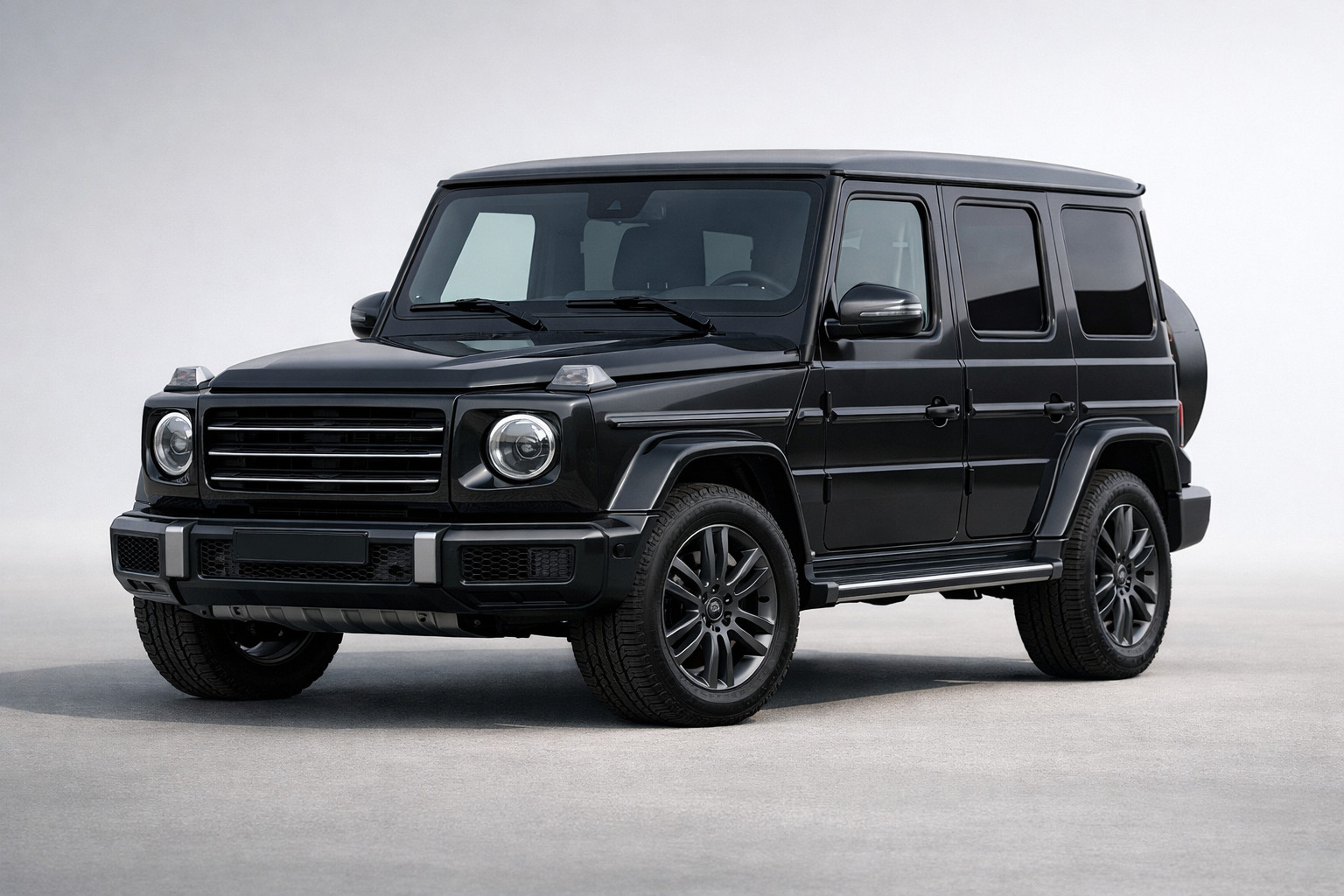
Mercedes G-Class 2018-2024 is not a rational family SUV, but an expensive body-on-frame machine with a very strong character. People buy it for the driving position, the shape, the sense of solidity, a true full-time 4WD system with low range and lockers—not for silence, easy ingress, or fuel savings.
In these years there’s one main trap: don’t mix up 2018 with 2019-2024. From the outside the difference isn’t dramatic, but technically they are different vehicles: 2018 is the finale of the old school, while from 2019 the G-Class became more modern inside, roomier, and more convenient for daily life—although wind noise, heavy doors, and expensive ownership didn’t go anywhere.
Model and its place in the market
The G-Class stands apart even among expensive SUVs. It’s less comfortable on asphalt than a Range Rover and less everyday-practical than a Defender, but it delivers exactly what people expect from it: an upright seating position, body-on-frame construction, a highly recognizable silhouette, and the feeling that it’s not just a big crossover.
Who it suits: those who consciously want an image-driven SUV with a real off-road arsenal and are ready to put up with the size, consumption, and running costs. Who it doesn’t suit: anyone looking for a quiet highway vehicle, easy ingress for short daily trips, and maximum utility for the same money.
- Model plus: the combination of status and genuine off-road hardware.
- Model minus: lots of day-to-day compromises, especially in the city and on the highway.
Generations and model history
2018 was the last year for the old technical version of the G-Class. It’s a vehicle with a very archaic feel: a tighter cabin, less everyday convenience, an older transmission, but the same boxy image people love it for.
From 2019, a new generation started with the same overall silhouette, but with a deep rework of the chassis, interior, and ergonomics. The vehicle became wider inside, cargo capacity grew to 1079 L, front and rear seating became less of a compromise, and the nine-speed automatic better matches the character of a heavy vehicle.
In 2024 there was no major change in concept: open sources mention G 550, AMG G 63, and the extreme 4x4 Squared. In other words, the idea remained the same: the G-Class is sold not as a universal family car, but as a distinct type of expensive SUV with a very recognizable presence.
Engines and transmissions
For this period, it’s easiest to ориент yourself around the gasoline versions, which are clearly documented in publicly available technical data. In 2018, the G 550 had a 4.0-liter V8 biturbo with 422 hp and 610 N·m with a 7-speed automatic transmission. That same year, the AMG G 63 was equipped with a 5.5-liter V8 biturbo with 571 hp and 761 N·m, also with a 7-speed automatic.
After the generation change, the 2019-2024 G 550 kept the 4.0-liter V8 with 422 hp and 610 N·m, but received a 9-speed automatic. In 2024, the AMG G 63 is already a 4.0-liter V8 with 585 hp and 850 N·m with a 9-speed automatic. For all of them, the key point isn’t only the engine but the drivetrain: permanent all-wheel drive, a two-speed transfer case, and three locking differentials.
| Version | Engine | Power and torque | Transmission | Ground clearance | Cargo capacity |
|---|---|---|---|---|---|
| G 550 2018 | 4.0 L V8 biturbo | 422 hp, 610 N·m | 7-speed automatic | 205 mm | 660/2127 L |
| AMG G 63 2018 | 5.5 L V8 biturbo | 571 hp, 761 N·m | 7-speed automatic | depends on version | data varies by market |
| G 550 2019-2024 | 4.0 L V8 turbo | 422 hp, 610 N·m | 9-speed automatic | 241 mm | 1079/1943 L |
| AMG G 63 2024 | 4.0 L V8 turbo | 585 hp, 850 N·m | 9-speed automatic | 236 mm | 1079/1943 L |
Important: you shouldn’t mechanically compare 2018 and 2019-2024 only by power figures. After the redesign, not only the transmission and interior changed, but also the overall feel of the vehicle. Likewise, you can’t lump together the G 550, AMG G 63, and 4x4 Squared: their weight, dimensions, and everyday use cases differ noticeably.
Body, dimensions, and chassis
The G-Class’s strong side is its closed body-on-frame construction, permanent all-wheel drive, and a serious off-road setup without decorative gimmicks. For the 2018 G 550, we have a 2850 mm wheelbase, 4765 mm length, 205 mm ground clearance, and 599 mm wading depth. For the G 550 2019-2024: a 2891 mm wheelbase, 4818 mm length, 241 mm ground clearance, approach and departure angles of 30.9° and 29.9°, and a 13.6 m turning circle.
The AMG G 63 2024 is a bit longer still—4873 mm—and ground clearance is 236 mm. In practice, that means one simple thing: even in the newer generation, the G-Class remains big, heavy, and not very maneuverable for a tight city. The high seating position gives good off-road geometry, but on asphalt you feel the mass, brick-like aerodynamics, and a sizable turning radius.
The suspension doesn’t hide the vehicle’s character. This isn’t a soft road cruiser, but a heavy body-on-frame SUV that became more civilized after 2019, yet didn’t lose its firm, sometimes rough delivery. That’s exactly why the G-Class appeals to those who want a “mechanical” feel—and irritates those who expect the ease of a large city vehicle.
Interior, comfort, and safety
The biggest leap happened in the cabin after 2019. There’s more space, the dashboard stopped looking museum-like, and the cargo area grew so much that the vehicle is no longer perceived purely as an image toy for daily use. But that doesn’t отменяет old traits: a high cargo floor, heavy side-hinged doors, and entry over a tall sill remained part of the everyday experience.
Comfort in the G-Class has always been специфічний. People like the high command seating position and the feeling of a lookout tower, but not everyone likes the wind noise at speed, the short door openings, and the fact that you literally have to climb into the vehicle. In 2019-2024, safety and electronic driver aids are noticeably more modern than in 2018, but the exact set depends on market and trim, so when buying a конкрет vehicle it’s worth checking the equipment separately.
Everyday use
Day to day, the G-Class requires getting used to. The newer generation’s width with mirrors reaches 2187 mm, so narrow parking spaces, tight courtyards, and old underground garages quickly remind you this isn’t a compact city car. The doors are heavy, the sill is high, and getting in requires a body movement, not just a step into the cabin.
Running costs also come with no surprises: they’re high. For 2024, open sources list consumption of about 16.8 L/100 km in the combined cycle, a 100 L tank, but in real city driving the appetite feels even stronger. For 2021-2024 vehicles, there’s an extra reason to pay attention to service history and recall work, including regarding the fuel system.
On the other hand, the G-Class has a strong reserve of torque, a high seating position, a true off-road drivetrain, and decent towing potential. So it can be a working tool for demanding scenarios—but those scenarios need to be real, otherwise the owner is simply paying every day for capabilities they don’t use.
Strengths and weaknesses
The G-Class’s strength is that it honestly delivers exactly what it promises: character, shape, torque, and genuine 4WD hardware. The weakness is the daily cost of that image: fuel, noise, mass, ingress/egress, and ownership costs.
| Aspect | Strengths | Weaknesses |
|---|---|---|
| Image and perception | One of the most recognizable shapes on the road, a strong sense of status | Often bought emotionally, then owners face expensive compromises |
| Off-road capability | Frame, low range, three lockers, high ground clearance | Most vehicles rarely use this potential to the fullest |
| Engines | Powerful V8 even in the base version, plenty of low-end pull | High fuel consumption and expensive maintenance |
| Comfort | High seating position, sense of solidity, better interior after 2019 | Wind noise, heavy doors, inconvenient entry and exit |
| Practicality | Newer generation has significantly better cargo space and ergonomics | Still not the most convenient format for city life and family routine |
Tuning and accessories
For the G-Class, tuning makes sense when it solves a specific task. With this model it’s easy to go purely decorative, but the smartest approach is to define your use case first: urban driving, off-road trips, winter travel, carrying cargo, or simply a desire to change the look without вмешательство in the mechanics.
If you need a starting point, take a look at the accessory подбор for G-Class W463 2018+. It’s more convenient than buying parts at random, because you can сразу see whether you need functional protection, an exterior package, or just a few small elements for your own scenario.
What to check out for this model
- Front protection 2018+ — a useful option if the vehicle doesn’t only drive on clean asphalt and you need to shield the lower front section from small контакти and dirt.
- BRABUS body kit — a solution for those who consciously work with the vehicle’s image and understand it’s a change in appearance, not a gain in off-road capability.
There’s truly room to upgrade a G-Class: from protection and exterior elements to cargo solutions and heavy-duty parts. But with this model, what works best isn’t the maximum list of parts—it’s a precise selection for how the vehicle is used every day.
Conclusion
Mercedes G-Class 2018-2024 is worth buying when you specifically want a G-Class—not just an expensive large SUV. It’s strong on image, off-road hardware, powerful V8s, and the feeling of a special vehicle, but weaker in noise, ease of entry, maneuverability, and everyday running costs.
Looked at soberly, 2018 is a choice for the old school, while 2019-2024 is a much more logical option for real use. This material is based on real selection experience, practice, and real-world use cases, so the main takeaway is simple: people buy a G-Class not for versatility, but for character—and you have to be ready to live with that character every day.
Pros and cons
Strong off-road hardware: the ladder-frame construction, permanent all-wheel drive, low-range gearing, and three differential locks deliver real off-road capability, not just the SUV image.
The car has a very recognizable silhouette and a sense of status that does not get lost among other expensive SUVs.
After 2019, the cabin became noticeably better for everyday use: more space, a more modern dashboard, and a more comfortable seating position in both front and rear.
The G-Class has strong petrol V8 engines with plenty of low-end torque, so it drives confidently in the city, under load, and in more demanding conditions.
The newer generation gained significantly better practicality: the trunk grew to 1079 l, and the 9-speed automatic transmission better suits the vehicle’s weight.
In everyday life, the G-Class is inconvenient: heavy doors, a high sill, and a seating position where you practically climb in rather than just sit down.
The car is large and not very maneuverable for the city: the width with mirrors is substantial, and the turning radius and dimensions quickly become noticeable in tight parking lots and courtyards.
Fuel consumption is high, and maintenance is expensive, so the car requires noticeably higher costs than many other SUVs in this class.
Even after the update, the G-Class did not become quiet or soft: wind noise, a firm and sometimes rough suspension, and the vehicle’s mass remain part of its character.