05.06.2026
335
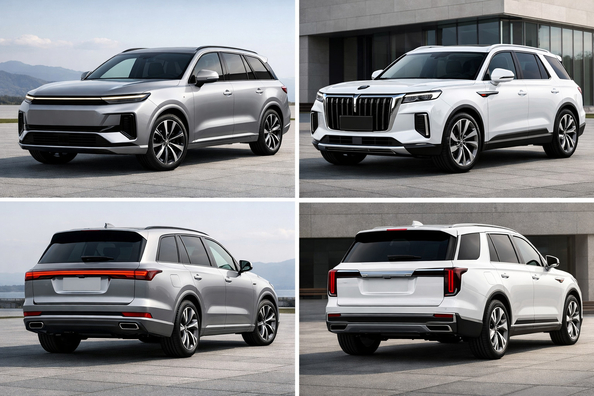
The choice between the Li Auto L9 and the Hongqi E-HS9 comes down not to the badge, but to how you drive every day. If you need a large family crossover for long trips, winter, and routes where charging isn’t always close at hand, logic points to the Li Auto L9. If you have reliable home or office charging and you want a truly large, quiet EV with a very spacious cabin, the Hongqi E-HS9 looks stronger.
There’s also an important numbers trap. For the L9, the parallel market often mixes specs from different generations, while the E-HS9’s characteristics noticeably depend on the battery, trim level, and market. So you should compare not the advertised maximums, but the specific version of the car for your scenario.
Li Auto L9 is essentially an EV in feel, but with a gasoline generator that removes the biggest fear of long-distance driving: being forced to stick to charging stations. That’s why its strength isn’t only range, but route predictability in winter, on the highway, and in regions with uneven infrastructure.
Hongqi E-HS9 is a different philosophy. It’s a large pure EV with a very spacious cabin, strong passenger comfort, and a quiet ride. But you pay for that quietness with greater dependence on charging—especially if the car drives far, often, and in the cold.
| Option | Strengths | Weaknesses | Who it’s for |
|---|---|---|---|
| Li Auto L9 | Long trips without constant dependence on chargers, very comfortable suspension, quiet ride, strong 6-seat family format | You must carefully verify the generation and model year, there are questions about brakes under hard use, more complex powertrain layout and service | Those who often drive highways, live in a cold climate, or don’t have stable charging infrastructure |
| Hongqi E-HS9 | Pure EV, very spacious cabin, 6 or 7 seats, city quietness, strong passenger comfort | High consumption, bigger range drop in cold weather, slower real-world charging, important questions about resale value and software | Those who have their own charging, mostly drive in the city, and want a large EV without a gasoline component |
DD Tuning expert comment: The most common mistake is comparing only the claimed range. With the E-HS9, it’s critical whether you have proper charging at home or at work, and with the L9 you need to check not only the year of manufacture, but also the exact generation and which market the car was imported for. Another frequent miss is underestimating how much stress comes not from energy consumption itself, but from an inconvenient daily-use scenario.
The L9’s strong point is versatility. It’s one of the few large family crossovers that in the city can feel almost like an EV, yet on the highway doesn’t force you to plan every stop around charging. For cold regions this is especially important: in winter you’re less dependent on how fast the car will accept a charge and how much real range remains after a freezing night.
The weak spot is complexity and ambiguity of specific versions. Publicly, figures for different L9 generations circulate at the same time, so without checking the VIN, year, and battery, it’s easy to buy something different than expected. Add to this remarks about the brakes under heavy use and possible minor ownership nuances outside a well-developed service network.
The E-HS9 wins in another way: it’s a big, quiet, very spacious EV that works well as an urban family car or a premium shuttle. It has a roomy interior, comes in 6- and 7-seat versions, and practicality in the second and third rows is higher than many expect from a flashy flagship.
But this comfort depends directly on charging discipline. If you don’t have your own charging, or the car often drives far, the E-HS9 quickly stops being convenient. In the cold, both range and charging speed drop, and the heavy weight and soft chassis tuning make it more of a relaxed cruiser than a precise driver’s tool.
For family trips between cities the Li Auto L9 is better. Its main advantage isn’t the absolute number on paper, but peace of mind on a real route.
For daily city driving with home charging the Hongqi E-HS9 is more interesting. Here you truly get the benefits of a big EV: silence, smoothness, and space.
For winter, морозів and uneven infrastructure the L9 wins again, because the gasoline backup saves you where an EV starts to require more planning.
For a quiet corporate or hotel shuttle the E-HS9 makes sense, but only if charging is your own and the schedule is controlled. If mileage is unpredictable, the L9 is more practical.
| Scenario | What’s better to choose | Why |
|---|---|---|
| City 50–100 km per day, own charging available | Hongqi E-HS9 | Best unlocks the advantages of a pure EV: silence, smoothness, large cabin |
| Frequent intercity trips 300–600 km | Li Auto L9 | Less dependence on the charging network, easier to plan the road and stops |
| Winter operation and морозів | Li Auto L9 | Lower risk of losing convenience due to range drop and slower charging |
| Large family car mainly for the city | Hongqi E-HS9 | Spacious cabin, 6- or 7-seat options, comfortable passenger-oriented character |
| Executive shuttle with unpredictable mileage | Li Auto L9 | More flexibility without being tied to charging infrastructure |
Paying extra for the Li Auto L9 is justified when the car must work without stress in real life: long routes, family, winter, regions where fast charging is there one day and gone the next. Here you’re paying not for pretty numbers, but for freedom of use.
Paying extra for the Hongqi E-HS9 is logical in a different case: you specifically want a large EV, have stable charging, and will use it mostly in a predictable routine. If your choice leans toward the E-HS9, it’s worth budgeting right away for practical interior protection: EVA mats are convenient for everyday dirt, rubber mats are useful for winter, and eco-leather seat covers help keep the expensive interior looking fresh for longer.
From a customer’s experience: a buyer was selecting a large family crossover for a city-plus-regular-intercity trips routine, but without stable fast charging along the way. After comparing, they chose the Li Auto L9 not for dynamics, but for peace of mind on winter trips and the lack of dependence on every single charging point. In a similar city scenario with their own charging, the choice, on the contrary, more often shifts toward the E-HS9.
The Li Auto L9 is better suited to those who need a large family flagship for highways, морозів, and unpredictable routes. The Hongqi E-HS9 is stronger as a spacious, quiet EV for the city and a controlled routine with reliable charging. The final choice should be made after verifying the specific version, year, and market—not based on averaged figures from listings. This material is based on real selection experience, hands-on practice, and real usage scenarios, so the main takeaway is simple: the L9 is about versatility without stress, the E-HS9 is about electric comfort where infrastructure is already sorted out.
| ✔ | Li Auto L9 is better suited for long trips, because it doesn’t tie the driver to charging stations and handles winter routes more easily. This is practical for highways, frost, and regions with uneven infrastructure. |
| ✔ | Hongqi E-HS9 offers a quiet ride and a very spacious cabin, which is especially noticeable in the city and as a family or corporate shuttle. It comes in 6- or 7-seat versions. |
| ✔ | L9 seems more versatile in everyday use because it combines electric driving feel with a gasoline backup. This reduces the risk of inconvenient stops on intercity trips. |
| ✔ | E-HS9 performs well where there is home or office charging. In this scenario, the owner gets smoothness, silence, and a large cabin without having to think about fuel often. |
| ✔ | For family trips between cities, L9 is more practical because it gives more freedom in route planning. In the article, it is directly named the better option for regular 300–600 km trips. |
| ✘ | Li Auto L9 has a version-related complexity: different generations are found on sale, so without checking the VIN, year, and battery, it is easy to get the specific car wrong. This makes buying on the secondary market more difficult. |
| ✘ | L9 is mentioned to have brake-related remarks in hard use. It also has a more complex powertrain setup and more service-related issues than a simple electric car. |
| ✘ | Hongqi E-HS9 depends heavily on charging discipline: without a home charging station or with frequent long-distance trips, it quickly loses its convenience. In cold weather, the range drops and charging slows down. |
| ✘ | E-HS9 has high consumption and slower real-world charging, so it needs to be planned more carefully than L9. This makes it less convenient for unpredictable mileage. |
| ✘ | For E-HS9, liquidity and software are important concerns. That is, even with a comfortable cabin, it should not be judged only by space and quietness. |
Shipping to EU
Wholesale and retail
Own warehouse
Опис продукту
Подарунки не надаються при оформленні покупки у кредит під 0,01% або при покупці частинами.