11.05.2026
402
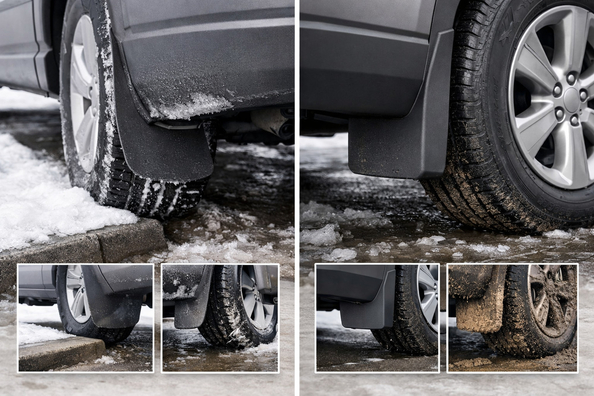
If a car regularly drives in winter, picks up slushy snow, salt, dirt, and occasionally touches curbs, in most cases softer rubber or polyurethane mud flaps are more practical. They flex on impact, handle frost better, and break mounting points less often. Rigid plastic or composite options are usually chosen when a neat factory look, compact size, and a calm driving style matter more.
The main mistake here is simple: looking at the name in the product card instead of the material, thickness, mounting scheme, and the real dimensions. On the market, the same part can be listed differently by different sellers, so the choice should be made not by the word in the title, but by how the mud flap will actually work on your car.
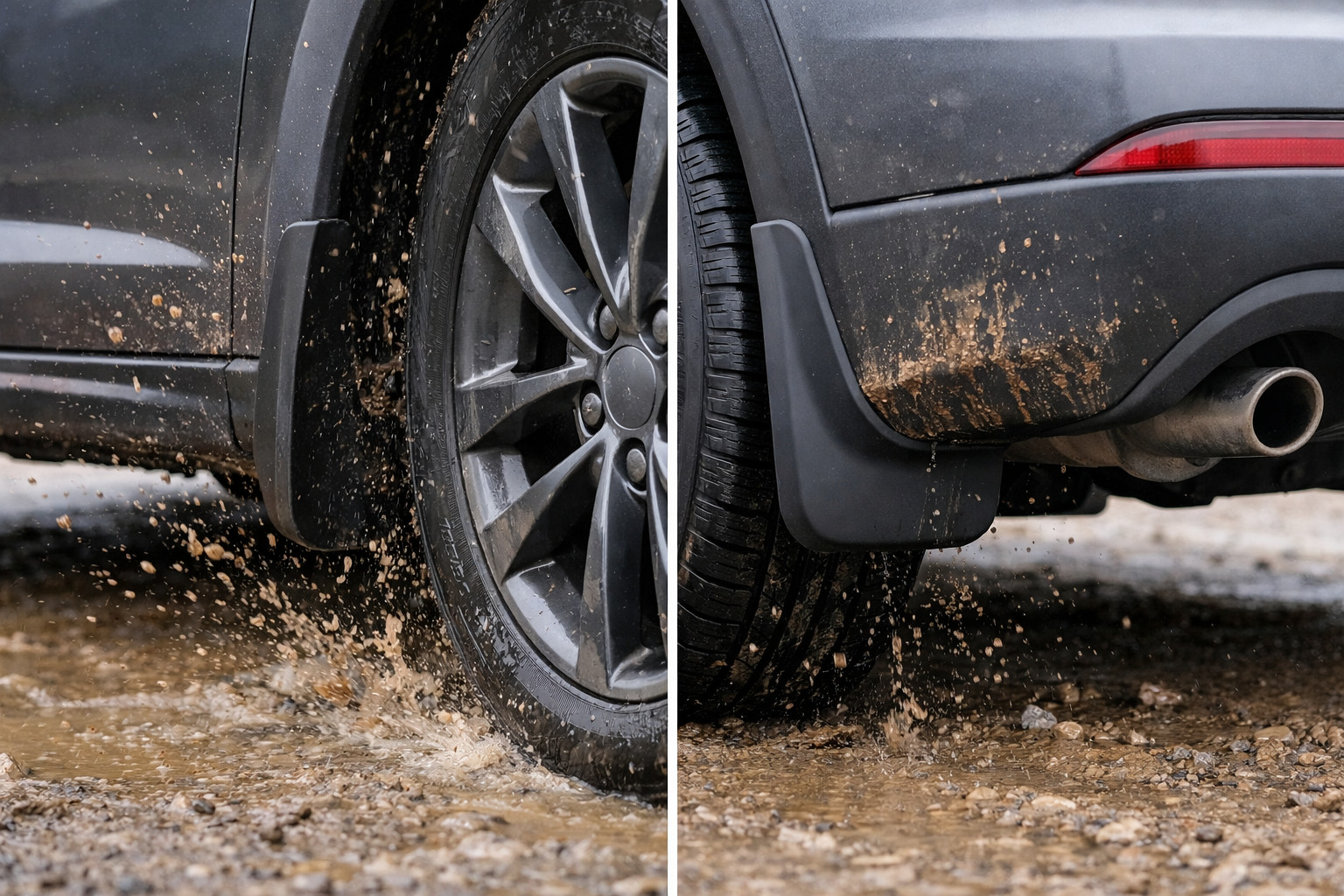
The difference between a soft and a rigid mud flap doesn’t show up in photos—it shows up in real life: ice, ruts, gravel, curbs, packed snow. A soft piece deflects and returns, while a rigid one keeps its shape but transfers the удар more strongly into clips and the lower edge of the wheel arch.
That’s why for winter and bad roads, elasticity matters more, while for city driving and asphalt without surprises a rigid compact set is often enough. One more nuance: a short, neat mud flap may look right, but it may cover the sill and doors poorly if the tire is wide or the wheel sticks out.
| Option | Strengths | Weaknesses | Who it’s for |
|---|---|---|---|
| Soft polyurethane | Works well in мороз, flexes when contacting snow and curbs, puts less load on mounts | If the material is thin or the mounting is weak, it may bend back at speed | For those who drive in winter, on highways, in mud, and want less risk of cracks |
| Soft thick rubber | Resistant to dirt, salt, sand; covers the area behind the wheel well; heavier and more stable | Bulkier; can be overkill for a typical city car if the size is chosen with too much margin | For commercial vehicles, frequent trips on bad roads, wide wheels |
| Rigid plastic or composite | Neat look, compact size, often easier integration into the OEM wheel-arch contour | Handles impacts from ice, stones, and curbs worse; in the cold it cracks or tears off more often | For city driving, calm highway use, and those who want an OEM-like format |
DD Tuning expert comment: most often, the mistake is choosing mud flaps only by the name or by wheel diameter. In reality, tire width, wheel offset, ground clearance, and how close the edge of the part sits to the body are more critical. The second common problem is reusing tired clips and installing without checking clearance to the paint.
Soft polyurethane mud flaps are the most sensible choice for mixed use: city, highway, winter, wet snow, mud. Their strong point is not that they’re “the strongest of all,” but that they survive impacts better without разрушение. For low cars this is especially important: a touch against a curb or a snowbank doesn’t always end with a crack.
Soft rubber models are worth considering when you need more coverage and practicality matters more than compactness. These mud flaps are often more массивні, better at holding back the поток of dirt and sand, but you need to pay close attention to height and width. If the set is too large for a passenger car, the lower edge will start catching uneven surfaces more often.
Rigid plastic or composite options are strong when the car mostly drives on normal asphalt and the driver wants a clean OEM look without protruding elements. In factory catalogs, such solutions are often presented as more compact and quieter. The weak point is also obvious: frost, a stone hit, or contact with a curb—they handle it worse.
Separately, it’s important to understand that size is often no less important than material. The market has compact plastic parts and much longer rubber options, so two outwardly similar sets may protect the sill, doors, and rear quarter differently. If the wheel sticks out due to tires or rims, a short rigid set simply won’t cover the грязь throw zone.
For a typical Ukrainian winter with реагенти, slush, and dirt, soft models have the advantage. They’re more practical not because they’re more expensive or “professional,” but because they don’t react as painfully to контакт with obstacles. If the car often parks up to a curb or has low ground clearance, that elasticity reserve is felt every day.
A rigid set makes sense where the scenario is simple: city, highway, mild climate, standard wheels, without constant trips into snow and gravel. For this use it can be sufficient in both protection and service life. But if the road regularly throws up ruts, ice, and stones, choosing a rigid option is most often done purely for appearance.
The компроміс approach is this: if you’re in doubt, choose not the softest and not the hardest set, but a vehicle-specific elastic option of medium size. It rarely requires modifications and handles real-world use better.
| Scenario | What to choose | Why |
|---|---|---|
| Winter, chemicals, slush, daily city driving | Soft polyurethane | Works better in the cold, less afraid of hits from snow and ice |
| Frequent curb contact or low ground clearance | Soft polyurethane or rubber | Flexes on contact and breaks mounts less often |
| Gravel, mud, country trips, wide wheels | Thick rubber | Better covers the area behind the wheel and is more resistant to dirt поток |
| City, normal asphalt, standard wheels | Rigid plastic or composite | Gives a compact look and usually enough protection |
| You need the simplest installation with no trimming | Vehicle-specific kit | Less risk of drilling, misalignment, and body rubbing |
| You need to protect the sills, not just the arch look | A wider and longer soft kit | Better blocks the dirt trajectory from the front wheel |
Paying extra is justified where conditions are truly harsh: мороз, snow, gravel, frequent curbs, a low car, or wide wheels. In these scenarios, a pricier set usually doesn’t mean “premium”—it means better material, more accurate geometry, and proper mounting. To compare, you can start with the mud flaps catalog, check universal models separately, and if you need a more precise fit without unnecessary compromises—original sets.
There’s no point paying more just for a rigid set with a красивою shape if the car constantly drives in snow and clips the edge of a parking curb. And наоборот: for calm city use, an overly large heavy rubber kit may simply be unnecessary.
From a customer’s experience: a crossover driver first installed rigid compact mud flaps because he wanted everything to look factory. After a winter with curbs and ice chunks, one piece cracked and the other started pulling on the mounts. After switching to a soft vehicle-specific kit, there were fewer issues with contacts, and noticeably less dirt started flying onto the body and sills.
In short: for winter, curbs, mud, gravel, and everyday practical driving, soft mud flaps are more often the better choice. Rigid ones make sense where compactness, a neat factory-style format, and calm asphalt driving without constant impacts are the priority. The final choice should be based not on the name, but on the material, thickness, size, and installation. This piece is based on real fitting experience, practical know-how, and real usage scenarios—not on formal descriptions in product cards.
| ✔ | Soft mud flaps made of rubber or polyurethane handle winter conditions better: they flex under the impact of snow, ice, or curbs and are less likely to break the mounts. For vehicles that often drive through slush, mud, and on rough roads, this is a more practical option. |
| ✔ | Rigid plastic or composite models usually look neater and more compact. For city driving and calm use on good asphalt, they can be sufficient without sticking out beyond the wheel arch contour. |
| ✔ | Vehicle-specific kits that do not require drilling are usually easier to install neatly than universal ones. This reduces the risk of poor fitment, misalignment, and unnecessary rubbing against the bodywork. |
| ✔ | Thick rubber mud flaps better cover the area behind the wheel and hold back dirt and sand spray. They are especially suitable for wide tires, commercial vehicles, and frequent trips on bad roads. |
| ✔ | If in doubt, a flexible medium-size kit looks like the least risky compromise. Such an option is less likely to require modifications and better withstands real-world use. |
| ✘ | Mud flaps that are too thin and soft can bend away at speed if the material or mounting is chosen poorly. So softness alone does not guarantee a good result. |
| ✘ | Rigid options handle impacts from ice, stones, and curbs worse, and in cold weather they can crack or tear off. In winter use, this noticeably reduces their practicality. |
| ✘ | Universal kits often require trimming, and sometimes even reworking the mounts. If you do not want to fuss with installation, this can become a problem. |
| ✘ | A mud flap that is too short may look neat but protect the sills and doors poorly. This is especially noticeable if the wheels are wide or stick out beyond the body. |
Shipping to EU
Wholesale and retail
Own warehouse
Опис продукту
Подарунки не надаються при оформленні покупки у кредит під 0,01% або при покупці частинами.