05.05.2026
374
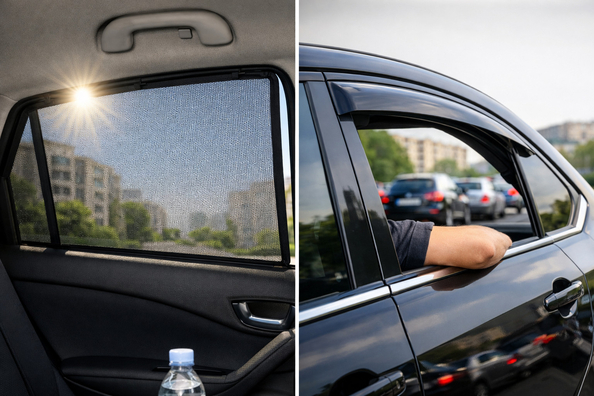

For summer city driving, the choice is simple: if your car often sits in the sun, sunshades usually bring more benefit; if you often drive with the window slightly open and want fresh air without rain, splashes, and excess airflow into the cabin, window deflectors are more practical. These aren’t interchangeable things because they solve different tasks.
The mistake starts when people buy sunshades for ventilation, and deflectors as protection from an overheated cabin after parking. Below is a short, no-fluff comparison: what actually works, where the noise and installation nuances are, and who should choose what.
Sunshades primarily work while parked. Their main city benefit is less cabin heat-up, less UV impact on interior trim, and better privacy when the car is parked near an office, store, or in the courtyard. According to manufacturers’ claims, the temperature effect can be noticeable, but it depends on the sun, body color, tinting, and where you park.
Window deflectors work differently: they don’t cool the cabin directly, but they let you keep the window slightly open in rain or heat. In city use this is convenient in traffic jams, during short stops, and when you want natural ventilation without a direct draft in your face.
| Option | Strengths | Weaknesses | Who it’s for |
|---|---|---|---|
| Sunshades | Better reduce cabin heat-up, block the cabin from prying eyes, help protect trim from fading | Almost no help while driving, need to be installed and removed, effect depends on fit accuracy | For those who often park in the sun and want to get into a less hot car |
| Window deflectors | Allow ventilation in rain and heat, convenient every day, can reduce turbulence with a partially open window | Don’t solve an overheated cabin, can add noise, sensitive to installation quality | For those who often drive around town with windows slightly open |
DD Tuning expert comment: the most common mistake with deflectors is buying a universal kit or installing it without following the instructions, then ending up with whistling or issues with the window closing properly. With sunshades, the opposite extreme happens: expecting a cheap model without an exact fit to deliver the same thermal effect as a tightly fitted solution. If your use case isn’t defined, the purchase almost always misses the target.
In a summer city, this is first and foremost a parking solution. If the car stays in the sun for a few hours, a windshield shade or a more complete set really reduces heat build-up and makes getting back into the car less unpleasant. Another plus is that items in the cabin are less visible from outside.
Practically, sunshades are simple: unfold, install, remove, store. But there’s a nuance— you have to remember to put them up. If you’re not ready to do it every time, even a good set won’t deliver the full benefit.
Their strength is while driving and during short stops. They let you crack the window so rain drops don’t fly into the cabin, side drafts are reduced, and splashes or insects are less annoying. For city trips this is convenient, especially when you don’t want to run the A/C at full blast.
The weak point of deflectors is that they don’t replace sun protection. If the car sits for hours in an open parking lot, by themselves they won’t deliver the effect that sunshades do. The second risk area is fit: vehicle-specific solutions are usually calmer in terms of noise and window operation, while a bad installation can ruin the whole experience.
For a typical city owner who leaves the car near work, home, or a shopping center, sunshades are more useful. They target the summer problem that annoys most: an overheated cabin, a hot steering wheel, hot seats, and that “oven” feeling after parking.
Deflectors win for those who drive more than they park. If you often ventilate the cabin naturally, want fresh air without a direct stream, or want to keep the window slightly open in the rain, they provide a small daily convenience that sunshades don’t provide at all.
Realistically, this isn’t a choice of “what’s cooler,” but “what you need more often.” For parking—sunshades. For driving with a slightly open window—deflectors.
| Scenario | What to choose | Why |
|---|---|---|
| The car sits in the sun near the office every day | Sunshades | Better reduce cabin heat-up and protect interior trim |
| Frequent short city trips with the window slightly open | Window deflectors | Provides ventilation without rain, splashes, and strong side airflow |
| Need to hide items in the cabin from prying eyes | Sunshades | Add privacy, which deflectors provide very little |
| Don’t want to install and remove something every time | Window deflectors | After installation they work continuously with no daily actions |
| Main complaint is heat after parking, not lack of air while driving | Sunshades | Deflectors don’t solve an overheated cabin directly |
Paying extra is justified when you need not just an accessory, but a predictable result. If the car spends a lot of time outdoors, it makes sense to look at sunshades with an exact fit: they cover the glass better without light gaps along the edges.
For ventilation, a pricier option makes sense when you care about quietness, stable window operation, and a neat fit. In that case, it’s logical to start with the window deflectors category rather than random universal kits.
If you’re unsure where exactly the difference is between a budget and a precise kit, it helps to follow the approach described in the article about vehicle-specific deflectors. In a more expensive solution, you’re not paying for “premium,” but for fewer compromises in fit, noise, and daily convenience.
From a customer’s experience: the request was simple—“after work it’s impossible to get into the car, I was thinking of getting deflectors.” After clarifying the scenario, it turned out the car sits in an open parking lot almost all day, so we chose a windshield sunshade instead of deflectors. Expectations matched the result: the main issue wasn’t lack of air while driving, but cabin overheating while parked.
In a summer city scenario, sunshades usually provide more benefit because they solve the most painful problem—cabin overheating while parked. Deflectors are worth getting when daily ventilation with a slightly open window in rain, heat, or traffic matters more to you.
So the choice comes down not to “what’s better in general,” but to a specific task. If parking in the sun—sunshades. If driving with natural ventilation—deflectors. This material is based on real selection experience, practice, and real use cases, so the key advice is simple: define your scenario first, and only then look at price and brand.
| ✔ | They better reduce cabin heat buildup when parked in the sun, so in the city after work or at the store the car feels less stuffy. |
| ✔ | They provide more privacy: the cabin and items inside are less visible from the outside. |
| ✔ | They help protect the trim from fading and reduce exposure to ultraviolet rays. |
| ✔ | Installation and removal are quick and easy, with no need to stay on the car all the time. |
| ✘ | They do little while driving, as they do not solve the task of ventilating the cabin. |
| ✘ | To be effective, they need to be put in place before parking each time and then removed. |
| ✘ | The result depends heavily on fit accuracy: cheaper or poorly designed models may have gaps and weaker protection. |
Shipping to EU
Wholesale and retail
Own warehouse
Опис продукту
Подарунки не надаються при оформленні покупки у кредит під 0,01% або при покупці частинами.