05.04.2026
1963
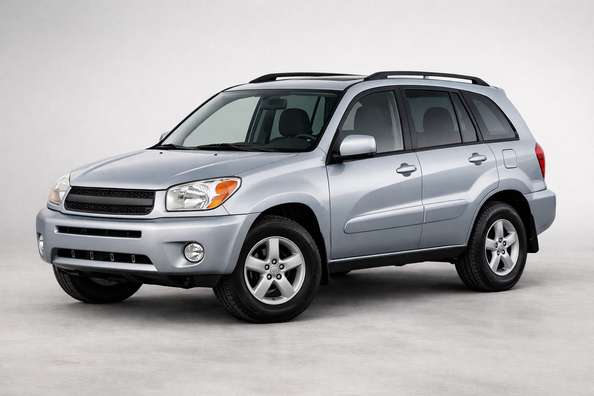

Toyota RAV4 2001-2005 is the second generation of the XA20 model, where you can still clearly feel the old-school approach: a compact body, naturally aspirated engines, a simple 5-speed manual or 4-speed automatic, an intuitive driving position, and all-wheel drive without extra electronic add-ons. Even today, this car still makes sense for the city and suburbs if you need not a big crossover, but a nimble and mechanically straightforward vehicle.
The relevance of the RAV4 II isn’t based on fashion, but on balance. It’s comfortable in everyday driving, has a flexible interior and decent geometry, but you shouldn’t expect space on the level of larger crossovers, the quietness of modern models, or trouble-free ownership of any version without inspection. This is especially true for 2001-2003 automatic cars and trims from different markets, which vary in engines and equipment.
The RAV4 of this period sat between a passenger car and a classic off-roader. It has a unibody structure, compact dimensions, and road manners closer to a regular hatchback or wagon than to a heavy body-on-frame SUV. That’s why the model appealed to those who wanted a high seating position, good visibility, and winter confidence without the bulk.
By character, it’s a pure city crossover. It feels at home on narrow streets, in parking lots, on gravel, and on country-lane approaches, but it wasn’t built for serious off-roading. In short, the RAV4 II suits those who value compactness and simple engineering, not those looking for maximum second-row space or a soft long-distance cruiser.
From 2001 to 2005, the second generation Toyota RAV4, index XA20, was produced. In Europe there were 3-door and 5-door bodies, while in North America the main version was the 4-door. This matters when choosing, because not only the bodies differ, but also dimensions, equipment, and powertrains.
Mid-cycle, the model received refinements. For Europe in 2004, suspension, steering, and sound insulation were revised, and safety equipment was updated on certain versions. For the North American market, a 2.4-liter gasoline engine appeared late in the cycle. Because of this, a 2001 RAV4 and a 2005 RAV4 are not quite the same car in terms of feel and feature set.
The lineup was based on naturally aspirated inline “fours.” For North America early on, the typical engine was the 2.0 L 1AZ-FE gasoline unit with 148 hp, and later, depending on market and year, the 2.4 L 2AZ-FE with 161 hp appeared. In Europe you can also find a 2.0 L gasoline engine with 147 hp and a 2.0 L D-4D diesel with 114 hp. Gearboxes were a 5-speed manual or a 4-speed automatic; drivetrains were front-wheel drive or full-time AWD with a viscous-coupling center differential.
The most caution is needed with 2001-2003 automatic versions: they’re known for an issue with harsh shifts related to the control unit, but that doesn’t mean every such RAV4 is problematic. For a healthy car, smooth shifting, no jerks, and a proper service history are critical.
| Version | Engine | Power | Transmission | Drivetrain |
|---|---|---|---|---|
| North America 2001-2003 | 2.0 L 1AZ-FE | 148 hp, 192 N·m | 5-speed manual or 4-speed automatic | Front-wheel drive or 4WD |
| North America 2004-2005 | 2.4 L 2AZ-FE | 161 hp, 224 N·m | 5-speed manual or 4-speed automatic | Front-wheel drive or 4WD |
| Europe 2004 | 2.0 L gasoline VVT-i | 147 hp, 192 N·m | Manual or automatic | Front-wheel drive or 4WD |
| Europe 2004 | 2.0 L diesel D-4D | 114 hp, 250 N·m | Manual | Mostly 4WD |
The strong point of the RAV4 II is its compact format. For the 5-door version, the wheelbase is 2490 mm; length depending on market and year is approximately 4195-4265 mm, width 1735-1785 mm, height 1680-1715 mm. Ground clearance is about 170 mm, and the minimum turning radius is about 5.3 m. That explains why the model is still convenient in the city.
Practicality is also on point: the 5-door’s trunk offers up to 678 L in normal configuration and up to 1909 L with the rear row folded. The second row can not only fold, but also slide, change backrest angle, and even be removed. By early-2000s standards, that’s a major advantage.
| Parameter | Value | What it means in practice |
|---|---|---|
| Body | Unibody, XA20 generation | Car-like road feel, less bulk |
| Length | 4195-4265 mm | Easier to park than larger crossovers |
| Wheelbase | 2490 mm | Compact wheelbase, good maneuverability |
| Ground clearance | 170 mm | Enough for curbs, snow, and dirt roads |
| Trunk | 678/1909 L | Strong cargo-area transformation for trips and daily needs |
| Fuel tank | 56-57 L | Decent driving range for its class |
| Towing | 680 kg | Not a tow rig, but it can handle a light trailer |
| Approach/departure angles | About 27-30° | Decent geometry for light off-road use |
The RAV4 II interior isn’t luxurious, but it’s well thought out. Seating is high, visibility is good, and the second-row transformation is genuinely useful if the car is used not only for a daily commute but also for trips, shopping, or country-house tasks. This cabin flexibility is exactly what keeps the model relevant even today.
Comfort has its limits. The rear row is tighter than in some competitors of that time, and at speed you’ll notice road and wind noise. A separate practical drawback is the side-hinged tailgate: when the car is parked close to a curb or wall, loading isn’t always convenient.
For safety, you need to look at the specific market and year. ABS with electronic brake-force distribution and brake assist is common, while side and curtain airbags depend on the trim. For some 2004-2005 U.S. cars, it’s worth checking the VIN separately for an airbag campaign.
In daily life, the RAV4 is strongest exactly where today’s big crossovers start to annoy with their size. It’s easy to park in a courtyard, easy to turn around, it doesn’t feel heavy, and it doesn’t require getting used to. For the city, that’s one of the most convincing arguments in the model’s favor.
Fuel consumption is within the norm for its age: official figures for gasoline versions were around 10.5-10.7 L in the city and 8.0-8.1 L on the highway, while real mixed numbers often hover around 10.3 L/100 km. But a lot depends on drivetrain, transmission, the condition of the driveline, and driving style. If you need a very quiet and soft car for long highway trips, the RAV4 II isn’t the first candidate.
From an owner’s perspective, this model is attractive not because of individual numbers, but because of the combination of simplicity, maneuverability, and everyday convenience. But the compromises are also obvious.
| What matters | Pros | Cons |
|---|---|---|
| City driving | Compact body, good visibility, easy parking | Somewhat firm ride on poor roads |
| Engineering | Simple naturally aspirated engines with a solid reputation | 2001-2003 automatic needs especially careful inspection |
| Practicality | Flexible interior, strong cargo-area transformation potential | Rear seat isn’t the roomiest in the class |
| Highway trips | Stable, lively behavior for its age | Road and wind noise are noticeable |
| Winter use | 4WD versions provide more confidence on slippery surfaces | Not a vehicle for heavy off-roading |
| Everyday logistics | Decent trunk and useful roof accessories | Side-hinged tailgate isn’t always convenient |
For the RAV4 2001-2005, the most sensible tuning isn’t performance-focused but practical. This model is better suited to everyday-use solutions: floor mats, trunk protection, mud flaps, cargo organization, roof rails or crossbars, a spare wheel cover, a tow bar, and trim pieces that simplify daily life and help preserve the interior. Checking compatible accessories for RAV4 2001-2007 makes sense specifically before seasonal use or right after buying the car.
If the car is used in the city, the first priority is the cabin and trunk. If it’s for trips outside the city—roof setup, mud flaps, and protection for areas that wear quickly. Investing in decorative items without first getting the body, suspension, and transmission in order doesn’t make sense here: this isn’t a model where looks matter more than functionality.
The Toyota RAV4 2001-2005 is still relevant for those looking for an old-school compact crossover: simple, nimble, with decent geometry and truly useful interior transformation. It won’t suit those who critically need a spacious second row, quiet highway cruising, or a modern equipment level without compromises.
The best scenario for this model is a well-kept car with a transparent history, the right engine choice, and a checked transmission. Then the RAV4 II remains not a museum piece, but a fully usable daily vehicle—one where accessories and practical tuning really do make sense.
| ✔ | Compact dimensions and a small turning radius make the RAV4 II convenient in the city: it is easier to park, turn around, and fit into narrow courtyards. |
| ✔ | Simple naturally aspirated engines and uncomplicated mechanics are generally easy to maintain and do not give the impression of an over-electronified car. |
| ✔ | The cabin has good versatility: the rear row can be slid, the backrest angle adjusted, and even removed, while the trunk in the 5-door version is quite spacious. |
| ✔ | The permanent all-wheel drive on some versions gives more confidence in winter and on slippery surfaces without turning the car into a heavy SUV. |
| ✔ | Ground clearance and body geometry are sufficient for curbs, snow, dirt roads, and country driveways, that is, for typical everyday driving conditions. |
| ✘ | The rear row is not as spacious as in larger crossovers, so rear passengers may feel cramped, especially compared with some rivals. |
| ✘ | On the highway, road and wind noise are clearly audible, so the RAV4 II is not for those expecting a quiet and soft long-distance ride. |
| ✘ | Automatic versions from 2001-2003 should be inspected especially carefully due to the well-known problem with harsh shifting. |
| ✘ | Side-opening tailgates are not always convenient for loading if the car is parked close to a curb or wall. |
Shipping to EU
Wholesale and retail
Own warehouse
Опис продукту
Подарунки не надаються при оформленні покупки у кредит під 0,01% або при покупці частинами.