 Author: Radomskyi Maksym Vasyliovych
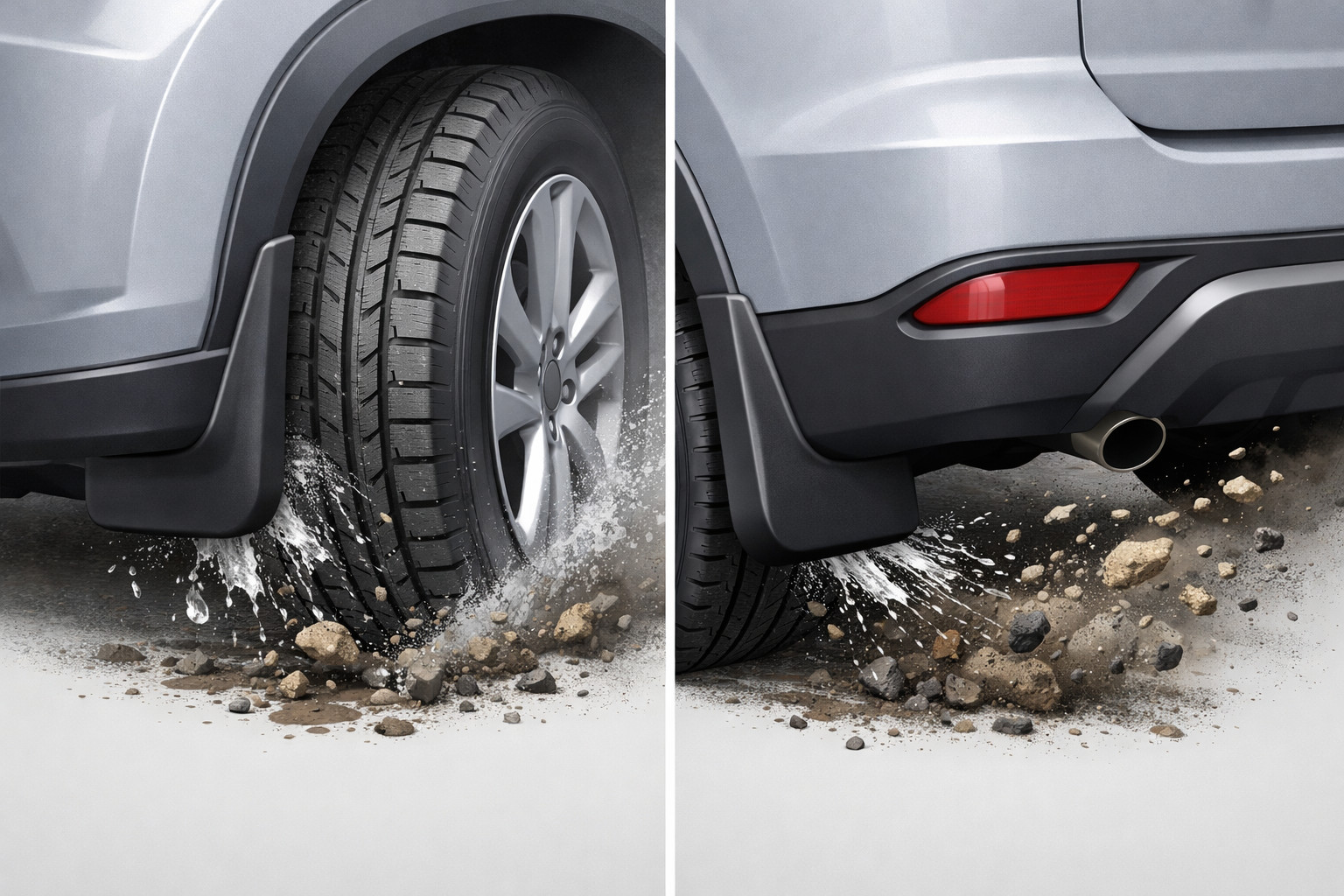
If you can choose only one pair, for most passenger cars, crossovers, and pickups it makes more sense to start with front mud flaps. The front wheels are the ones that most often throw dirt, salt, and small stones into the rocker area, the lower edge of the doors, and the joints near the seals. Rear mud flaps matter more when the main goal is to spray less water and debris onto the vehicle behind you or a trailer.
But there’s no one-size-fits-all answer. The result depends on tire width, wheel offset, a lifted suspension, speed on wet roads, winter road salt, and whether you tow a trailer. So it’s better to choose not by the “front or rear in general” principle, but by where the dirt is actually flying in your case.
Why this problem comes up
The problem appears when budget or product availability forces you to buy not a full set, but only one pair. Because of that, the owner tries to solve two different tasks with one accessory at once: protect their own bodywork and reduce spray for those driving behind.
The challenge is that front and rear mud flaps work in different zones. Front ones primarily take the stream that hits the rockers and the lower part of the doors. Rear ones affect the plume of water, snow, and small stones behind the vehicle more. So “what matters more” depends not on the accessory name, but on which outcome annoys you the most.
Main causes
- The main dirt stream comes from the front wheels. On most vehicles, they spray the rockers, the lower part of the doors, and the front section of the side panel.
- The rear wheels have a bigger impact on what happens behind. If you often drive on highways, with a trailer or a boat, the rear pair becomes noticeably more important.
- Wide tires or wheels that stick out increase spray. In that case, a short mud flap often doesn’t cover the real flow.
- Winter slush and salt make the problem more acute. Then even a small difference in protecting the rockers and door seams becomes very noticeable.
- A wrongly chosen set gives a weak effect. Mud flaps that are too short, too narrow, or poorly installed work only partially, no matter whether they’re on the front or rear.
How to understand the cause in your specific case
The easiest check is to wash the car, drive 10–20 km on wet roads, and don’t wipe the body right away. If the dirtiest areas are the rockers, the lower edge of the front doors, and the area between the doors and the rockers, then front mud flaps are what you need first.
If, however, the rear bumper, tailgate, trailer suffer most, or you constantly see a thick water plume in the mirror, then rear ones will give a more noticeable effect. For a pickup or crossover with a trailer, this is a typical scenario.
Another check is to look from above and see whether the tread protrudes beyond the edge of the wheel arch. If it does, the mud flap has to cover a wider stream, and a simple short model may not work. In this setup, it often makes sense to look at a full set right away rather than argue which axle matters more.
DD Tuning expert comment: the most common mistake is buying the first universal set you find and expecting it to completely eliminate stones hitting the side panels. If the wheel is wide or pushed outward, a short mud flap won’t cover the actual flow. The second frequent mistake is not protecting the contact area with the paint, which leads to scuffs near the mounting point.
Symptoms, causes, and what to do (table)
| Symptom | Likely cause | What to do |
|---|---|---|
| Dirty rockers and the lower front doors even after a short trip | The main stream comes from the front wheels | Start with front mud flaps |
| Strong water plume behind, the trailer gets dirty | The problem mainly comes from the rear wheels | Install rear mud flaps, especially for highway driving and towing |
| Stones still reach the doors and arches | The mud flap is too short or the wheel sticks out past the arch | Look for a longer vehicle-specific set or a full kit |
| Paint scuffs near the mounting point | Incorrect installation or no protection in the contact area | Reinstall the set and protect the contact point |
| Off-road, mud flaps catch and get torn off | Too long or too rigid a design for that use | For hard off-road use, choose removable ones or don’t fit long guards |
What really helps
Front mud flaps as the first step. If the goal is to protect your own bodywork, this is the most practical start for most cars. They noticeably reduce the hit of dirt on the rockers and the lower part of the doors, especially in winter.
A full set front and rear for wide tires, frequent highway miles, or a trailer. If the wheels are pushed outward, the vehicle is lifted, or you tow regularly, one pair often solves only half the task.
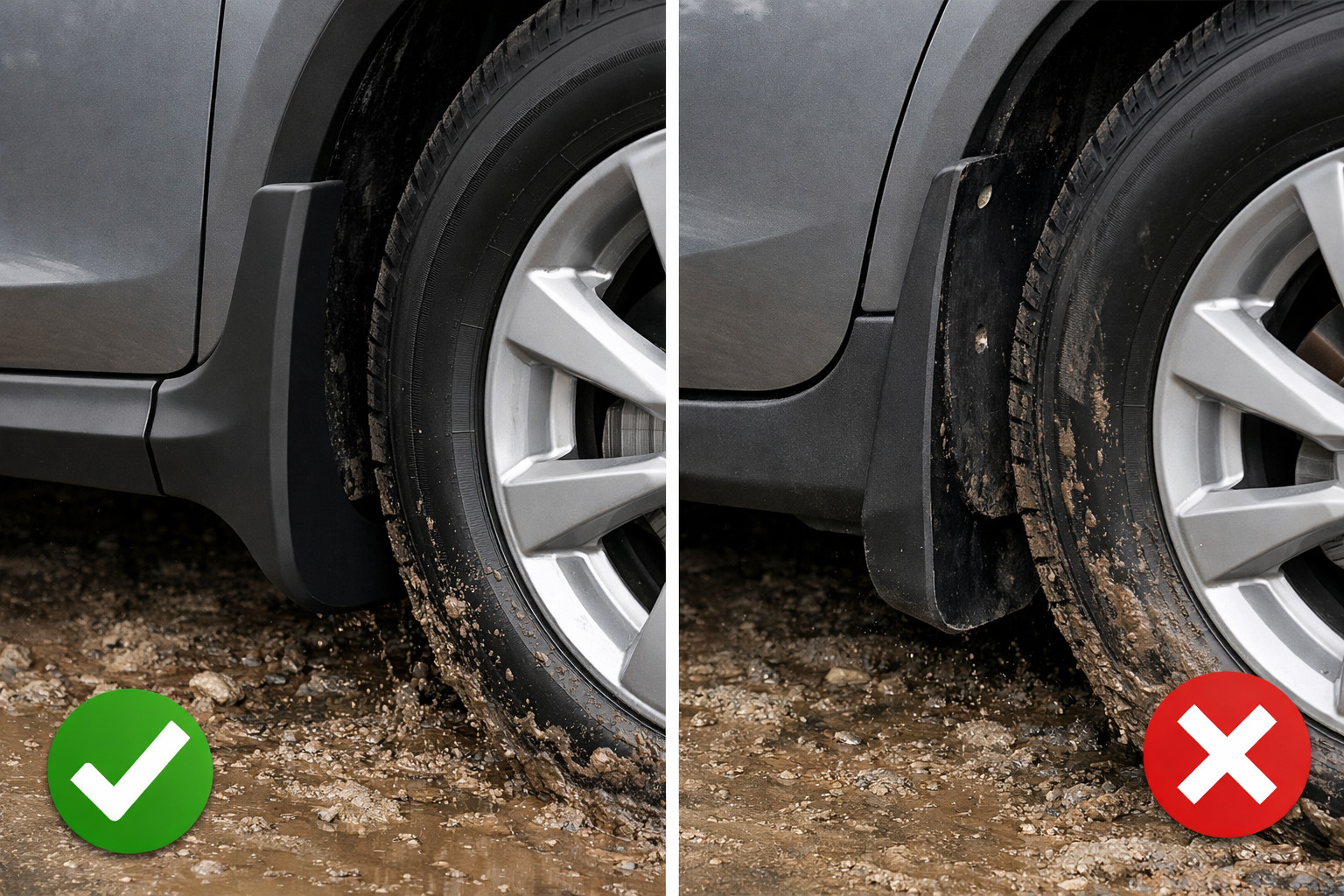
A vehicle-specific set with proper geometry. The mud flap that follows the arch and covers the flow across the wheel’s width works better than one that just hangs behind it.
Installation without unnecessary interference with the body. If there’s a no-drill option, it reduces the risk of issues at mounting points and makes installation easier.
What almost doesn’t work or helps only briefly
Very short or narrow universal mud flaps provide little noticeable effect when the wheel is wide or protrudes beyond the arch. They may reduce some dirt, but they don’t block the main stream.
It’s a poor idea to install only rear mud flaps on a typical city sedan or crossover if what bothers you is dirty rockers and front doors. For protecting your own bodywork, this often misses the point.
You also shouldn’t expect complete protection from stones. Mud flaps reduce throw, but they don’t turn the side of the body into a “clean zone.” If the vehicle is used on gravel or crushed stone, some impacts will still happen.
When accessories or replacing parts makes sense
If you’re only choosing a set now, it’s best to start with the mud flaps section. For vehicles where precise fitment and minimal compromise on shape matter, it’s more logical to look at original mud flaps.
Universal sets make sense when there’s no vehicle-specific solution or you need a temporary budget option. But if the problem is already visible on the rockers and doors, saving on geometry often means a weaker result.
Replacing parts or adding extra protection is needed when an old mud flap has cracked, become stiff, rubs the bodywork, or no longer covers the width of the installed wheel after changing rims or tires.
Solution: when it works and when it’s not worth the money (table)
| Solution | When it works | When it’s not worth the money |
|---|---|---|
| Front mud flaps | When you need to protect the rockers, the lower door area, and reduce salt buildup on your own vehicle | When the main problem is the plume behind the vehicle or the trailer |
| Rear mud flaps | When it’s important to spray less onto the car behind, tow a trailer, and drive highways in slush | When you expect them to protect the front doors and rockers |
| Full set front and rear | For wide tires, offset wheels, a lifted suspension, frequent highway driving, and mixed tasks | When the vehicle is stock, driven mostly in the city, and the budget is limited |
| Short universal set | As a temporary solution or when there’s no vehicle-specific option | When you need a noticeable result on a vehicle with wide wheels |
| Vehicle-specific no-drill set | When precise fitment, easy installation, and fewer risks at mounting points matter | When no such kit exists for the specific model and you have to force-fit it |
From a customer’s experience: the owner of a crossover wanted to buy only the rear pair because he was thinking mainly about the water plume behind. After reviewing photos of the dirty body, it turned out the rockers and the lower front doors suffered most, so he started with front mud flaps. After the first week on wet roads, those areas became noticeably cleaner, and he addressed the rear set later, when he started driving with a trailer.
Conclusion
If you have to choose just one, for most regular passenger cars, crossovers, and many pickups it’s best to install front mud flaps first: they protect your own bodywork better in the zone that most often takes the hit. Rear ones are more important when the priority is less spray behind, highway driving, towing, or wheels with a large offset.
The key is to look not at the name of the set, but at the dirt marks after a drive, the wheel width, and your usage scenario. This material is based on real fitment experience, practical testing, and real-world use cases—not on an abstract rule like “front is always better” or “only rear is needed.”
Pros and cons
Front mud flaps for most passenger cars, SUVs, and pickups better protect the sills, the lower edge of the doors, and the seams near the seals, because the front wheels throw most of the dirt and salt there.
If the main issue is dirty sills and the lower part of the front doors after a short trip, the front pair delivers the most practical and noticeable result without the need to install a full set.
Rear mud flaps are useful when it is important to reduce how much water and debris is thrown onto the vehicle behind or the trailer, especially when driving on the highway or towing.
A model-specific set with proper geometry works better than short universal options because it follows the wheel arch more closely and covers the wheel width better.
For wide tires, offset wheels, a lifted suspension, or mixed use, a full set may be justified, because one pair often covers only part of the problem.
Short or narrow universal mud flaps may have almost no effect if the wheel is wide or sticks out past the arch, because they do not block the main flow of dirt.
If you install only rear mud flaps on a regular city sedan or crossover, they will not solve the problem of dirty sills and front doors.
Mud flaps do not provide full protection from stones: on gravel or crushed stone, some impacts will still hit the body.
Off-road, long or stiff mud flaps can catch and tear off, so they are not always convenient for this kind of use.