05.07.2026
328
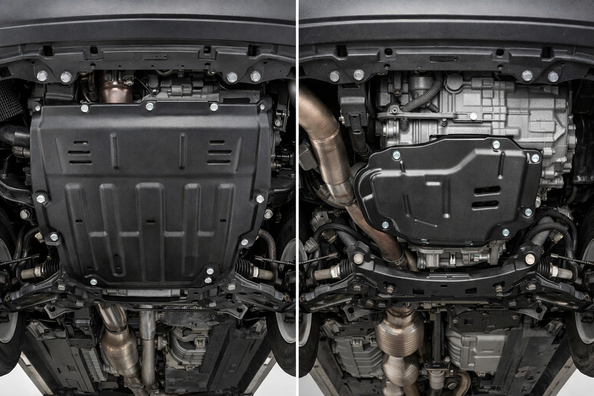
If you’re buying only one item, in most cases the first thing worth installing is an engine skid plate, with a transmission skid plate as the second step. The reason is simple: the front lower area with the oil pan is usually the first to meet a pothole, ice, a stone, a tall asphalt joint, or a bad drop-off.
There are exceptions too. On some models the gearbox or CVT hangs lower, and sometimes a transmission skid plate is designed to be installed only together with the front shield. So the right question isn’t “what’s more important in general,” but “what sits lower, what gets hit more often, and what can be properly installed on your specific car.”
Choosing between an engine skid plate and a transmission skid plate isn’t about the component name—it’s about risk priority. If the car is driven in the city, on winter roads, broken asphalt, and occasionally catches ruts or ice, the first hit almost always goes to the front. In that scenario, an engine skid plate delivers the biggest effect for the first money spent.
A transmission skid plate becomes the top priority less often: when that specific model’s gearbox is genuinely low, when the car frequently bottoms out in the middle on dirt, or when the front area is already covered by an OEM shield or a quality aftermarket plate. If it’s not, starting with only the transmission plate is usually illogical—the engine oil pan stays exposed.
Installation. Before buying, look not only at the plate shape but also at the mounting scheme. Some transmission skid plates install only as a pair with a front plate or use shared mounting points. If you miss this, you can end up buying a part you’ll have to return or modify.
Noise. A metal skid plate itself isn’t a problem, but after installation you may get squeaks, buzzing, and resonance. Most often the cause isn’t the product, but metal-to-metal contact, over-tightened bolts, misalignment, or missing proper clearances.
Service life. For a daily driver exposed to salt and moisture, aluminum is more practical: less weight and less hassle with corrosion. Steel handles a hard hit better, but requires monitoring the coating. As for thickness, the logic is: light duty—around 3.2 mm, universal—around 4.8 mm, frequent harsh contact—around 6.35 mm.
Practicality. A good plate shouldn’t make service harder. If every oil change means a long removal of half the underbody, that’s inconvenient. Also check whether the design reduces ground clearance where it matters.
Price. A single front plate is almost always a cheaper entry than full underbody coverage. So people buy first what covers the most likely impact scenario.
| Option | Strengths | Weaknesses | Who it’s for |
|---|---|---|---|
| Engine skid plate first | Covers the most vulnerable front area; delivers the biggest real-world benefit in the city, in winter, and on bad roads; often serves as a base for a future full set | Doesn’t address gearbox impact risk if the car bottoms out in the middle; on some models requires checking compatibility with the subframe and service access | Most owners of passenger cars, crossovers, and daily drivers |
| Transmission skid plate first | Useful if the gearbox is low or the car often contacts the underbody in the center; relevant on routes with ruts, stones, stumps | The front end and engine oil pan may remain unprotected; sometimes cannot be installed separately without the front plate | Those whose gearbox is structurally more vulnerable, or who already have reliable protection for the front area |
DD Tuning expert comment: the most common mistake is looking only at the part name rather than the geometry of a specific car. People order a transmission skid plate first, and then it turns out the gearbox isn’t lower than the engine oil pan, or that the element fits properly only together with the front plate. The second typical issue is over-tightened fasteners after installation, which causes unwanted noises.
This is the basic and most often correct scenario. The front plate takes impacts to the oil pan, the lower crossmember, and the front edge of the underbody. This area is the first to catch obstacles when the car drops into a deep pothole, hits frozen snow, or drives on a broken dirt road.
Another advantage is step-by-step upgrading. You install an engine plate now, and later—if needed—add transmission, transfer case, or fuel tank protection. For most daily cars, this is more rational than investing in a full kit right away without knowing whether you truly need it.
This route makes sense when the middle of the car is more vulnerable. That happens on models where the gearbox pan or CVT housing protrudes noticeably lower, and on cars that often drive in ruts, rutted snow, or rocky climbs where the car bottoms out not with the nose, but with the belly.
But it’s a more selective solution. If the front is open, you’re protecting the second-priority unit while leaving the first without proper coverage. Plus, a transmission skid plate must be checked especially carefully for serviceability: access to drain points and compatibility with OEM components.
For city driving, highways, winter trips, and broken asphalt, the best start is an engine skid plate. The main threat here isn’t technical off-roading, but a random front hit: a chunk of ice, a road ledge, a deep pothole, or a curb edge.
For light trips outdoors, it’s also more often enough to start with the front plate—especially if the car isn’t crawling over rocks. But when there are regular runs in ruts, along forest roads, for fishing or hunting, where the car truly bottoms out in the center, the transmission skid plate quickly shifts from “optional” to “the next must-have.”
If the car is used hard and regularly, the question “what first” often turns into “is it better to install a modular kit right away.” Because a single plate solves only part of the problem.
| Scenario | What to choose | Why |
|---|---|---|
| City, highway, winter, poor asphalt | Engine skid plate first | The front lower area more often takes the first hit, and in these conditions the gearbox is less often the first contact point |
| Country house, dirt roads, snow, occasional trips out of town | Engine skid plate first, then transmission | Gives maximum benefit right away and lets you build out the kit later without unnecessary expense |
| Frequent ruts, rocks, the car bottoms out in the center | Assess the geometry; often you need transmission protection right after the engine plate or together | Impact and abrasion affect not only the front edge but also the middle section of the underbody |
| On this model the gearbox or CVT hangs lower than the engine oil pan | You can start with a transmission skid plate | The general rule doesn’t apply here because the transmission is the first at risk |
| Regular heavy off-roading | Don’t drag it out—install a kit | A single plate won’t cover all critical components, and loads and hits will be repetitive |
A more expensive solution is justified not when you just want “extra margin,” but when the load repeats. If the car often drives over rocks, deep ruts, carries extra weight, runs in expedition mode, or simply regularly touches the underbody, it’s better to look not at a single plate but at a modular set: engine protection as the base, then transmission protection, and only after that other components.
A pricier option also makes sense when you need better thickness, correct geometry, and proper serviceability without drilling and cutting. If you’re unsure about material and design, it helps to first understand how to choose an engine skid plate, and only then select the second element to match your driving style.
From a customer’s experience: the most typical scenario is this—someone wanted to protect the gearbox right away after a few dirt-road trips, but an inspection showed that the front area is what takes the first hits. As a result, they installed an engine skid plate first, and only later added transmission protection when out-of-town trips became regular. This step-by-step approach turned out cheaper and more practical than a mistaken first purchase.
If you need to choose just one item, in most cases the engine skid plate goes first, and the transmission skid plate second. This works best in terms of real risk, budget, installation, and everyday practicality. Starting with transmission protection makes sense when the transmission sits lower, is more vulnerable, or when the design of that specific model requires it.
The key is not to buy blindly based on the part name. Look at underbody geometry, mounting compatibility, serviceability, material, and your real driving scenario. This material is based on real selection experience, hands-on practice, and real use cases—not an abstract “one-size-fits-all” rule.
| ✔ | In most cases, it is recommended to install the oil pan protection first, because the front lower area is most often the first to hit a pothole, ice, a stone, or a high road seam. This gives the greatest practical benefit in the city, in winter, and on rough asphalt. |
| ✔ | Starting with the oil pan protection as the first purchase allows you to proceed step by step: first cover the most vulnerable area, and then, if needed, add transmission protection or protection for other components. This reduces the risk of unnecessary spending on a full kit right away. |
| ✔ | The article directly takes exceptions into account and advises looking at the car’s specific geometry rather than the part name. This is practical, because on some models the gearbox or CVT really hangs lower than the engine sump. |
| ✔ | There are clear selection criteria: installation, noise after installation, material lifespan, serviceability, and price. Such a list helps avoid compatibility mistakes and prevents buying a part that interferes with vehicle maintenance. |
| ✔ | For more demanding use, the authors do not recommend limiting yourself to a single sheet and instead suggest looking at a modular kit. This makes sense for regular ruts, stones, or situations where the car sits on the underbody in the center. |
| ✘ | If you start with transmission protection without checking the model, you can leave the engine sump exposed, even though it is more often the first to take the hit. On some cars, this is simply an unfortunate installation order. |
| ✘ | Transmission protection is not always installed separately: sometimes it is compatible only with the front shield or uses shared mounting points. This makes buying more difficult and may require a return or modifications. |
| ✘ | After installation, a metal guard may produce squeaks, rattles, or resonance if the bolts are over-tightened, there is misalignment, or the gaps are poor. In other words, the part itself does not guarantee silence without proper installation. |
| ✘ | You need to think about service access: if every oil change requires removing part of the underbody, it will be inconvenient in everyday use. Also, the guard can reduce ground clearance at critical points. |
Shipping to EU
Wholesale and retail
Own warehouse
Опис продукту
Подарунки не надаються при оформленні покупки у кредит під 0,01% або при покупці частинами.