10.04.2026
352
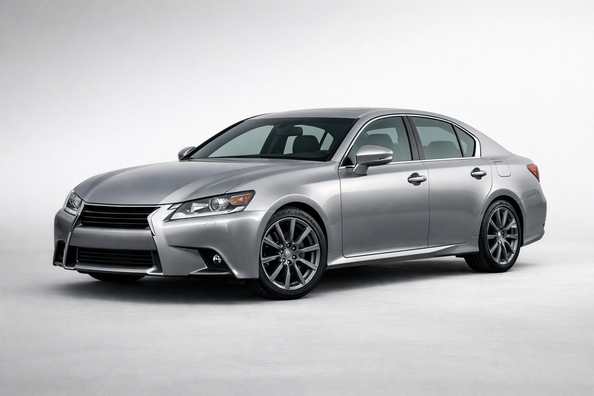

The Lexus GS of this generation is a premium business-class sedan for those who want quietness, a naturally aspirated V6, and fewer long-term ownership surprises than German classmates often deliver. The review title says 2011–2020, but there’s an important clarification: the new GS in North America launched as a 2013 model year, and 2011 here is more of a transition point between generations.
By character, it’s not a car for showy sharpness. The GS is strong where an owner notices the difference every day: sound insulation, ride smoothness, great seats, and straightforward mechanicals without an excess of turbo complexity. It won’t suit those who need the newest infotainment, a very practical trunk, or a vividly sporty steering feel.
The Lexus GS sat in the same segment as the BMW 5 Series, Mercedes-Benz E-Class, and Audi A6. But its approach is different: less emphasis on razor-sharp interfaces and flashy mode changes, more on quietness, smoothness, and the feel of a well-built daily sedan.
That’s why the GS works well for people who drive a lot on the highway, value a calm cabin, and don’t want to constantly think about complex turbo engines. If you need the most liquid German badge on the used market, a huge range of trims, and the latest electronics, the GS is unlikely to be the first candidate.
Within the 2011–2020 topic, it’s important not to mix two different phases. The generation most people mean for the Lexus GS in this period is the L10 body: it debuted in late 2011 as a 2013 model year for North America and was produced until the GS ended its run after the 2020 model year.
In 2016 the model was updated: the GS 350 received 311 hp, and a 2.0-liter 241 hp turbo engine appeared in the GS 200t version, which later became the GS 300 in some markets. In parallel there were the hybrid GS 450h and the standalone GS F with a naturally aspirated V8. By 2020 in the U.S., only the GS 350 and GS F remained in the lineup.
The GS’s main strength is that even the regular versions weren’t weak. The entry-level GS 350 already delivered 311 hp, and beyond that you could choose between the more economical hybrid and the truly rare GS F.
| Version | Engine | Power | Transmission | Practical character |
|---|---|---|---|---|
| GS 350 RWD | 3.5 L V6 DOHC VVT-i | 311 hp | 8-speed automatic | The most classic GS: smooth, quiet, and quick enough |
| GS 350 AWD | 3.5 L V6 DOHC VVT-i | 311 hp | 6-speed automatic | A sensible choice for winter and highway driving, feels a bit heavier |
| GS 450h | 3.5 L V6 Atkinson-cycle + hybrid system | 338 hp | CVT | The most economical in the lineup, yet quick in everyday driving |
| GS F | 5.0 L V8 D-4S | 467 hp | 8-speed automatic Sport Direct Shift | A niche option for those deliberately looking for a naturally aspirated V8 |
If you want balance without exotic choices, the most logical option is the GS 350. The GS 450h is interesting because it combines 338 hp with an official combined consumption of about 7.5 L/100 km, while the GS F is worth choosing only when you clearly know why you want a V8 and higher wear-item maintenance costs.
The GS was sedan-only, and that immediately explains its strengths and weaknesses. The body is rigid, aerodynamics are good for the class, and the suspension is double-wishbone up front and multi-link at the rear. In AWD versions, torque can be distributed from 30:70 to 50:50 between the axles, so in winter the car feels very composed.
| Parameter | GS 350 AWD | GS F |
|---|---|---|
| Length | 4 880 mm | 4 915 mm |
| Width | 1 840 mm | 1 845 mm |
| Height | 1 470 mm | 1 440 mm |
| Wheelbase | 2 850 mm | 2 850 mm |
| Ground clearance | 140 mm | 130 mm |
| Trunk volume | 521 L | 399 L |
| Turning radius | 10.8 m | 11.2 m |
For daily driving, this means one simple thing: the GS isn’t a low-slung sports weapon, but it’s not a fan of rough courtyard roads either. Ground clearance of 130–140 mm requires attention to curbs and ruts. The hybrid GS 450h has a smaller trunk—450 L—so if you regularly carry suitcases or large boxes, it’s worth considering before you buy.
The interior is one of the main reasons to look at a GS today. It’s genuinely quiet, the seats are comfortable on long trips, and the overall feeling of build quality is stronger than in many rivals of the same age. In higher trims there was a 12.3-inch display, a Mark Levinson audio system, three-zone climate control, heated and ventilated front seats, and on the GS F a broad set of comfort options for the rear row as well.
The weak point is the Remote Touch infotainment. It works, but the ergonomics are already outdated and, compared to modern systems, can be irritating due to slow control logic. Safety is better: later cars offer a pre-collision system, adaptive cruise control, automatic high beams, lane keeping, blind-spot monitoring, rear cross-traffic alert, and parking assist features.
As a daily driver, the GS is very strong on the highway: it tracks straight, stays quiet, and doesn’t wear you out. For the GS 350, real-world consumption typically sits around 10–11 L/100 km—so it’s not a fuel-economy record, but there are no unpleasant surprises for a naturally aspirated V6 with this output. On the GS 350 AWD, the official combined consumption was about 10.9 L/100 km.
There are also everyday limitations. The rear seatbacks don’t fold, so the sedan can’t pretend to be a small wagon. On older cars, minor squeaks, vibrations, and occasional electronic quirks can appear, and when buying used you should обязательно check the VIN for recall campaigns, including the fuel pump recall on some vehicles.
From an owner’s perspective, the GS wins not with one standout feature, but with a sum of small things: calm mechanicals, a high-quality cabin, solid performance, and the feeling that the car doesn’t require constant patience. But there are also reasons why some buyers should look elsewhere right away.
| Strengths | Weaknesses |
|---|---|
| Quiet cabin and comfortable seats for long distances | Infotainment and the control joystick are frankly outdated |
| Good reliability reputation and strong value retention | The trunk isn’t very flexible; rear seatbacks don’t fold |
| Powerful naturally aspirated V6 and V8 without complex turbo layouts | In real life, the GS 350 isn’t what you’d call economical |
| AWD and a stable chassis work well for winter and highway driving | On higher-mileage cars, minor electronic glitches and interior noises occur |
| Comfort without a soft, floaty feel | Before buying, you need to carefully check service history and recall work |
For the Lexus GS, sensible rather than aggressive tuning makes the most sense. In F SPORT versions—and even more so in the GS F—there are already enough visual and chassis accents from the factory, so the best upgrades are the ones that protect the body and make daily use easier. Because of the modest ground clearance, underbody protection is useful, and given the car’s status, even small scratches around the trunk opening quickly become annoying.
If you choose items based on practicality, most people start with accessories for Lexus GS, then look at engine undertray protection, and for a tidy trunk an rear bumper protector is useful. Small details like these are often more important for the GS than a decorative body kit.
The Lexus GS 2011–2020 is a strong alternative for those who want a premium sedan without constantly chasing new screens and trendy powertrain concepts. The most versatile choice is the GS 350, the hybrid suits those who want lower consumption, and the GS F is for the narrower group of people who deliberately seek a naturally aspirated V8.
The key is to honestly understand the model’s format: it’s not the most practical sedan in the class and not the most up-to-date in interface terms, but it feels very mature as a car. If you need a calm, high-quality, and technically straightforward premium sedan for daily use, the GS is worth considering.
| ✔ | A quiet cabin and comfortable seats make the GS a comfortable car for long trips, especially if it often drives on the highway. |
| ✔ | Naturally aspirated V6 and V8 engines deliver good pull without a complex turbo setup, so in everyday use the car feels technically simpler and more straightforward. |
| ✔ | All-wheel drive in AWD versions adds confidence in winter, while the chassis stays composed on the highway. |
| ✔ | Late models come with a useful set of safety systems: adaptive cruise control, lane keeping, blind spot monitoring, and automatic high beams. |
| ✔ | The GS 350 looks like the most balanced version in terms of a mix of dynamics, comfort, and a lack of unnecessary exotic features. |
| ✘ | The multimedia system with Remote Touch is already outdated and not as convenient to use as modern systems. |
| ✘ | The sedan is not very practical in everyday use: the rear seatbacks do not fold down, and the trunk cannot be called flexible. |
| ✘ | The GS 350 is not economical in real-world driving, so fuel costs will be noticeable for a naturally aspirated V6. |
| ✘ | On older cars, minor squeaks, vibrations, and electronic quirks may appear, so a used example needs to be checked carefully. |
| ✘ | Before buying, it is important to check the service history and recall campaigns, especially those related to the fuel pump. |
Shipping to EU
Wholesale and retail
Own warehouse
Опис продукту
Подарунки не надаються при оформленні покупки у кредит під 0,01% або при покупці частинами.