03.05.2026
965
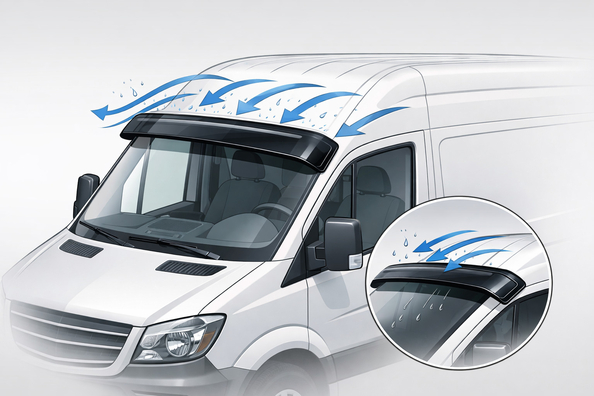

In short: for a van, a deflector is genuinely useful not as a “shield” for the entire windshield, but as a way to slightly change the airflow in front of the vehicle. So the practical effect is usually this: fewer insects, sand, and fine gravel in the area along the front edge of the hood and partly on the lower section of the glass. It won’t save you from large stones, already damaged paint, or a crooked installation.
On vans and minivans, the result strongly depends on the shape of the front end, the windshield angle, the height of the deflector “lip,” and speed. On the highway the benefit is more noticeable; in the city it’s often weak. That’s why one driver is happy, while another only hears whistling and doesn’t see a tangible difference.
The main confusion is that people expect a deflector to fully protect the windshield, even though it works differently: it doesn’t block impacts, it redirects part of the airflow upward. Some debris will still reach the vehicle, and that’s a normal limit of effectiveness, not a sign of poor quality.
For a van, the issue is more pronounced because of the large frontal area and specific aerodynamics. On one model the flow changes noticeably; on another it’s almost imperceptible. Add a poor fit or a universal accessory, and instead of benefit you get noise, vibration, and gaps along the hood.
DD Tuning expert comment: The most common mistake is installing a universal deflector and expecting the windshield to become almost clean. In practice, the main gain is visible on the front edge of the hood, not across the entire glass area. If a whistle appears after installation or the hood closes with tension, it won’t “wear in”—the fit needs to be corrected immediately.
| Symptom | Likely cause | What to do |
|---|---|---|
| The hood has fewer chips, but the windshield gets dirty almost the same | Normal limit of effectiveness; expectations were too high | Keep the accessory if your goal is to protect the hood edge, not a “dry/clean” windshield |
| Whistling, clicking, or rattling at speed | Weak mounts, misalignment, too thin or poorly chosen profile | Check the fit, tighten or redo the installation; if needed, replace with a vehicle-specific version |
| The hood won’t close properly or a gap remains | Incorrect installation, excessive mounting thickness, hole alignment error | Don’t force the latch; remove and reinstall correctly |
| In the city there’s almost no difference | Low speed and few conditions where the deflector actually works | Assess the accessory only after highway driving, insect season, or trips on gravel |
| Dirt accumulates under the deflector, marks remain | The gap traps dust; the area hasn’t been cleaned for a long time | Rinse regularly, don’t let debris build up, watch contact points with the paintwork |
If you need a ready-made solution for a specific van, it makes sense to look at a vehicle-specific windshield deflector rather than a universal strip. If the main problem is sand and dirt thrown from the wheels onto the body, mud flaps often help more. And when a driver wants less rain and wind with the side windows slightly open, that’s the job of window deflectors, not an accessory for the front edge.
Replacing the deflector itself is justified when the old one is cracked, has loosened up, or was a poor universal solution from the start. If the issue is only the mounting, a proper reinstallation may be enough; but if the hood is already closing with misalignment, it’s not worth delaying.
| Solution | When it works | When it’s not worth the money |
|---|---|---|
| Taller vehicle-specific deflector | Highway driving, insect season, frequent trips on sand and fine gravel | If you expect full windshield protection or drive almost only in the city |
| Low-profile hood protector | When it’s more important to preserve the paint on the front edge | If the main goal is to noticeably change airflow in front of the windshield |
| Reinstallation with proper mounts | When the product itself is good but whistles or sits crooked | When the accessory is wrong in shape and stiffness from the start |
| Regular cleaning and gentle washing | When the deflector is installed correctly but dirt builds up under it | When there are already rubbing marks, play, or hood-closing problems |
| Not installing one | When mileage is mostly urban, speeds are low, and the motivation isn’t practical | When the van regularly runs highways and the front hood edge really suffers from gravel and insects |
From a customer’s experience: the owner of a van used for intercity runs wasn’t looking for a “nice trim piece,” but a way to reduce chips on the front edge of the hood and slightly ease insect season. After rejecting a universal option, he installed a vehicle-specific deflector and got exactly the result he expected: the hood caught less fine gravel, and the windshield wasn’t perfect but was a bit easier to live with on the highway.
For a van, a deflector makes sense when you honestly understand its role: it’s partial protection from insects, sand, and fine debris—primarily in the area along the front edge of the hood and partly near the windshield. It performs best on the highway, during insect season, and on roads with abrasive dirt. If driving is mostly urban or expectations come down to full windshield protection, the expense often isn’t justified.
The key to a normal result is a vehicle-specific product, the right profile, and careful installation without misalignment. This material is based on real selection experience, hands-on practice, and real use scenarios—these are what show that a deflector can be useful, but only within its real capabilities.
| ✔ | On the highway, the deflector really reduces the amount of insects, sand, and small gravel hitting the front edge of the hood and partly the lower part of the windshield. For intercity trips, this is more noticeable than in city driving. |
| ✔ | A model-specific deflector made for a particular body fits more precisely and is less likely to cause whistling, vibration, or gaps. The article explicitly emphasizes that universal options create problems more often. |
| ✔ | If the main goal is to protect the paint on the front edge of the hood, the deflector can be appropriate even if the windshield does not stay much cleaner. This is useful for vans that often pick up abrasive dirt. |
| ✔ | During the insect season and on roads with sand or small gravel, the effect of the accessory is more noticeable. In such conditions, it justifies its installation better than in ordinary city driving. |
| ✔ | With proper installation and regular cleaning, the area under the deflector accumulates less dirt and leaves marks on the paint less often. In other words, the accessory works properly if it was not installed crookedly and has been properly maintained. |
| ✘ | The deflector does not fully protect the windshield and does not save it from large stones. If you expect exactly that effect, the result will be disappointing. |
| ✘ | In the city, its benefit is often weak due to lower speeds. The article’s authors directly note that the effect should be evaluated after highway driving, not after a short city trip. |
| ✘ | Improper installation can cause whistling, rattling, play, or even problems with closing the hood. In that case, it is no longer a minor drawback but a real practical problem. |
| ✘ | Universal or overly cheap trims often fail to properly account for the shape of a specific van. Because of this, instead of benefit you can end up with gaps, misalignment, and rubbing against the paintwork. |
Shipping to EU
Wholesale and retail
Own warehouse
Опис продукту
Подарунки не надаються при оформленні покупки у кредит під 0,01% або при покупці частинами.