31.05.2026
289
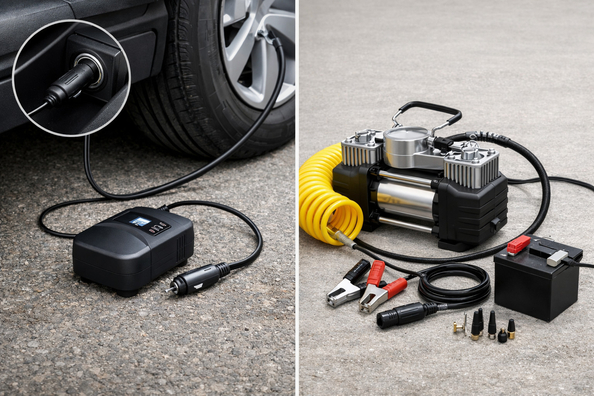
If you drive a regular passenger car and only need a compressor a few times per season, the least annoying option is a compact model that runs from the 12‑volt socket: plug it in, top up, toss it into the trunk compartment. But that convenience lasts only until you hit the socket’s limit, slow performance, overheating, or a short cable.
A more powerful compressor with battery clamps, or a mains-powered garage unit, removes some of those issues but adds others: more weight, noise, cables, and cost. So the choice here isn’t about “stronger is always better,” but about which format is less irritating in your specific use case.
Basically, there are three different ways people use them. The first is occasional top-ups in the city: check pressure once a month, bring a tire back up after a cold snap, top up after a tire shop visit. Here, a socket-powered compressor is often truly the most convenient.
The second is regular or heavy use: big wheels, a crossover or pickup, multiple cars in the family, gravel-road trips, winter driving when pressure drops more often. In this scenario, it’s the slow speed, heat buildup, and current limits that start to annoy you—so a clamp-to-battery compressor begins to make more sense.
The third is the at-home scenario. If your car is parked near a garage or yard with access to mains power, the most comfortable option is a plug-in compressor: it’s faster, doesn’t depend on the vehicle socket, and often has auto shut-off. But on the road, it won’t replace an onboard solution.
| Option | Strengths | Weaknesses | Who it’s for |
|---|---|---|---|
| 12‑volt socket compressor | Fast connection, compact, easy to store, convenient for infrequent top-ups | Socket current limits, slower operation, overheats more often during longer sessions | Passenger car, city driving, 1–2 tires occasionally |
| High-power 12‑volt compressor with battery clamps | Higher airflow, better endurance, more convenient for larger tires and multiple tires in a row | Heavier, louder, more expensive, more hassle with cables | Crossover, SUV, frequent trips, winter, off-road |
| Mains-powered garage compressor | Most comfortable at home, fast inflation, often has auto shut-off and wall storage | Doesn’t help on the road, depends on access to mains power | Private home, garage, seasonal pressure checks near home |
DD Tuning expert comment: the most common mistake is looking only at the maximum pressure number and ignoring current draw and hose length. The second typical issue is buying a powerful heavy compressor “just in case,” and then not carrying it because of its size. If you need a compressor only occasionally, connection convenience matters no less than performance.
This is the simplest everyday format. It’s handy when you don’t need to “save a flat from zero,” but just add 0.2–0.5 bar from time to time. For this use, compactness and quick start matter more than absolute speed.
Its weak point is power. In different cars, the socket may be rated for 120–180 W, and in older vehicles you can find even weaker outlets. That’s why one model works fine, while another on the same car is already at the limit or requires very careful attention to run time.
Another nuance is endurance in a long session. If you need to inflate several large tires in a row, a socket compressor slows down, heats up, and loses its main advantage—no hassle.
Here there are fewer power limitations and higher airflow. That’s why clamp models feel noticeably nicer with big tires, after airing down on gravel, or when you need to top up several cars at once. In practice, this means less waiting by the wheel and less chance of hitting an overheat limit.
But you pay for that speed with everyday comfort. You have to open the hood, connect the clamps, lay out the cables—and in winter, you also need a healthy battery. If you use a compressor twice a year, all of this can be more irritating than the slower top-up from a socket model.
This is also a different class in terms of weight and noise. Some of these compressors are genuinely fast, but they take up more trunk space and aren’t ideal for everyone as a constant road tool.
For home use, this is the least stressful option. Pull up where there’s power, grab the hose, set the pressure—and that’s it. In good versions with wall mounting and auto shut-off, this format requires the fewest extra movements.
Its drawback is obvious: on a trip, it solves nothing. So a mains compressor makes sense as a home tool, not as your only backup for the road.
For one passenger car in the city, when a compressor sits in the trunk “just in case,” a compact socket-powered format works best. It doesn’t require preparation to inflate, which means people actually use it rather than just carry it around.
For a crossover, a wagon fully loaded, winter highways, or trips outdoors, the advantage shifts toward the clamp option. There’s less chance you’ll start getting annoyed by the speed—especially if you need to inflate more than one tire.
If the main place of use is the yard or garage rather than the road, a mains compressor often provides the best everyday experience. Here you pay not for “power,” but for convenience: fast, clean, and not dependent on the vehicle’s socket.
| Scenario | Best choice | Why |
|---|---|---|
| Sedan or hatchback, top-up once every few weeks | 12‑volt socket compressor | Minimum steps before starting, enough for small pressure corrections |
| Crossover or minivan, 2–4 tires in a row | 12‑volt clamp compressor | Inflates faster and handles longer run time more easily |
| Off-road driving followed by reinflating all tires | 12‑volt clamp compressor | The difference in performance and duty cycle becomes critical |
| Home garage, seasonal checks for several cars | Mains-powered garage compressor | Least fuss, fast inflation, convenient to store permanently |
| Winter, older car, weak socket or questionable battery | Depends on the car’s condition, but socket models should be checked especially carefully | It’s in winter that power issues show up most often |
| Commercial or very frequent use | More powerful clamp or stationary option | Time, durability, and thermal headroom matter more than compactness |
A more expensive compressor is justified when you regularly face tasks a budget format handles slowly or stressfully: large tires, several tires in a row, frequent trips, regular off-road driving, winter top-ups, or multiple cars in the household. In those conditions, you’re paying not for “just in case” headroom, but for less waiting, better thermal reserve, and more stable operation.
If your current use is a basic city scenario, it’s enough to look at tire inflators. To calmly compare specs before buying, this guide on choosing a compressor is helpful. And when you need a noticeable performance reserve, it’s worth looking at something like a 190 l/min compressor.
From a customer’s experience: at first, they were looking for a small compressor for a family crossover because their old socket unit took too long after gravel-road trips. In the end, they chose a more powerful battery-clamp option because it restored pressure across all tires faster and didn’t overheat on the second or third tire. For rare city top-ups, that format would be overkill—but for their use, it turned out to be more practical.
In short, for most passenger cars and occasional top-ups, a 12‑volt socket compressor is the least annoying. If your main issue isn’t connection, but time, heat, and big tires, it’s better to look straight toward a clamp solution. And for home use, a mains-powered garage format often ends up being the most comfortable.
This conclusion is based not on abstract numbers, but on real selection experience, hands-on practice, and real-world scenarios: what people inflate, how often they do it, and what becomes annoying first—slowness, cables, noise, or unnecessary bulk.
| ✔ | A compact 12V socket compressor connects quickly and doesn’t take up much space in the trunk. For occasional inflation, it’s the least troublesome option for everyday use. |
| ✔ | A more powerful compressor with battery clamps handles larger wheels and inflating several tires in a row better. It is less limited by the car socket and overheats less often during a long session. |
| ✔ | A mains-powered garage compressor is the most convenient for home or the garage, as it inflates quickly and doesn’t depend on the car socket. In good versions, it also has auto shutoff and convenient stationary storage. |
| ✔ | For a city passenger car with infrequent pressure checks, the socket-powered option is enough and doesn’t require getting ready every time. That is why it is more often actually used rather than just carried around. |
| ✔ | A clamp-on or stationary compressor gives a noticeable advantage when you need to inflate several wheels, after off-road driving, or in winter. In such scenarios, speed and endurance matter more than compactness. |
| ✘ | A socket-powered compressor depends on the capabilities of the 12V socket, and with weak power it may run slowly or blow a fuse. This is especially noticeable in older cars or during longer operation. |
| ✘ | A more powerful clamp-on compressor is less convenient in everyday use: you have to open the hood, connect the clamps, and lay out the cables. If you use it rarely, this preparation can be more annoying than the inflation itself. |
| ✘ | Clamp-on models are usually heavier, louder, and take up more space in the trunk. Because of this, you may not always want to carry them as a permanent travel tool. |
| ✘ | A mains-powered compressor is not useful on the road, because it depends on access to the power grid. It is convenient only as a home or garage option. |
Shipping to EU
Wholesale and retail
Own warehouse
Опис продукту
Подарунки не надаються при оформленні покупки у кредит під 0,01% або при покупці частинами.