12.05.2026
236
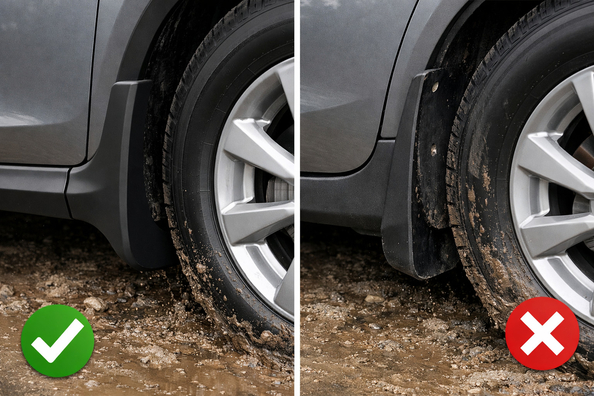
In short: when there’s an exact kit for a specific car, vehicle-specific mud flaps usually fit better and tear off less often. The reason isn’t the label itself, but the fact that they follow the wheel-arch shape, more often use factory mounting points, and don’t force the owner to guess the hole position, angle, and clearance to the tire.
Universal ones make sense when there’s no ready-made solution for a particular vehicle, the car has been modified, or you need wider coverage. But in that case, the result depends much more on trimming, hardware, material stiffness, and how carefully everything is installed.
The main question here isn’t only what looks cleaner. You need to understand what will hold best on your car, won’t start rubbing the wheel, won’t catch on a curb, and will actually protect the side skirt and the lower part of the fender from dirt.
In most typical scenarios, the vehicle-specific option wins: less risk of getting the geometry wrong, easier installation, predictable results. The universal option wins where a standard kit either doesn’t exist or no longer fits due to non-standard tires, different wheel offset, or the need for more coverage.
| Option | Strengths | Weaknesses | Who it’s for |
|---|---|---|---|
| Vehicle-specific | More precise fit, often faster installation, less chance of tire rubbing, neat look | More expensive, depend on the exact vehicle trim, sometimes too short for real protection | Those with a stock vehicle configuration who want to install without lengthy trimming |
| Universal | Can be adapted to a rare or modified car, easier to get more coverage in width and height, often lower starting price | More work during installation, requires measuring and hardware, higher risk of poor fit or tearing off due to mistakes | Those who don’t have an exact kit or need a non-standard solution |
DD Tuning expert comment: the most common mistake is buying mud flaps based on photos only and not checking tire clearance and the mounting method. If the car has wider wheels, different offset, or a lifted suspension, even a good kit can end up being a poor match. The second typical mistake is saving on fasteners: a weak clip or a random self-tapping screw is often the reason they tear off, not the mud flap itself.
Their main advantage is predictable geometry. If the kit is made for a specific body and model year, it sits closer to the arch, doesn’t require long positioning, and more often uses existing mounting points. That’s why vehicle-specific mud flaps, on average, fit better and tear off less often after the first winter or trips on wet dirt roads.
But that doesn’t mean the vehicle-specific option is automatically best for everyone. On some cars it can turn out too short, especially if the owner wants not just a tidy arch edge but real protection for the side skirt. Another nuance is non-standard wheels and tires: if the tire is wider or the wheel sits further out, even an exact kit can end up working with minimal clearance.
In terms of service life, vehicle-specific solutions win when the material is elastic and the load is properly distributed across the mounting points. Price-wise they’re usually more expensive upfront, but often cheaper in the end because they don’t require experimenting with templates and drilling.
Universal mud flaps aren’t bad in themselves; they just depend much more on the installer’s hands. Their advantage is freedom. You can choose a greater length and width, trim the edge to your arch, and get better coverage where a ready vehicle-specific kit is weak or unavailable.
The problem is that this freedom requires accurate marking, your own hardware, sometimes new holes, and constant clearance checks. If you miss by a few millimeters, the mud flap will either sit crooked, start rubbing the tire, or act like a lever on the fasteners. That’s why a universal kit more often tears off not because of the format, but because of a poor fit.
For longevity, everything here is decided by the material. Plastic that’s too rigid can become brittle in the cold, while a sheet that’s too soft without proper fixation will flap in the airflow. But if the material is semi-rigid or elastic and the hardware is chosen correctly, a universal option can last a long time and work very well.
For regular city driving, highway use, and seasonal slush, a vehicle-specific kit is more practical. It goes on faster, is less stressful to install, and less often creates extra noise or tire contact. If the car is stock, it’s the simplest way to get a solid result.
For winter, what matters isn’t so much vehicle-specific vs universal, but material flexibility and the right height margin. Mud flaps that are too long can catch packed snow, and ones that are too rigid can handle impacts poorly. Here, a quality vehicle-specific kit made of elastic material often wins, or a properly selected universal kit if you need more coverage.
For trips on bad roads, rural routes, or cars with changed body geometry, universal options are often more logical. They allow you to compensate for non-standard wheel width or the need for greater protection. But only if you’re ready to spend time test-fitting and not install them blindly.
| Scenario | What to choose | Why |
|---|---|---|
| Stock car for city and highway | Vehicle-specific | Faster installation, better fit, less chance of rubbing and misalignment |
| Car with a rare body or no ready-made kit | Universal | You can adapt the shape and mounting points to the specific wheel arch |
| Wider tires or different wheel offset | Depends on clearance, often universal | A standard vehicle-specific kit may not provide enough coverage or may conflict with the wheel |
| Winter, slush, frequent road chemicals | Flexible vehicle-specific or flexible universal | Material elasticity and correct length are critical, not the label of the type |
| Maximum protection for the side skirts | Universal or longer vehicle-specific | Short factory-style solutions don’t always block the dirt spray |
| Need a quick install with no experimenting | Vehicle-specific | Less manual trimming and a lower risk of installation mistakes |
Paying extra is worth it when you need not just a piece of material behind the wheel, but a predictable result: proper fit, a neat look, minimal mounting risks, and less chance you’ll have to redo anything. For a daily driver that sees rain, slush, and winter, a more expensive kit is often justified simply because it installs cleaner and doesn’t require you to adjust every hole by hand.
If a precise fit without extra experimenting matters, it makes sense to look at vehicle-specific mud flaps. If you want a solution that’s as close as possible to factory geometry, it’s worth comparing original kits. And when there’s no exact set for your car or the vehicle has already been modified, it’s more practical to consider universal options with enough allowance for proper fitting.
A more expensive solution also makes sense if the car often drives on poor roads and you don’t want to take risks due to weak fasteners or an unsuccessful material choice. But it’s important to remember a simple rule: more expensive doesn’t automatically mean better if the kit doesn’t match the geometry or is installed without accounting for clearances.
From a customer’s experience: for a crossover with an increased winter tire profile, they initially looked for a short vehicle-specific kit because they wanted a quick installation with no modifications. After a test fit, it became clear that side-skirt protection would be weak and clearance to the wheel on turns would be minimal. In the end, they chose a longer universal option with proper marking and hardware, and the owner was satisfied with the actual body coverage rather than the formal simplicity of installation.
If there’s an exact kit for your car and the configuration is stock, vehicle-specific mud flaps usually fit better and have a lower risk of tearing off. Universal ones should be chosen not as a default cheaper replacement, but as a tool for non-standard tasks: a rare model, modified wheels, or the need for more coverage.
The key to the right choice is simple: look not only at the shape, but at the mounting method, tire clearance, material elasticity, and actual length. This material is based on real selection experience, practical work, and real-world use scenarios, so the main takeaway is: the best mud flap isn’t the one that’s called more expensive or more universal, but the one that fits your specific car correctly and works without conflicts in your conditions.
| ✔ | Model-specific mud flaps usually fit a particular car better, as they follow the shape of the wheel arch and often use factory mounting points. This reduces the risk of misalignment and contact with the tire. |
| ✔ | Installing a model-specific set is usually simpler and faster. There is less need for trimming, templates, and hardware selection. |
| ✔ | For a standard car, model-specific mud flaps are less likely to come off, because the fit is more predictable and the крепление works without extra load. |
| ✔ | Universal mud flaps offer more flexibility when there is no exact set for the car or when the vehicle has been modified. They can be trimmed and adjusted for a non-standard wheel arch or wider wheels. |
| ✔ | Universal options can provide more coverage in width and height if the factory solution is too short. This is useful when you need better protection for the sills and lower part of the fender from dirt. |
| ✘ | Model-specific mud flaps do not always provide enough coverage, especially if the owner needs greater protection for the sills. On some cars, they may turn out to be too short. |
| ✘ | Universal mud flaps depend more heavily on installation quality. If the marking or clearances are off, they may sit crooked, rub against the tire, or come loose. |
| ✘ | A universal set often requires buying additional hardware and spending more time on installation. Because of this, a lower starting price does not always mean a cheaper final result. |
| ✘ | Both options can cause problems in winter if chosen incorrectly: a material that is too rigid handles impacts poorly, while mud flaps that are too long catch on snow and packed snow. |
Shipping to EU
Wholesale and retail
Own warehouse
Опис продукту
Подарунки не надаються при оформленні покупки у кредит під 0,01% або при покупці частинами.