28.04.2026
316
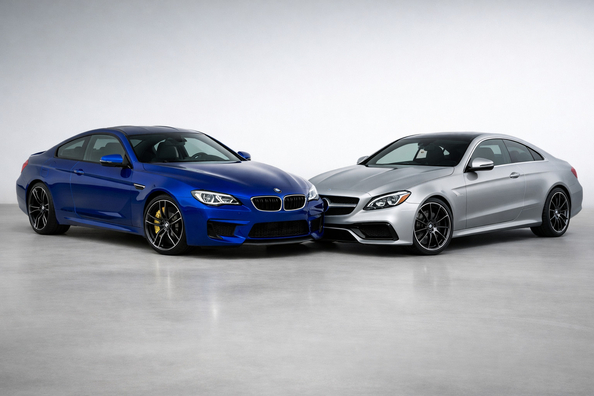

If you strip away the marketing noise, this is a choice between two very different ideas of a fast coupe. BMW M6 Coupé F13 is a rear-wheel-drive coupe with a 4.4-liter twin-turbo V8, sharp responses, and a distinctly mechanical character. With Mercedes there’s an important nuance: in the current official two-door lineup, the relevant AMG version is the Mercedes-AMG E 53 Coupé, not an E63 Coupé, so for a fair comparison you need to look specifically at the E 53.
So the point is simple: people choose the M6 for the V8, rear-wheel drive, and that “old-school” feel, while the E 53 Coupé is chosen for all-wheel drive, lower consumption, a more modern interior, and a calmer daily routine. If you meant a different generation of the two-door AMG E-Class, the numbers and conclusions will be different.
Both cars play in the expensive fast-coupe segment, but their roles are different. The BMW M6 is more of a big M coupe with an emphasis on the engine, rear-axle traction, and fast driving on dry asphalt. The Mercedes-AMG E 53 Coupé is closer to a fast daily coupe: it feels less aggressive, but it handles rain, cold, long highway runs, and city pace more easily. For a family scenario with frequent four-up trips neither is ideal, but the Mercedes is more tolerable in that respect.
The BMW M6 Coupé in the F13 body is the third generation of the M6 and was produced from 2012 to 2018. The base version had 560 hp, and with the Competition package output increased by another 15 hp. The Mercedes-AMG E 53 Coupé appeared in 2018 within the E-Class Coupé C238 generation, while the two-door E-Class of this generation started in 2017. This is exactly where the confusion comes from: in this lineup, the official AMG coupe flagship was the E 53, so there’s no direct new “E63 Coupé” for this comparison.
In terms of powertrains, they’re almost opposites. The M6 has a large 4.4 twin-turbo V8 and runs through a 7-speed dual-clutch transmission; in some markets there was also a 6-speed manual. The E 53 Coupé uses a 3.0-liter turbocharged inline-six with a 48-volt mild-hybrid system, paired with a 9-speed automatic and all-wheel drive. On paper the BMW is quicker, but the Mercedes makes far more sense where grip is inconsistent or the car is used every day.
| Parameter | BMW M6 Coupé F13 | Mercedes-AMG E 53 Coupé |
|---|---|---|
| Engine | 4.4 L twin-turbo V8 | 3.0 L turbocharged inline-six with a 48-volt system |
| Power | 560 hp | 429 hp plus short-term electric assist |
| Torque | 680 N·m | 520 N·m plus electric assist |
| Transmission | 7-speed dual-clutch; in some markets a 6-speed manual | 9-speed automatic |
| Drive | Rear-wheel | All-wheel, with variable torque distribution |
| 0–100 km/h | 4.2 s | 4.4 s |
| Top speed | 250 km/h, up to 305 km/h with the unlock package | 250 km/h |
| Rated fuel consumption | About 13.8–14.7 L/100 km depending on transmission | About 9.8 L/100 km |
| Real-world consumption | A benchmark around 12.4 L/100 km, but it rises easily with spirited driving | Noticeably lower than BMW; some owner reports quote about 11.1 L/100 km in the city and 7.7 L/100 km on the highway |
The M6 is longer, lower, and visually “flattened” to the road. Officially it has just 106 mm of ground clearance, so curbs, steep ramps, and winter courtyards aren’t its habitat. The E 53 Coupé is shorter in length, but has a slightly longer wheelbase and is better adapted to daily driving thanks to all-wheel drive and a more comfort-oriented chassis setup; in many versions it also comes with air suspension. Important: the Mercedes width in the data provided is listed including mirrors, so these figures aren’t perfectly symmetrical with the BMW.
| Parameter | BMW M6 Coupé F13 | Mercedes-AMG E 53 Coupé |
|---|---|---|
| Length × width × height | 4903 × 1899 × 1374 mm | 4842 × 2055 × 1430 mm |
| Wheelbase | 2851 mm | 2873 mm |
| Ground clearance | 106 mm | Not specified in the available official data |
| Trunk | 460 L | 425 L |
| Fuel tank | 80 L | 66 L |
| Curb weight | 1928 kg | 1905 kg by one standard or about 1980 kg by another |
| Rear seat | Tight for adults | More realistic for average-height adults |
In the BMW, the interior is older in architecture, but the ergonomics are straightforward and the driving position is excellent. Up front the M6 is comfortable even on long trips, but the second row is more of a formality. In the Mercedes, the cabin feels more modern, is easier for everyday interaction, and is better suited to the role of an expensive fast coupe for daily use. In safety, the platform age is what makes the difference: the newer Mercedes typically offers a broader set of electronic assistants, while the BMW relies less on electronics and more on a strong foundational dynamic “school.”
In the city, the M6 demands patience: a long hood, low height, low ground clearance, expensive tires, and a big appetite. On the other hand, the large 80-liter tank works well on the highway—if you’re not constantly “flat out.” The E 53 Coupé is noticeably easier to live with day to day: it burns less fuel, holds on better on slippery surfaces, and handles long trips more comfortably. But in return you have to accept more complex electronics, the 48-volt system, air-suspension risks, and the vulnerability of large wheels to potholes. If you need a coupe for every day, the Mercedes is the more logical choice; if it’s a second or third car for fun, the M6 looks more convincing.
Below is not an abstract list, but what an owner will actually feel after a few months of use.
| Model | Pros | Cons |
|---|---|---|
| BMW M6 Coupé F13 |
|
|
| Mercedes-AMG E 53 Coupé |
|
|
For both cars, the biggest value isn’t in deep power builds, but in things that genuinely make ownership easier. For the M6, that means interior and trunk protection, neat sill protection, the right tires, and restrained exterior elements without compromising ground clearance. For the E 53 Coupé, the same basics apply, plus special attention to wheels, tires, and body protection from daily wear.
As a reference point for the types of solutions for a big BMW, you can check out accessories for the BMW 6 Series. If you need a broader selection of practical items like mats, trunk protection, or trim pieces, it’s convenient to start with the accessories catalog. In short, these coupes need smart accessories and consumables more than questionable “tuning for the number.”
BMW M6 Coupé F13 is worth choosing for someone who specifically wants a V8, rear-wheel drive, and sharp sensations, and is ready to put up with the model’s age, consumption, and higher running costs. Mercedes-AMG E 53 Coupé suits someone looking for a fast premium coupe without daily stress: less fuel, more versatility, and a more modern cabin environment. And if you’re after a two-door E63 from a different era, that’s a separate comparison—then the balance of power will be different.
| ✔ | BMW M6 Coupé F13 delivers a more vivid driving feel thanks to its V8, rear-wheel drive, and quicker throttle response. For those looking specifically for emotion and the “old school” feel, this is its main strength. |
| ✔ | The BMW has a larger trunk — 460 liters — so it is more practical than the Mercedes for trips with luggage. The front seat in the M6 is also very well designed and comfortable for long journeys. |
| ✔ | Mercedes-AMG E 53 Coupé is better suited for everyday use: all-wheel drive, more stable traction in rain and cold, and lower fuel consumption. In daily city and highway driving, it is less demanding on the driver. |
| ✔ | The Mercedes interior feels more modern and is more convenient in everyday use. The second row is also more usable for adults than in the BMW M6. |
| ✘ | BMW M6 Coupé F13 is noticeably more difficult to use every day because of its low 106 mm ground clearance and long body. In the city, this means inconvenience with curbs, ramps, and winter roads. |
| ✘ | Fuel consumption in the M6 is high both on paper and in real life, especially during active driving. On top of that come expensive tires, brakes, and drivetrain maintenance. |
| ✘ | The rear seat in the BMW is tight for adults, so as a coupé for regular trips with passengers it is limited. In fact, this car is more about the front seats than full practicality. |
| ✘ | Mercedes-AMG E 53 Coupé lacks the V8 emotion that many expect from AMG. It also has more complex electronics, there are risks related to the air suspension, and the 20-inch wheels react sensitively to poor roads. |
Shipping to EU
Wholesale and retail
Own warehouse
Опис продукту
Подарунки не надаються при оформленні покупки у кредит під 0,01% або при покупці частинами.