02.04.2026
269
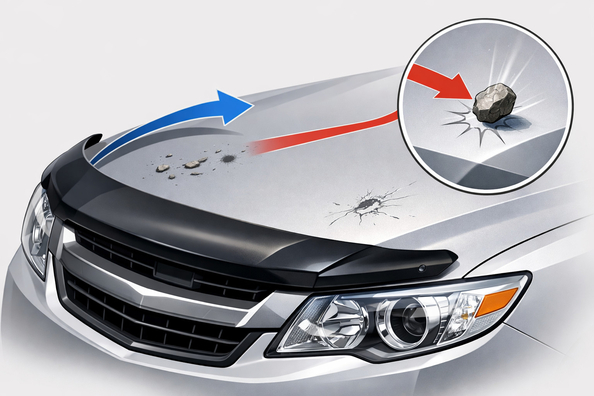
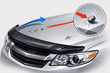
A hood deflector won’t save you from every chip on the hood for a simple reason: it doesn’t armor the metal—it only changes the airflow in front of the leading edge. It can indeed deflect some small debris, insects, and certain impacts, but a stone can still hit higher up, from the side, or at an angle where the deflector no longer works.
So chips after installing a hood deflector don’t always mean the accessory is “bad.” More often it’s the limit of what it can do, an unlucky front-end geometry on your particular vehicle, sustained high-speed highway driving, or installation mistakes that cause the part to vibrate or even rub the paint.
A hood deflector works as an aerodynamic element: it lifts part of the airflow upward rather than covering the entire impact area with a solid shield. It performs best along the hood’s leading edge, but the center section, the upper hood, the fender edges, and the windshield remain vulnerable.
In practice, a stone’s trajectory depends not only on the deflector itself, but also on the shape of the vehicle’s nose, the hood angle, the accessory’s mounting height, speed, and road type. On highways, on sanded asphalt, or on gravel, fine abrasive is thrown much more aggressively—so the limits of this kind of protection show up especially quickly.
Look not only at the fact that chips exist, but at their pattern. If the damage is concentrated on the leading edge, the deflector either doesn’t cover that zone properly, or the airflow doesn’t have time to divert debris. If chips appear above the deflector line or even spread to the windshield, the issue isn’t the deflector’s “strength,” but the front-end geometry and impact trajectory.
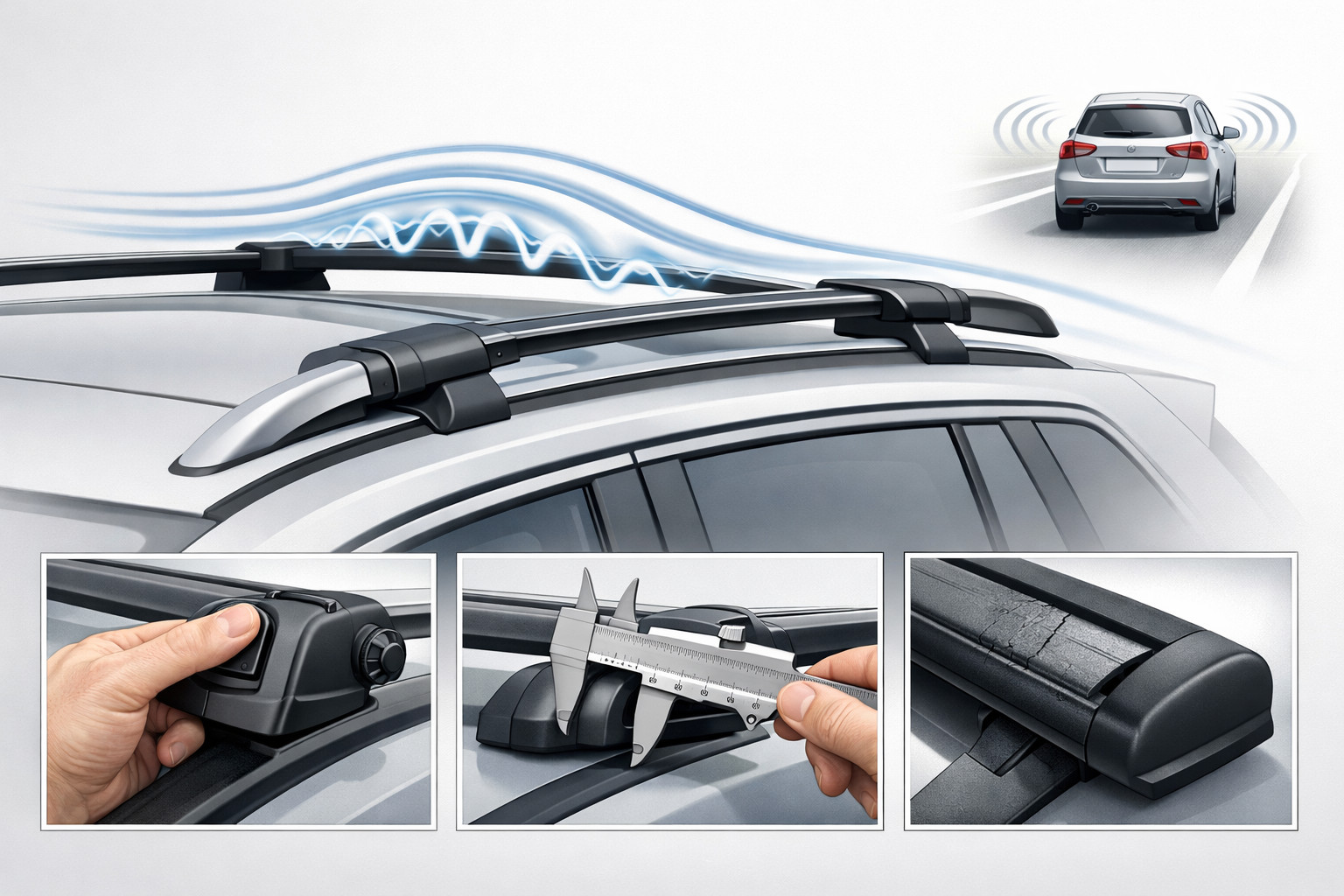
Next, check the installation. Gently rock the deflector by hand: it shouldn’t move around. Inspect the mounting points, rubber stops, anti-abrasion pads, and the area under the hood edge. Dull marks, a dust stripe, sand, or scratches near contact points mean the accessory is acting not only as a deflector, but also as a source of friction.
Another simple test is to link new chips to driving conditions. If the issue gets noticeably worse in winter, after road repairs, on the highway behind trucks, or on gravel, the main cause is road abrasive—not the part itself.
DD Tuning expert comment: the most common mistake is expecting from a hood deflector what only a real layer of physical protection can provide. The second typical issue is installing it without checking gaps and stops: the owner sees the accessory in place but doesn’t verify whether there’s movement, rubbing, or dirt buildup under the edge. If you don’t do a follow-up inspection after a few days of driving, a small misalignment can be missed.
| Symptom | Likely cause | What to do |
|---|---|---|
| Chips remain on the hood’s leading edge | The deflector covers only part of the impact zone or sits poorly | Check fitment and gaps, and consider protective film specifically on the edge |
| Chips appear above the deflector or on the windshield | The airflow doesn’t divert debris high enough | Don’t expect full protection from a deflector; choose film for the hood and a separate solution for the windshield |
| Noise or shaking at speed | There is play, weak fastening, or incorrect stops | Reinstall the accessory and check all contact points |
| Rubbing marks near the mounts | Installation error or dirt between the part and the hood | Remove it, clean it, check pads, and don’t leave abrasive under the edge |
| New chips appear mostly after highway driving or in winter | High abrasive load from sand, salt, and stones | Reduce driving close behind trucks, add physical clear-coat protection, and wash the area under the deflector more often |
If the goal isn’t just fewer insects but fewer chips, the most effective option is protective polyurethane film on the front part of the hood—or on the entire hood with wrapped edges. It doesn’t redirect the impact; it takes it. That’s why the difference between it and a hood deflector is felt immediately on the highway.
A hood deflector still makes sense, but as a partial solution: for the leading edge, to reduce dirt, and as an add-on—not as full protection. With model-specific fitment and proper installation it’s useful, but not all-powerful.
Simple prevention also helps in real life: don’t drive right behind other vehicles, periodically clean the area under the deflector, and don’t let sand accumulate there. It won’t eliminate the risk entirely, but it removes extra abrasive that can damage the clear coat on its own.
Wax, liquid glass, ceramic coatings, and other thin coatings are useful for easier washing and appearance, but they won’t save you from a stone. People often expect them to prevent chips, but in reality they don’t create a sufficient physical barrier.
Touch-up with a paint pen doesn’t solve the root cause either. It masks the consequence, but the next stone strike will reopen the weak spot. Likewise, cheap universal deflectors without proper hood-shape matching are ineffective: if the profile doesn’t match, the benefit is minimal, while the risk of noise and rubbing is higher.
The logic is simple: choose an accessory for a specific task, not “just in case.”
Replacing or repainting the hood makes sense only when damage has already turned into corrosion or the clear coat is worn along the entire leading edge. But doing it without fixing the cause means you’ll quickly end up with the same problem again.
| Solution | When it works | When it’s not worth spending money |
|---|---|---|
| Hood deflector | When you need partial leading-edge protection and vehicle-specific fitment | When you expect full protection of the entire hood and windshield |
| Reinstalling the deflector | When there’s noise, play, rubbing marks, or incorrect gaps | When chips appear high on the hood due to airflow geometry itself |
| Protective polyurethane film on the edge | When most impacts hit the front part of the hood | When the hood is already heavily corroded and the finish needs restoration first |
| Protective polyurethane film on the whole hood | When there’s lots of highway mileage, winter driving, gravel, and paint integrity matters | When the vehicle rarely leaves the city and the risk is minimal |
| Ceramic coating or wax | When you want easier maintenance and less dirt sticking | When you want to stop stone chips |
| Local touch-up | When you need to seal an existing chip from moisture | When you hope new chips will stop appearing |
From a customer’s experience: the owner of a crossover contacted us after a season of highway trips because with a hood deflector there were fewer chips only on the edge itself, but higher up on the hood they still appeared. After inspection it turned out the installation was fine, meaning the issue wasn’t a defect but the limits of the accessory on that front-end geometry. In the end, he kept the deflector for dirt and insects, and covered the risk area with protective film—this is what delivered a noticeable result.
A hood deflector isn’t useless, but it’s not a universal shield from every chip. It works best along the hood’s leading edge, while impacts higher up, from the side, or on the windshield may still get through. If chips keep appearing, you need to distinguish the accessory’s limits from an installation mistake—and not confuse an aerodynamic deflector with real physical paint protection.
The smartest approach is: check fitment, gaps, rubbing marks, and the damage pattern—and only then spend money on the next solution. This material is based on real selection experience, installation practice, and real-world use cases, so the conclusion is simple: a hood deflector can help, but it won’t save you from all chips.
| ✔ | Helps reduce the amount of insects, dirt, and some impacts on the front edge of the hood. This is useful if the problem is mainly dirt and minor impacts at the front. |
| ✔ | Can partially reduce the load on the front edge, especially on the highway or with a precise fit for a specific car. In other words, the accessory works, but only within its overlap zone. |
| ✔ | With proper installation, it can be an additional layer of protection together with film or as a temporary solution. This makes more sense than expecting full protection for the entire hood from it. |
| ✔ | A cheap and simple alternative for those who do not need a solid barrier, but only a partial reduction in impacts and dirt buildup. The article explicitly states that it should be viewed as a partial solution. |
| ✘ | Does not protect the entire hood: impacts can come from higher up, from the side, or at an angle, where the deflector no longer works. Because of this, chips on the central part of the hood or on the windshield may still remain. |
| ✘ | Its effectiveness depends greatly on the shape of the car’s front end, the installation height, speed, and road type. On the highway, gravel, or salted asphalt, the limits of protection become especially clear. |
| ✘ | If installed incorrectly, it can start to vibrate, make noise, or rub the paint. In that case, the accessory not only fails to help, but also becomes a source of problems itself. |
| ✘ | It does not replace physical protection such as polyurethane film. Wax, ceramic coating, or liquid glass also do not solve the problem of stone chips, so expectations for the bug deflector are often too high. |
Shipping to EU
Wholesale and retail
Own warehouse
Опис продукту
Подарунки не надаються при оформленні покупки у кредит під 0,01% або при покупці частинами.