 Author: Radomskyi Maksym Vasyliovych
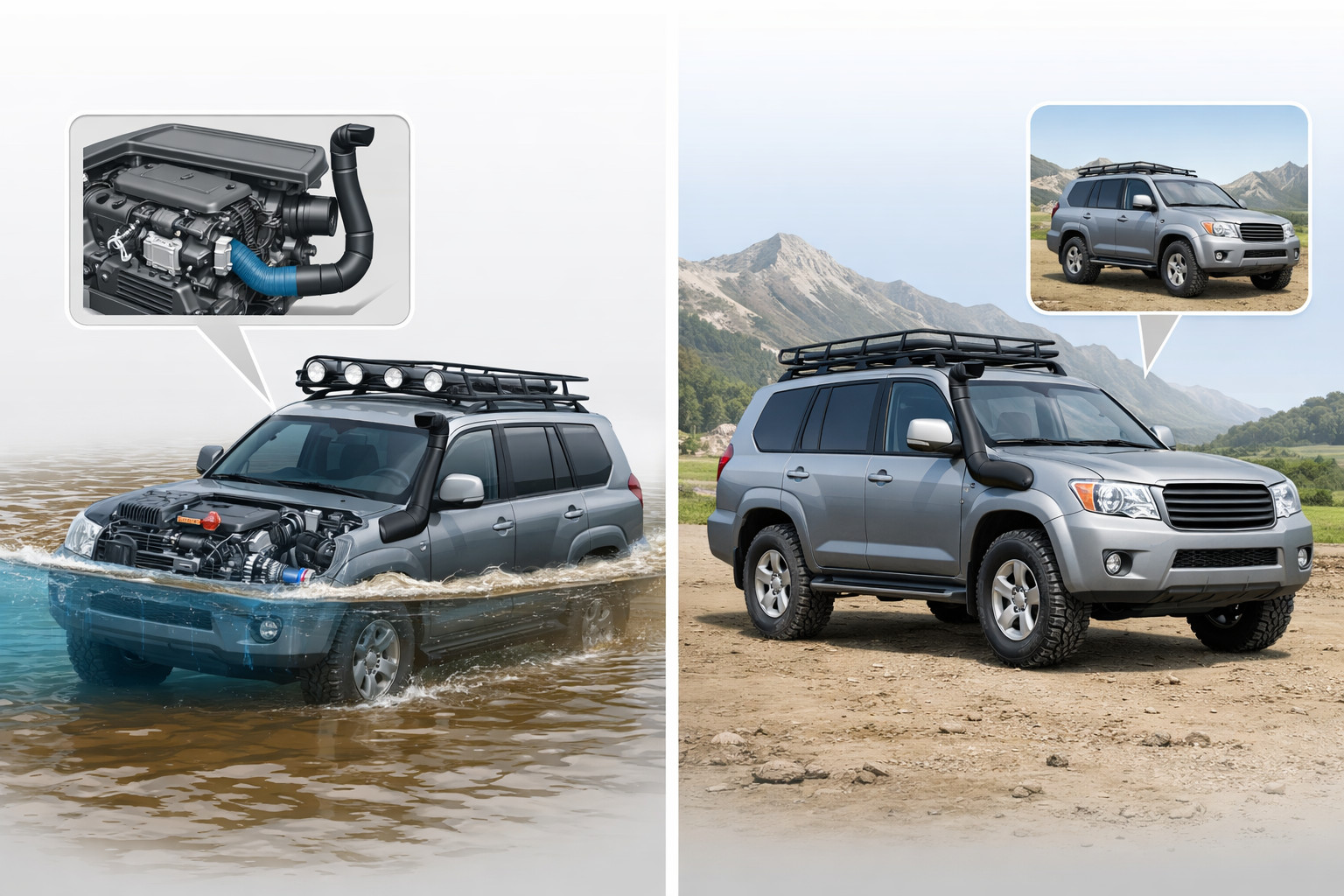
A snorkel isn’t needed just because your vehicle leaves the asphalt once a year. The real benefit shows up in three scenarios: regular dust on dry dirt roads, driving in a convoy, and deep slow water where the factory air intake is already close to the risk zone. But it only works when the system is truly sealed from the snorkel head to the airbox.
The main confusion is that a raised air intake and a full snorkel are not the same thing. A pipe on the A-pillar doesn’t turn a car into a “submarine”, doesn’t increase the wading limit by itself, and doesn’t protect axle, transmission and transfer case breathers, or the electrics. So the right question is: which risk are you trying to remove—water, dust, or just the visual effect.
Why this problem happens
The problem comes from wrong expectations about the part. Many people see a snorkel as a universal pass through a ford, while in practice it solves only part of the task—it raises the air intake point and, if done properly, reduces the chance of hydrolock through the intake.
The second layer of the problem is how similar different solutions look from the outside. On some vehicles, the factory element is only a high-mounted intake for cleaner air, not a sealed system. In that case the look is there, but the water margin is almost none. There’s also the opposite situation: people are genuinely bothered by dust in a convoy, but they install any “pipe” without checking sealing and the condition of the airbox.
Main causes
- Low or poorly placed air intake point. On some vehicles the stock intake quickly draws dust or risks taking in water in a deep puddle or ford.
- Regular driving on dry dirt roads. Especially in a convoy, where the densest dust hangs around the fender and bumper.
- Confusing a sealed snorkel with a decorative raised intake. From the outside the difference is small, in reality it’s critical.
- Ignoring related systems. Even a proper snorkel doesn’t replace raised breathers, dry connectors, and correct fording technique.
- Installing it “for the picture”. If the vehicle lives on asphalt, there’s often no real technical task to solve.
How to understand what the cause is in your case
Start simple: look at where your model’s factory air intake is and how often the vehicle actually sees water or dust. If the worst you face is city rain, wet highways, and normal puddles, a snorkel is usually unnecessary. But if after trips across fields the filter darkens quickly and there’s a lot of fine dust in the airbox, the problem is already closer to real.
For the water scenario, the check is different. After a questionable crossing or a flooded road, open the airbox: moisture, splash marks, or a wet filter means the risk isn’t theoretical. Then look not only at the intake, but also at the axle, transmission, and transfer case breathers. If they’re low, a snorkel alone won’t solve it.
Another marker is the route itself. If the water is above the knee and the current is strong enough that walking the ford feels unpleasant, the issue isn’t the lack of a snorkel—it’s that the crossing may be unjustified. And if the task is dust, consider whether you really need a snorkel or if pre-cleaning and a larger gap in the convoy are enough.
DD Tuning expert comment: Most often people look only at the height of the snorkel head and don’t check the joints from the fender to the airbox. The second typical mistake is installing it “just in case” but driving only in the city. If the task is dust, separately evaluate the filter condition and the need for pre-cleaning; if the task is water, start with sealing and the breathers.
Symptoms, causes, and what to do (table)
| Symptom | Likely cause | What to do |
|---|---|---|
| After a ford there’s moisture in the airbox or the filter is wet | Unsealed intake tract; water enters not only through the head | Check all joints from the head to the airbox, fender seals, hoses, and the airbox itself |
| The filter clogs very quickly after dirt roads in a convoy | The air intake operates in the dustiest zone | Consider a snorkel or a pre-cleaner, increase following distance, check the filter more often |
| You want to drive deeper than the factory wading depth just because there’s a pipe on the A-pillar | False sense of security | First assess breathers, electrics, current and bottom; sometimes the right decision is not to go |
| After installation there’s noise, but no obvious benefit | Low-quality kit or your use case doesn’t require a snorkel | Check installation and sealing; if it’s a city vehicle, don’t expect a noticeable practical effect |
| There’s fear that in rain the engine will “drink” water from above | Misunderstanding of how the snorkel head works | With a quality system, don’t turn the head backward without need; sealing and drainage matter more |
What really helps
A sealed snorkel makes sense where the vehicle regularly sees deep slow water or lots of dust. Its benefit isn’t magic—it’s a correctly relocated intake point and more consistent access to cleaner air.
A pre-cleaner often delivers more practical value in dust than in water. If the vehicle runs in steppe terrain, quarries, or in a convoy, it really reduces how much dirt reaches the filter and airbox. But for a city vehicle it’s already overkill.
Comprehensive preparation for fording works better than any single part: extended breathers, checked connectors, dry electrics, sensible speed, and an advance assessment of the bottom. If the water is deep but slow, it adds margin. If the current is strong, no snorkel makes the crossing a smart idea.
What barely works or helps only briefly
A decorative raised intake without fully sealing the tract almost doesn’t work. From the outside it looks like a snorkel, but in a real ford the weak point shows up at the joints, inside the fender, or near the airbox. That’s why on some factory solutions a high intake doesn’t increase the rated wading depth.
Trying to “save everything” with sealant only on visible seams also helps poorly. If hoses, the airbox, drains, and breathers aren’t checked, water will still find a way. Turning the head backward in rain also doesn’t make much sense: a quality head diverts water on its own, and an unnecessary turn can worsen airflow.
Another expensive mistake is putting a snorkel on a city crossover that doesn’t run in dust and doesn’t see real fords. In that scenario it’s mostly a look, not a solution.
When accessories or replacing parts makes sense
When a vehicle truly lives in mud, water, and long-distance trips, a snorkel only makes sense as part of a working kit. First, it’s worth understanding the logic of the part itself—briefly covered in the material what a snorkel is.
Next, look at the consequences of use. On popular off-road models, it’s not only intake solutions that are practical: if the vehicle is constantly being showered with mud, mud flaps for Wrangler make sense. And if after water and clay the interior suffers, rubber floor mats for Pajero Wagon IV pay for themselves quickly—they don’t increase capability, but they solve a real everyday downside of those trips.
Solution: when it works and when it’s not worth spending money (table)
| Solution | When it works | When it’s not worth spending money |
|---|---|---|
| Sealed snorkel | Regular fords, dusty routes, convoy driving, verified sealing | City, highway, rare trips without water and dust |
| Cyclone pre-cleaner | Dry dirt roads, steppe, quarries, multi-day dusty routes | When the vehicle barely sees dust or when every percent of airflow matters |
| Extended breathers and electrical protection | When deep slow crossings are planned and the vehicle is truly being prepared for water | If the snorkel is installed only for looks and there’s no water scenario |
| Raised air intake without sealing | Sometimes provides cleaner air in dust | When you expect a real increase in wading depth and hydrolock protection |
| Turning the head backward in rain | Provides almost no practical gain | As a permanent “solution” for water or engine protection |
| Snorkel “for looks” | Only if the task is purely the vehicle’s exterior image | When you want to solve a specific technical problem |
From a customer’s experience: a pickup owner was looking for a snorkel out of fear of fords, but during the conversation it turned out his main problem was dust and fast filter clogging on dry convoy routes. In the end he chose a proper sealed kit and pre-cleaning, and dropped the idea of “driving deeper through any water” until the breathers were upgraded. What he valued most wasn’t the look, but that the airbox stayed cleaner and maintenance became more predictable.
Conclusion
A snorkel is truly needed when you regularly drive in dust or cross deep slow water and are ready to finish the whole system—not just bolt a pipe to the A-pillar. If the vehicle lives on asphalt and your scenario is limited to rain and ordinary puddles, it’s mostly an expensive look.
The practical takeaway is simple: first define the risk, then check intake sealing, breathers, and the real operating conditions. This material is based on real selection experience, hands-on practice, and real-world use cases, so the key advice here is without myths: it’s not the snorkel itself that works, but a correctly assembled solution for a specific task.
Pros and cons
A sealed snorkel is truly useful in dusty conditions and in deep, slow-moving water, if the entire intake system is assembled without leaks. In such scenarios, it raises the air intake point and reduces the risk of hydrolock through the intake.
For driving in a convoy on dry dirt roads, a snorkel or pre-cleaner can noticeably reduce the amount of dirt reaching the filter. This is especially practical where the factory air intake operates in the dustiest zone.
Comprehensive preparation for fording brings more benefit than a single separate part. Raised breathers, dry electronics, and checked connectors really complement the snorkel in a water scenario.
A cyclone pre-cleaner is useful specifically in dust: on steppe, quarry, and multi-day routes, it can significantly extend the life of the main filter. For a vehicle that rarely sees dust, this is less relevant.
A snorkel makes sense when the vehicle regularly operates in difficult conditions and the owner is ready to check the entire intake tract for tightness. In that case, it is not a decorative element, but part of a working solution for a specific risk.
A raised air intake does not make a vehicle capable of safely crossing any ford. It does not remove the depth limit, nor does it protect the breathers, gearbox, transfer case, or electrical system.
A decorative or non-sealed “snorkel” offers little practical benefit. The weakest points still remain at the joints, in the fender, or near the air box.
On a city car, a snorkel often does not solve any real problem. If the car lives on asphalt and never sees dust or fords, it is mostly an unnecessary expense.
Relying only on turning the head backward in the rain is not worth it. The article states directly that it offers almost no practical gain and is not a permanent solution for engine protection.