29.06.2026
152
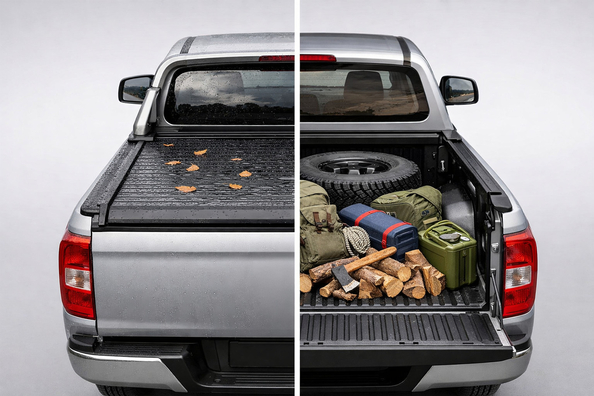
A tonneau cover makes sense not as a magic way to cut fuel consumption, but as a practical cover for the bed. Its real value shows up when you need to protect cargo from rain, snow, and чужих рук, and also want normal access to the bed without constantly removing a lid.
If a pickup lives in the city, mostly carries bulky cargo above the bed rails, or the bed often needs to be fully open, driving without a tonneau is often the more rational choice. But if you regularly keep tools, bags, gear, or travel items in the bed, the cover quickly stops being a decorative accessory and becomes a working piece of kit.
The main question here is simple: do you want to keep the bed as open as possible, or make it more protected and suitable for everyday hauling. An open bed gives you zero height ограничения and the fastest access, but protects nothing. A tonneau adds order, hides the contents, and slightly improves aerodynamics on the highway, but you pay for it with money, weight, and certain access compromises.
So the choice is not between “useful” and “useless”, but between different use cases. For highway trips, winter, travel, and work tools, a tonneau is usually justified. For hauling refrigerators, motorcycles, строительные материалы, and anything that regularly sticks above the bed rails, it may get in the way more often than it helps.
You should compare not by looks, but by five practical criteria: installation, noise, service life, practicality, and price. On top of that, consider security, water resistance, and compatibility with other accessories.
Separately, look at whether you truly need aerodynamics. On the highway there can be a benefit because a cover reduces air drag at speed, but in the city or on short routes you shouldn’t expect noticeable fuel savings.
| Option | Strengths | Weaknesses | Who it suits |
|---|---|---|---|
| No tonneau | No purchase or installation costs, full bed access, no limits on cargo height | No protection from rain, dirt, or theft, items are always visible, no aerodynamic benefit | For those who often carry tall or dirty loads and don’t leave valuables in the bed |
| Soft tonneau | Best balance of price and convenience, quick to open, full bed access, decent weather protection when installed correctly | Easier to damage or cut, requires tension checks, minimal load capacity on top | For everyday city use, commuting, gear, bags, and tools without elevated security requirements |
| Hard tonneau or retractable system | Better security, higher rigidity, handles winter better; some models allow a meaningful evenly distributed load on top | More expensive, heavier, more complex installation, cassette may take up bed space | For those who regularly carry valuables, drive a lot on the highway, or want fewer compromises in bad weather |
If you boil it down to one sentence: without a tonneau you win in bed freedom, a soft tonneau wins in everyday convenience, and a hard one wins in protection and durability.
DD Tuning expert comment: the most common mistake when choosing a tonneau is looking only at price and not checking what the person actually hauls every day. If the load is regularly higher than the bed rails, even a good cover will start to annoy you within a week. The second typical story is weak tension and unevenly installed rails—then the owner complains not about the model, but about noise and leaks caused by the install.
This is the most straightforward option for a work pickup that constantly hauls large items, building supplies, or equipment. You don’t unscrew anything, clean anything, tension anything, or worry whether the load will fit under a cover. If the bed is used as an open platform, this is a logical scenario.
The downside is that any tools, bags, or gear lose protection. Add water, dust, snow, and the постоянная need to strap down or package items separately. For long trips, this format is less convenient.
This is the most pragmatic format if you just need to cover the bed without big costs. It provides full access after rolling up, installs relatively easily, and doesn’t take up space near the cab. For city and daily use, it’s the smartest starting point.
But treat it as a convenient cover, not a safe. The material can be damaged, top load capacity is minimal on these models, and water resistance depends on installation accuracy. In winter and грязь you need to watch the tension, clean the surface before opening, and periodically check the clamps.
This option isn’t bought for minor fuel savings, but when the bed holds something worth more than the price difference. Hard slats are harder to damage, the конструкция handles daily use better, and some models let you place useful load on top—something soft systems can hardly do.
The compromises are also obvious: higher price, more weight, more complex installation, and potential loss of space due to the cassette near the cab. If you have a tool box, cargo drawer, or hitch setup in the bed, compatibility should be checked for the конкретная model, not just by the general cover type.
In short, the deciding factor is not the type of accessory itself, but your typical usage pattern. For the city, a simple and light solution is выгоднее; for highways and travel—protection and quiet; for heavy work—bed freedom without a cover.
| Scenario | Best choice | Why |
|---|---|---|
| City pickup: shopping, bags, small tools | Soft tonneau | Fast bed access, hides items from view, and doesn’t require major spending |
| Long highway trips | Hard tonneau or retractable system | Better weather protection, fewer security compromises, more stable behavior at speed |
| Work pickup with expensive tools | Hard tonneau | Aerodynamics matter less than harder access to the contents and better durability |
| Frequent transport of refrigerators, motorcycles, building materials | No tonneau | No height limit and no need to open or roll up the cover every time |
| Winter, muddy roads, snow | Hard tonneau | Handles harsh conditions better, depends less on fabric tension, and is usually quieter |
| Infrequent bed use, minimal budget | No tonneau or a basic soft tonneau | Depends on whether you need to cover cargo at all, at least from rain and prying eyes |
A more expensive hard tonneau or retractable system is justified when the pickup is truly working: tools stay in the bed, the vehicle often sits unattended, there are lots of highway miles, winter, mud, and a desire to think less about fabric tension. It’s also a logical choice if you need higher rigidity and the ability to place some load on top of the cover.
If you’re already leaning toward a hard solution, it makes sense to first look at tonneau covers. If you need an even higher level of enclosure and usable volume above the bed rails, compare it with a pickup canopy. And if you’re still choosing between different cover formats, it’s useful to review what to cover a pickup bed with.
There’s no point overpaying if the bed is empty most of the time, the cargo is tall, and you don’t leave valuables in it. In that scenario, an expensive system pays off not in practice, but only in the desire to have a pricier accessory.
From a customer’s experience: a pickup owner was primarily looking for fuel savings, but after a conversation he focused on real tasks—he carried tools in the bed every day and drove highway routes between cities. In the end he отказался of a soft model and chose a hard tonneau, because security and peace of mind in parking lots mattered more to him than a small difference in consumption. He’s happy mainly because he stopped moving things into the cabin and relies less on the weather.
A tonneau cover provides real value when you’re covering not an empty bed, but regularly hauling items that need protection from precipitation, dirt, and prying eyes. For the city and basic tasks, a soft tonneau often looks like the most rational choice; for highways, winter, and expensive cargo—a hard or retractable system; and for regular bulky/tall loads, the most honest решение may be no tonneau at all.
The key is not to buy it for the wrong reasons. This article is based on real selection experience, practice, and real usage scenarios, and they show: the right tonneau solves access, protection, and everyday convenience, while the wrong one simply adds costs and limitations.
| ✔ | Provides solid protection for cargo from rain, snow, dust, and prying hands if tools, bags, or gear are regularly carried in the bed. |
| ✔ | Keeps full access to the bed after opening, so it’s convenient to work with items without constantly removing the cover. |
| ✔ | Can slightly improve aerodynamics on the highway, so it offers practical benefits on long trips. |
| ✔ | A soft roll-up cover is relatively easy to install, often without drilling, and doesn’t take up much space near the cab. |
| ✔ | A hard roll-up cover or retractable system is better suited for valuable cargo: it is stronger, quieter, and handles winter and daily use better. |
| ✘ | It’s not a solution for constantly heavy loads: if items regularly stick out above the sides, the tonneau cover will only get in the way during loading. |
| ✘ | Soft models offer weaker protection, are easier to damage or cut, and require tension checks and maintenance. |
| ✘ | Hard systems are more expensive, heavier, and more complex to install, and the canister may take up part of the bed volume. |
| ✘ | Don’t expect noticeable fuel savings in the city: the real aerodynamic benefit is more noticeable on the highway. |
Shipping to EU
Wholesale and retail
Own warehouse
Опис продукту
Подарунки не надаються при оформленні покупки у кредит під 0,01% або при покупці частинами.