04.07.2026
216
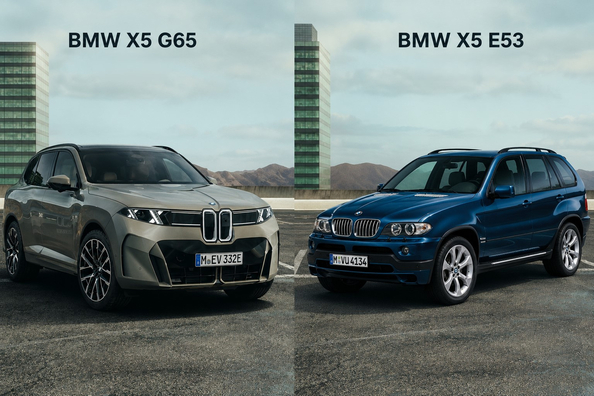

BMW X5 G65 and X5 E53 are not just two generations, but two different approaches to the same class. People choose the G65 for its quietness, power reserve, long-distance comfort, modern electronics, and better trailer pulling capability. The E53 is chosen for a lower entry price, simpler mechanics, and the ability to maintain the car without being constantly tied to complex systems.
The key point is simple: if you want a comfortable daily crossover that doesn’t feel dated, the logic is on the G65’s side. If you want an inexpensive project, a car “built for you,” or an older BMW with a more direct character, the E53 still makes sense—but only with a repair budget in reserve. For the figures below, it’s important to remember: performance and fuel consumption depend heavily on the engine, so the baseline comparison is best read as G65 40 xDrive vs E53 3.0i.
The point isn’t which X5 is better in general, but which one will annoy you less in your scenario. The G65 is bigger, quieter, faster, and better suited for highway use, family trips, and towing. The E53 feels simpler in everyday life: less electronic complexity, a lower starting budget, and a more mechanical feel.
But the cheaper entry into an E53 almost always means older components. So the decision often comes down to what you’re willing to pay for: a high purchase price now, or service, diagnostics, and restoration later.
| Option | Strengths | Weaknesses | Who it suits |
|---|---|---|---|
| BMW X5 G65 | Modern platform, quiet on the highway, 400 hp in the base gasoline engine, 8-speed automatic, better towing capability, more space with the second row folded | High entry price, a new model without long-term durability stats, more complex electronics, fewer physical buttons | Those who drive daily, travel often, tow a trailer, or don’t want to put up with an aging vehicle |
| BMW X5 E53 | Lower purchase budget, simpler design, more direct steering feel, a more realistic option for DIY maintenance | Age, typical cooling and electrical issues, suspension and transmission risks, higher noise, weaker performance, an older set of systems | Those looking for an inexpensive project, an older BMW with character, or a car you can keep going with your hands, not just money |
The G65 is a completely different level of X5. It’s noticeably larger than the E53, has a longer wheelbase, a modern electronic architecture, and a much stronger base gasoline engine: 400 hp and 580 N·m versus 225 hp and 290 N·m in the E53 3.0i. In practice, this means not only quicker acceleration, but also calmer passing, lower engine load on the highway, and more reserve for a full cabin or a trailer.
The G65’s strength is not only power, but overall composure. A newer suspension, modern dampers, and optional air suspension deliver a quieter, smoother ride. For a family, daily use, and long routes, this is a very noticeable advantage. The downside is that this generation’s long-term durability hasn’t been proven over years yet, and any complex retrofits or body repairs can potentially be more expensive.
The E53 is valued not for the numbers, but for its character. It’s more compact, feels simpler and more honest, and in good condition still delivers enjoyable steering and decent comfort. If you choose the inline “six” rather than a V8, the car is usually more sensible in terms of service costs.
The E53’s problem is different: it’s no longer just an old X5—it’s an aging BMW. You need to budget for cooling, crankcase ventilation, seals, suspension, electrics, and sometimes the transmission. In other words, the main risk isn’t that the model is bad, but that many people buy it as a “cheap X5” and then are surprised by the real cost of restoration.
For highway driving, high mileage, and the role of a single family vehicle, the G65 looks better. It’s quieter, faster, calmer at speed, and more practical for trips with luggage. Here, the extra spend pays off every day, not only on the spec sheet.
For short city trips, irregular use, or a hobby project, the E53 can be the smarter choice. It’s easier on the initial budget and simpler for a shop to work on. But only if you’re buying condition, not the lowest price on the market.
For towing, heavy loading, and frequent trailer trips, the advantage also goes to the G65: up to 3000 kg of towing versus 2700 kg in the E53, better stability, and modern assistants. For “old school” driving without dependence on lots of electronics, the E53 still remains more appealing.
| Scenario | What’s better to choose | Why |
|---|---|---|
| Daily driving, family, highway | BMW X5 G65 | Less noise, better performance, modern driver aids, more usable space with the seats folded |
| Cheaper entry into an X5 | BMW X5 E53 | Lower purchase price, simpler design, makes more sense for an owner with DIY maintenance skills |
| Towing a trailer | BMW X5 G65 | Higher rated towing capacity, better power reserve, modern maneuvering assistants |
| A “built for you” project and simple upgrades | BMW X5 E53 | Less dependence on complex electronics, easier installation of basic accessories, and less risk of affecting driver-assistance systems |
| Maximum predictable comfort without the “old car” feel | BMW X5 G65 | A newer car hides bumps better, is quieter, and doesn’t require planning major age-related service right away |
Paying extra for the G65 looks logical if the X5 will be your main vehicle, if you often drive on the highway, carry family, tow a trailer, or simply don’t want to live with the compromises of older premium cars. In that scenario, the difference pays back not through resale, but through everyday peace of mind: less noise, more pulling power, better stability, and more modern systems.
If you’re already looking toward the new generation, it’s worth evaluating compatible solutions for BMW X5 G65 right away. If you’re deliberately choosing an older car for restoration or moderate retrofitting, it’s more practical to browse the catalog for BMW X5 E53. And if your choice hasn’t narrowed to a single generation yet, it’s more convenient to start from the general BMW accessories page.
BMW X5 G65 and BMW X5 E53 don’t compete in a vacuum. The G65 is the choice for comfort, quietness, power, and daily versatility. The E53 is the choice for a lower starting budget, simpler mechanics, and a more lively old-school feel. If you need one car for every day, the logic usually favors the G65. If you want an affordable X5 with character and you’re ready for maintenance, the E53 still makes sense—but you should buy condition, not the price tag.
| ✔ | BMW X5 G65 retains the format of a large premium crossover that suits family use, long trips, and mixed driving. It offers space, a high seating position, and a solid level of practicality without stepping up to the even larger X7. |
| ✔ | The model is focused on comfortable highway driving: the car is stable, holds speed well, and gives a sense of composure on fast roads. For trips between cities, this matters more than flashy little details in the cabin. |
| ✔ | The inline six-cylinder versions look the most balanced for such a large body. They combine good pulling power with more reasonable running costs than the top trims, without losing everyday flexibility. |
| ✔ | BMW X5 has a spacious trunk and good rear-seat room. This makes it convenient for family use and trips where you need to carry a lot of things. |
| ✔ | The model retains strong resale value in the premium segment. For the buyer, this means the car is usually easier to sell than less popular large crossovers. |
| ✘ | Maintaining the X5 is expensive compared with an average crossover. Large wheels, wide tires, massive brakes, and complex electronics quickly drive up running costs. |
| ✘ | The large body is not very convenient in dense city traffic or narrow parking lots. For such a car, you need to get used to the dimensions and keep a close eye on maneuvers. |
| ✘ | Large wheels can noticeably reduce comfort on bad roads. If it also has air suspension, it adds convenience, but makes the system more demanding in terms of condition. |
| ✘ | Complex electronics and optional systems require careful servicing. Without proper care, savings on maintenance here quickly turn into extra expenses. |
Shipping to EU
Wholesale and retail
Own warehouse
Опис продукту
Подарунки не надаються при оформленні покупки у кредит під 0,01% або при покупці частинами.