03.07.2026
202
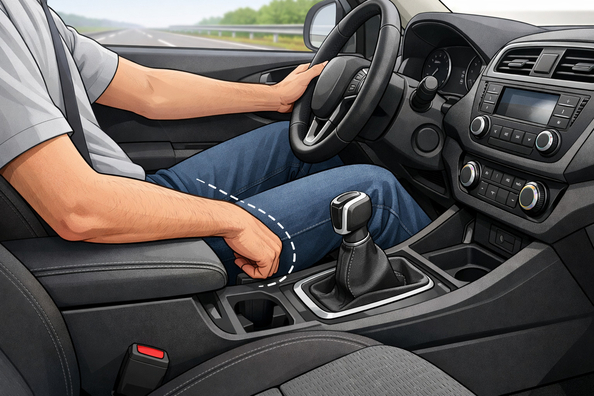

On the highway, the right hand often gets tired not because the car has no armrest, but because the support is either too low, too far away, or the driving position is set so that the forearm has nowhere to rest. As a result, the shoulder slightly hangs, the neck tightens up, and after 30–60 minutes you want to change your grip on the steering wheel.
You should start not with buying a cover, but with seat geometry: your hands should reach the steering wheel without stretching, it’s advisable to keep about 25–30 cm from the sternum to the wheel, keep the backrest within 90–110°, and the support should hold the lower part of the forearm specifically. If after that the right hand is still “in the air,” then an armrest or an extender starts to make sense.
On short trips you may not notice it. On the highway the body sits for a long time with almost no change in position, small vibrations add up, and even a minor mistake in support height or reach quickly becomes noticeable. In winter the effect is stronger: muscles and joints are stiff, so the hand tolerates an unsupported position worse.
An important nuance: a comfortable support is needed not for the shoulder and not for the elbow “on the corner,” but for the lower part of the forearm. If you have to lift your shoulder or reach forward with your elbow, the armrest is there formally, but in practice it doesn’t work.
Check everything step by step, not randomly. First set the seat so that about 25–30 cm remains between your sternum and the steering wheel, at least about 76 mm of road is visible above the top of the wheel, and 2–3 fingers remain between the seat edge and the back of the knee. Backrest angle—roughly 90–110°, hands on the wheel at 9 and 3, without stretched shoulders.
Then place your right forearm on the factory support. If the shoulder rises, the support is too high. If you unconsciously lean to the right, it’s too low. If the elbow slides forward or to the side, the problem is reach or width. If it’s comfortable for the first 10 minutes but numbness appears after 40–60 minutes, it’s not only the seating angle—there’s also a hard edge or too narrow a support area.
The most honest check is a drive of about an hour at your usual highway pace. If after adjusting the seat and steering wheel your right hand gets less tired, the cause was the seating position. If not, look for the solution in the support itself.
DD Tuning expert comment: the most common mistake is choosing an armrest based on cabin photos rather than your own driving position. If the driver is already sitting too close to the wheel just to get arm support, buying a taller cover without readjusting the seat is risky: you can end up with even more shoulder tension or awkward access to the handbrake and shifter.
| Symptom | Likely cause | What to do |
|---|---|---|
| Shoulder gets tired quickly | Armrest is too high or the hand has to reach for it | Lower the seating position or change the backrest angle; if it doesn’t help, look for a lower support |
| Neck pulls to the right | Armrest is too low, the body tilts to the side | Check seat and steering wheel height; if cabin geometry is poor, install an extender or a different armrest |
| Elbow slides forward | Support is too far away or too short | You need an armrest with greater reach or a closer position |
| Numbness, tingling in the forearm | Hard edge or too narrow support area | A softer and wider top section, without a sharp ridge |
| Discomfort only on the highway | Static posture and vibrations, not only the armrest shape | Readjust the driving position and take short breaks every 1–2 hours |
| Worse in winter | Stiff muscles and joints due to cold | Warm up the cabin; don’t judge the armrest on a cold start |
A step-by-step approach works—from free to paid. First, reset the seat, backrest, and steering wheel. Then drive at least an hour and understand what’s missing: height, reach, or softness. Only after that choose a solution.
The best effect comes from a support that holds the lower part of the forearm without lifting the shoulder. If there’s no factory support at all or it’s too low, a rigidly mounted armrest or extender helps. On long highway drives, simple things matter too: change hand positions, take short pauses every 1–2 hours, and in winter drive in a warmed-up cabin.
Soft covers that compress heavily under the weight of the arm work poorly: in a parked car they seem comfortable, but on the highway the support “floats,” and the shoulder takes the load again. Another questionable solution is simply to sit closer to the steering wheel for the sake of support: you can reduce the clearance to the airbag and still not eliminate fatigue.
It’s also not worth relying on the habit of “I’ll just endure it until I arrive.” If the arm hangs in the air, the body compensates with the neck, lower back, or steering grip. Over a short distance it’s tolerable; over a long one it isn’t.
It makes sense when you’ve already set your driving position, but the right hand still doesn’t have a natural support. If the car doesn’t have a proper central support, it’s logical to look at a universal armrest. If you want to compare different formats and mountings, it’s more convenient to start with the armrests section.
When the factory console is low and you want a wider, more pronounced support between the seats, a model with a wider console may work. But an accessory only makes sense if it doesn’t block the handbrake, seat belt, shifter, or access to controls. If the issue is the seat geometry itself or a steering wheel that’s too far away, an armrest won’t fix everything on its own.
| Solution | When it works | When it’s not worth spending money |
|---|---|---|
| Readjusting the seat, backrest, and steering wheel | If the cause is your driving position, stretched arms, or a tilted torso | If even with the correct driving position your arm can’t reach the support |
| Rigidly mounted universal armrest | When the car lacks a central support or the factory one is too low | If it blocks access to the handbrake, seat belt, or gear shifting |
| Extender or cover for the factory armrest | When you’re missing a small amount of height or length | If the factory base itself is too far away or at the wrong angle |
| Soft cushion on top | Only when the basic geometry is already correct and you just want less pressure on the forearm | If you need to compensate for a serious lack of height or reach |
| Replacing the factory part | When a design issue in the cabin is obvious and there’s a compatible solution | If the discomfort disappears after proper driving-position adjustment |
From a customer’s experience: the driver wasn’t looking for a “softer top,” but for a way to remove right-shoulder fatigue on the highway after 50–60 minutes. After readjusting the seat it got better, but the arm still had no support, so he chose a rigidly installed universal armrest instead of a soft cover. As a result, the feeling that the forearm was hanging in the air disappeared, and he didn’t have to tailor his seating position to the accessory.
If the car has no proper support for the right arm, the cause is usually not just one thing: your driving position, cabin geometry, support height, and long-trip conditions all come together. The correct sequence is simple: first set the seat, backrest, and steering wheel; then check yourself on an hour-long drive; and only after that decide whether you need an armrest, an extender, or a factory-part replacement.
The best solution is the one that supports the lower part of the forearm without lifting the shoulder and without safety compromises. The material is based on real selection experience and practical use, so the main advice is one: don’t treat the symptom with a soft cover if the problem is in the driving position itself or the cabin geometry.
Shipping to EU
Wholesale and retail
Own warehouse
Опис продукту
Подарунки не надаються при оформленні покупки у кредит під 0,01% або при покупці частинами.