08.06.2026
274
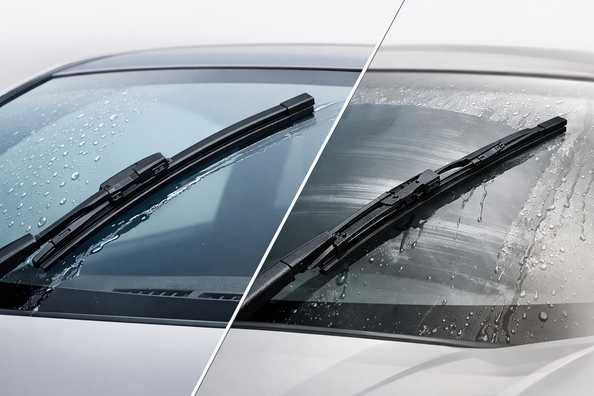

New wiper blades can clean worse than the old ones not because they’re necessarily defective. More often the reason is different: there’s a greasy film, wax, or road grime on the glass, the blade sits at the wrong angle, the adapter is seated with play, and in winter ice and snow add to it. In other words, the new rubber edge just quickly reveals a problem that was already on the car.
To avoid buying a second and third set at random, split the diagnosis into three steps: first remove contamination from the glass and the blade edge, then check the mounting and fit, and only after that evaluate the arm, the mechanism, and the wiper type for the specific windshield curvature.
The old blade sometimes seems “better” simply because its edge has already partially adapted to that particular windshield. A new edge is straight and sensitive, so it immediately reacts to wax residue after a wash, polishing compounds, fine abrasive dust, or an oily film. That’s where the paradox comes from: the new set is noisy, while the old one still worked more or less tolerably.
The second typical story is that after replacing the blades, an arm problem becomes noticeable. If downforce is weak, the angle is wrong, or the latch and adapter have even a slight amount of play, a new wiper starts to chatter, leave streaks, or clean one side poorly. This is especially common after windshield replacement or after the blades freeze to the glass in winter.
Start with the simple things. Thoroughly wash the windshield—don’t just spray washer fluid—then wipe the rubber edge. If the noise, jerking, or streaks decrease right away, the cause was contamination. If nothing changes, move on to the mounting and mechanics.
Next, check whether the adapter is locked correctly, whether there’s any play in the latch, and whether the blade length matches the factory size. On some cars, wipers should be replaced in the service position; if you install them in a hurry, misalignment is easy to introduce during mounting.
After that, look at the symptom itself. One persistent streak in the central viewing area or several persistent streaks at the edges on clean glass is not normal. If only the passenger side works worse, suspicion most often falls on the glass shape, the arm angle, or an unsuitable blade type for that zone. After adjustment, the blade should work against the glass at almost a right angle.
Also recall what happened before the issue appeared: a wash with wax, polishing, windshield replacement, severe frost, or trying to tear off frozen blades. Such events often explain the situation more accurately than the brand name on the box.
DD Tuning expert comment: the most common mistake is to blame the new wipers immediately and buy another set. In practice, you should first check the cleanliness of the glass, the correct adapter, and the fit in the latch, because even slight play causes the same symptoms as a truly poor blade. If, after cleaning, only one side still chatters on clean glass, the issue is more likely the arm or the windshield curvature.
| Symptom | Likely cause | What to do |
|---|---|---|
| Squeaking and rattling from the first strokes | Film on the glass, wax, dirt on the blade edge | Wash the glass, clean the rubber edge, recheck operation |
| The blade jumps or jerks | Incorrect arm angle or uneven downforce | Check the arm, blade seating, and the contact angle to the glass |
| A persistent streak remains in the center | Poor edge contact, misaligned mounting, damaged rubber | Reinstall the blade, check the adapter; if it doesn’t go away, replace the blade or inspect the arm |
| Only the passenger side cleans poorly | Windshield curvature, unsuitable blade type, arm angle is off | Check the arm and consider a different blade type for curved glass |
| It got worse after a wash or polishing | Wax residue or other coatings | Fully degrease the windshield and clean the blade edge again |
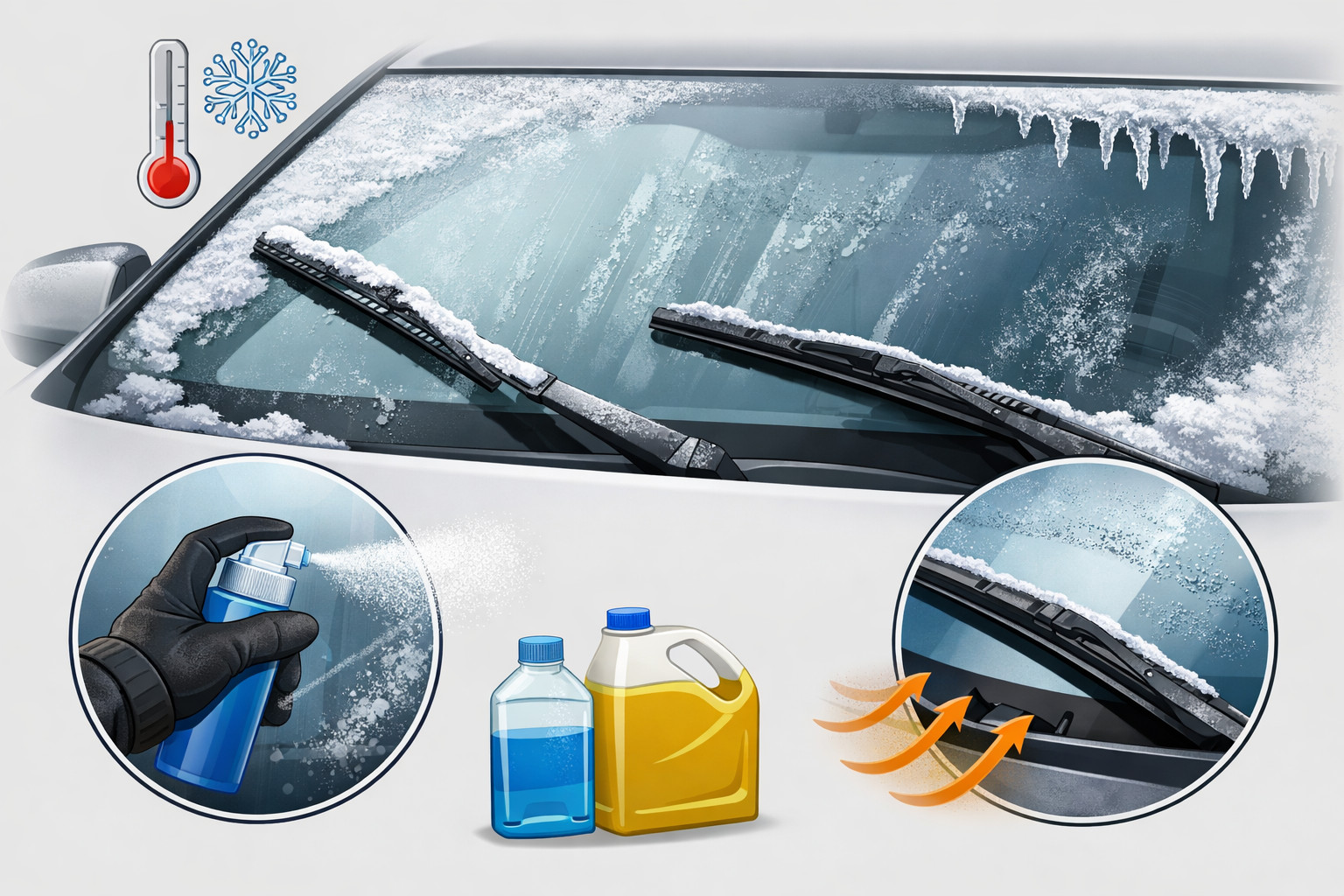
| After frost, noise and streaks appeared | Ice, snow, freezing, rubber edge damage | Remove ice before starting, inspect the edge and joints, replace the blade if needed |
If the cause is a worn edge or an unsuitable blade type, it makes sense to look at wiper blades rather than trying to save old rubber. If the main issue is an oily film and poor dirt removal in the warm season, a proper summer windshield washer fluid helps. In winter, it’s worth switching to a winter washer fluid and not running the blades on ice.
But accessories only make sense after the basic checks. If on clean glass the blade still jumps, leaves a persistent streak, or one side works poorly, the problem often isn’t the fluid or the new set—it’s the arm, the mechanism, or even the windshield itself after replacement.
| Solution | When it works | When it’s not worth spending money |
|---|---|---|
| Deep cleaning of the glass and blade edge | There’s wax, oily film, dirt; the problem appeared after a wash or polishing | If the adapter has play or the arm sits at the wrong angle |
| Reinstallation with the correct adapter | The blade sits loosely, there’s misalignment, compatibility of the mount is in doubt | If the rubber is already damaged or the issue is the arm itself |
| Adjusting the arm angle and downforce | The blade bounces, is noisy on the return stroke, one side works poorly | If the windshield is simply dirty or the blade type doesn’t match the glass curvature |
| Switching to a different blade type | The windshield is strongly curved, pressure along the length is uneven, it often freezes in cold weather | If the problem disappeared after cleaning or the cause is in the mechanism |
| Replacing the blades with new ones | The edge is damaged, the set has already reached its service life, streaks remain on clean glass | If the current blades are new and you haven’t diagnosed the glass and mounting yet |
| Winter prep and the right fluid | The problem occurs in frost, with snow, salt, and freezing | If the wipers are run on ice or the mechanism is already damaged |
From a customer’s experience: someone replaced the set twice because the new blades squeaked louder than the old ones and smeared the passenger side. After a check, it turned out the windshield had an oily film after a wash, and one blade wasn’t seated perfectly in the adapter. After proper glass cleaning and correct reinstallation, the set started working quietly, without buying yet another pair of wipers.
When new wipers work worse than old ones, it’s usually not a paradox and not necessarily a defect. Most often the culprit is a dirty windshield, wax residue, an incorrect adapter, an arm angle that’s off, an unsuitable blade type for a specific curvature, or winter freezing.
A practical order of actions is: clean the glass and the edge, check the mounting and service position, assess the symptom by the cleaning zone, and only then decide on a new blade, a different design, or arm repair. This material is based on real selection experience, hands-on practice, and real-world use cases, where the same blade behaves differently on different cars specifically because of the glass, the mechanics, and operating conditions.
Shipping to EU
Wholesale and retail
Own warehouse
Опис продукту
Подарунки не надаються при оформленні покупки у кредит під 0,01% або при покупці частинами.